
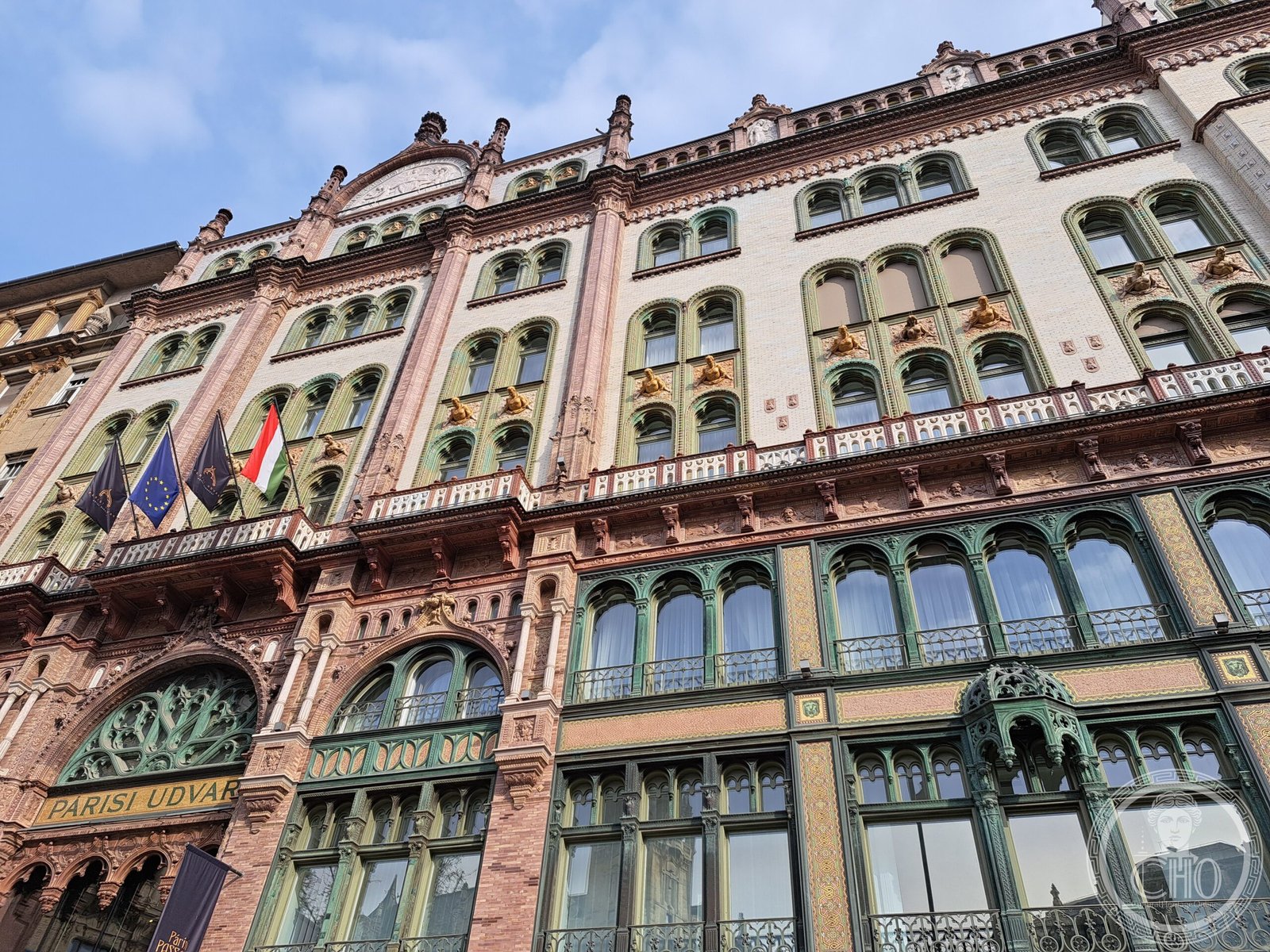
Behind an unassuming façade on Ferenciek tere hides the most theatrical interior in Budapest — a soaring glass vault where Gothic tracery meets Moorish tilework in a passage that once anchored the city’s banking quarter.
At a glance
Designed by the German-born architect Henrik Schmahl for the Belvárosi Savings Bank and completed in 1913 — one year after Schmahl’s death — the Párisi Udvar is Budapest’s only surviving early-twentieth-century covered shopping arcade. Its exuberant eclecticism draws on Venetian Gothic, Arabic, and Moorish sources simultaneously, producing a space the Telegraph described as feeling like “a gothic cathedral crossed with an Ottoman palace.” Long abandoned as a retail space, the building underwent a three-year restoration of more than 85,000 hours and reopened in 2019 as the Párisi Udvar Hotel, part of the Unbound Collection by Hyatt. It is protected as Hungarian listed monument number 468.
Key facts
- Built: 1909–1913 by Henrik Schmahl (died 1912)
- Style: Historicist Eclectic with Orientalist and Art Nouveau ornament
- Status: Luxury hotel — Párisi Udvar Hotel, Unbound Collection by Hyatt (110 rooms)
- Address: Ferenciek tere 10, 1053 Budapest, Hungary
- GPS: 47.4932, 19.0548 — Open in Google Maps
- Listed: Hungarian national monument, műemlék no. 468
History
The site at Ferenciek tere has been home to a covered passage since 1817, when Baron József Brudern commissioned Mihály Pollack — architect of the Hungarian National Museum — to build a shopping arcade modelled on the Parisian Passage des Panoramas. That first arcade housed 32 luxury shops for nearly a century before the Belvárosi Savings Bank acquired the property in 1906 and launched a design competition that drew 43 submissions.
The jury initially selected a different winner, but the bank rejected that design and turned to Schmahl, a student of the great Budapest architect Miklós Ybl. Construction ran from 1909 to 1913. The new building replaced the Pollack arcade with a mixed-use block: two levels of sumptuous shopping passages capped by office floors. After the savings bank era, the ground-floor arcade passed through several tenants — including IBUSZ, Hungary’s state travel agency — before shops vacated entirely by 2015.
A Parisian consortium purchased the derelict building and entrusted its restoration to architects Archikon and Kroki Studio. The painstaking work reinstated original Zsolnay ceramic tiles, marble staircases, and the iconic crystal dome. The hotel opened in 2019, with the arcade itself now housing the Párisi Passage Café & Brasserie.
What you see
The street façade on Ferenciek tere is restrained — a dignified Historicist composition in stone — giving no hint of the spectacle within. Step through the entrance portal and the scale shifts entirely. The arcade rises through two tall storeys beneath a metal-and-glass vault, its surfaces encrusted with carved stonework, wrought-iron balustrades, and lustrous Zsolnay ceramic details in deep greens and golds. The visual grammar shifts from bay to bay: Gothic pointed arches give way to Moorish horseshoe forms and Oriental geometric panels, all united by the diffuse northern light filtering through the glass ceiling.
The centrepiece is the octagonal central hall, crowned by a crystal chandelier that took two years to assemble during the restoration. Original iconography of the Belvárosi Savings Bank — including the honey-bee mascot — has been preserved in mosaic roundels. The upper floors, converted to hotel rooms, retain original plasterwork cornices; several suites look directly down into the arcade through glazed floor panels.
Practical information
- Hotel guests and visitors to the Párisi Passage Café & Brasserie may enter the arcade freely; hotel lobby access for non-guests during café hours
- Best visited in morning light, when daylight streams through the glass vault most dramatically
- Guided heritage tours available through the hotel concierge
- Estimated visit (arcade + café): 30–60 minutes; hotel stay for full immersion
Getting there
Budapest Ferenc Liszt International Airport is approximately 25 km away; direct airport buses (100E) reach Deák Ferenc tér in around 35 minutes. The building sits on Ferenciek tere, served directly by Metro line M3 (Ferenciek tere station, one stop from the central hub at Deák tér). Váci utca shopping street is a two-minute walk; the Danube embankment and Chain Bridge are within ten minutes on foot.
Nearby
- Inner City Parish Church (Belvárosi Plébániatemplom): Budapest’s oldest church, partially Roman, on the Pest bank of the Danube — 300 m south
- Váci utca: Budapest’s historic pedestrian shopping street lined with nineteenth-century palaces — adjacent
- Hungarian National Museum: Neoclassical museum housing the Hungarian royal crown jewels — 600 m south-east
- Great Synagogue on Dohány Street: The largest synagogue in Europe, an Orientalist-Byzantine landmark — 700 m north-east
Sources
Find it on the map
See this place and what’s around it →📷 Become a Cultural Heritage Online photographer
Share your photos of places: they stay published under your name as the author. The more they're seen, the more you get noticed — and soon a contest will reward the most appreciated photos.
Log in or sign up free to add a photoIs this page about you?
This page is read by travellers and heritage enthusiasts who find it on Google. Tell us how you are connected to this place and we will take it from there.