
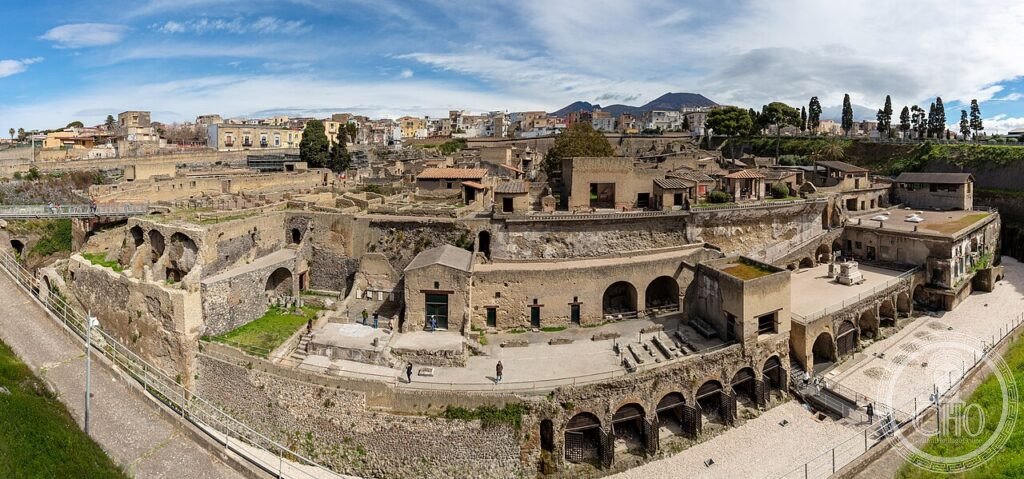
The Roman city buried by Vesuvius in 79 CE alongside Pompeii — but where the pyroclastic surge carbonised organic matter rather than burning it, preserving wooden beams, furniture, food, papyrus scrolls, and the everyday substance of Roman urban life in a way that Pompeii, despite its larger scale, cannot match.
At a glance
Herculaneum (modern Ercolano) was a prosperous Roman town of 4,000–5,000 inhabitants at the foot of Vesuvius on the Bay of Naples, separated from Pompeii by 17 km of coastal road. The eruption of Vesuvius on 24 August 79 CE sent a pyroclastic surge — a fast-moving flow of superheated gas and volcanic rock — that buried Herculaneum under 15–20 metres of material, compared to Pompeii’s 4–6 metres of ash and pumice. This difference in burial mechanism is the key to Herculaneum’s exceptional preservation: the pyroclastic flow carbonised wood, food, and organic matter rather than incinerating it, producing conditions in which charred but recognisable objects survive after nineteen centuries.
Inscribed as part of the UNESCO site “Archaeological Areas of Pompeii, Herculaneum and Torre Annunziata” (1997, ref. 829), Herculaneum covers approximately 5 hectares of excavated area — a fraction of the full ancient city, which extends under the modern town of Ercolano.
Key facts
- Founded: Traditionally attributed to the mythological Heracles; archaeologically attested from 8th century BCE
- Buried: 24 August 79 CE, pyroclastic surge from Vesuvius
- Depth of burial: 15–20 metres of solidified pyroclastic material
- Unique preservation: Wood, furniture, food, carbonised papyrus scrolls (Villa of the Papyri)
- Area excavated: ~5 ha (c. 20% of the ancient city; remainder under modern Ercolano)
- UNESCO inscription: 1997, ref. 829 — “Archaeological Areas of Pompeii, Herculaneum and Torre Annunziata”
- GPS: 40.8056, 14.3481 — Google Maps
History
The first excavations at Herculaneum were financed by Charles of Bourbon (future Charles III of Spain), beginning in 1738 — eight years before Pompeii. The early work was destructive: tunnels were driven through the solidified pyroclastic rock to extract art objects for the royal collections at Portici (the Museo Ercolanese, now in Naples). The systematic open-air excavation of the site began only in 1927 under Amedeo Maiuri, who directed work until 1961 and established the approach of exposing entire blocks rather than tunnelling.
The Herculaneum Conservation Project (2001–2012), a joint initiative of the Packard Humanities Institute and the Italian Ministry of Culture, addressed a conservation crisis — the decaying building fabric — and established new standards for site management. From this work emerged the current approach of stabilising standing structures while continuing selective excavation.
The Villa of the Papyri, a vast suburban villa extending west of the excavated area and still only partially explored, yielded approximately 1,800 carbonised papyrus scrolls in the eighteenth-century tunnels. Most were Greek philosophical texts of the Epicurean school, including works by Philodemus of Gadara. The Herculaneum Papyri are now partially readable through multispectral imaging and, since 2023, AI-assisted decipherment via the Vesuvius Challenge.
What you see
Herculaneum is experienced differently from Pompeii. The site is compact (you can walk it in two hours); the streets are narrower; the houses rise to two and sometimes three storeys, their upper floors intact in carbonised wood. The Casa a Graticcio preserves timber-framed construction of a type that survived otherwise nowhere in the Roman world. The Casa del Bicentenario contains a wooden cross and shrine from the upper floor — a possible Christian domestic chapel of 79 CE, predating any other archaeological evidence of Christianity in the Latin West.
The town’s decumanus maximus (main east-west street) is still paved with the original basalt setts; the ruts worn by cart wheels are clearly visible, as are the stepping-stones by which pedestrians crossed in wet weather. The Forum Baths preserve their marble wall coverings and hypocaust system intact. The boathouses at the seafront — discovered in 1982 — contained over 300 human skeletons of people who took shelter from the eruption and were killed by the first pyroclastic surge.
Gallery
Practical information
- Opening: Daily 9:00–19:30 (summer, last entry 18:00); 9:00–17:00 (winter, last entry 15:30). Closed Tuesdays from November to March.
- Admission: ~€13; combined ticket with Villa of the Papyri and Pompeii available.
- Duration: 2–3 hours for the main site; more with the Antiquarium.
- Crowds: Significantly less crowded than Pompeii; pre-booking recommended in summer but usually not required in low season.
- Best combination: Herculaneum morning + National Archaeological Museum Naples afternoon (holds the Herculaneum bronzes).
Getting there
Ercolano is 12 km south-east of Naples on the A3 motorway, exit Ercolano–Portici. Circumvesuviana railway (Napoli Porta Nolana–Sorrento line): Ercolano Scavi station, 30 min from Naples Piazza Garibaldi, every 20 min. The archaeological park entrance is a 5-min walk from the station. By car from Naples: SS18 (coastal road) via Portici, 30 min. From Pompeii: Circumvesuviana 15 min. Day trip from Sorrento: 45 min Circumvesuviana.
Nearby
- Pompeii — 17 km south-east; larger and more famous, complementary rather than competing
- Museo Archeologico Nazionale di Napoli — the supreme repository for Herculaneum finds: bronzes, papyri, the Secret Room of erotic art
- Reggia di Portici — the Bourbon royal residence above Herculaneum where the first excavated objects were housed; now the Facoltà di Agraria of Naples
Sources
- UNESCO World Heritage Centre: whc.unesco.org/en/list/829
- Wikipedia EN: Herculaneum
- Wallace-Hadrill, Andrew: Herculaneum: Past and Future, London, Frances Lincoln, 2011
- Maiuri, Amedeo: Ercolano, Rome, 1958
Find it on the map
See this place and what’s around it →📷 Become a Cultural Heritage Online photographer
Share your photos of places: they stay published under your name as the author. The more they're seen, the more you get noticed — and soon a contest will reward the most appreciated photos.
Log in or sign up free to add a photoIs this page about you?
This page is read by travellers and heritage enthusiasts who find it on Google. Tell us how you are connected to this place and we will take it from there.