
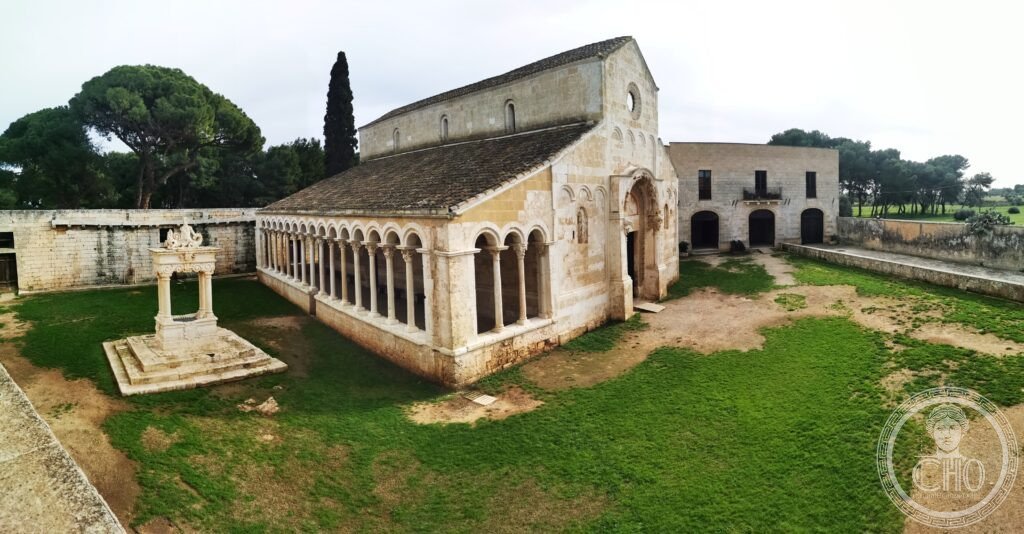
A twelfth-century Basilian abbey set in the olive groves ten kilometres north of Lecce, whose porticoed atrium, carved Romanesque portal, and surviving fresco cycle make it one of the most significant medieval complexes in the Salento — restored and managed by FAI since 2012.
At a glance
The Abbazia di Santa Maria di Cerrate stands in open countryside outside Squinzano, between Lecce and Brindisi, in a landscape of ancient olive trees and flat Apulian farmland. Founded in the twelfth century and traditionally attributed (without documentary proof) to a Norman royal foundation — some legends name Roger II, others William I — the abbey was in reality probably established by a community of Basilian monks from the Byzantine tradition that persisted in Salento long after the Norman conquest of southern Italy. It functioned as a major centre of religious, agricultural, and artistic production through the medieval period before declining in the early modern era.
FAI (Fondo Ambiente Italiano) acquired the complex in 2012 and undertook a major restoration of the church and its fresco cycle. The site opened to the public in 2015 and now includes the church, the porticoed atrium, the cloistered courtyard, and a small museum of local agricultural tradition in the abbey buildings.
Key facts
- Founded: XII century (traditional attribution: Norman foundation, c. 1100–1150)
- Monastic order: Basilian (Greek-Byzantine rite), later Benedictine
- FAI property: Acquired 2012; opened to public 2015
- Key feature: Romanesque portal with carved lunette + fresco cycle, XII–XV century
- Location: Via Cerrate, Squinzano (LE), Puglia
- GPS: 40.4611, 18.1886 — Google Maps
History
The Salento peninsula (the “heel” of Italy) was a zone of sustained Byzantine cultural influence long after the Norman conquest of southern Italy in the eleventh century. In many communities, Greek-rite Christianity and its associated monastic institutions co-existed with the Latin rite imposed by Norman and later Angevin rulers. Basilian monasteries — following the Rule of St Basil in the Byzantine tradition — remained active in Puglia and Calabria into the thirteenth century, producing manuscript books, fresco programmes, and agricultural estates that followed Byzantine rather than Benedictine patterns.
The Abbazia di Cerrate was one of the last and most substantial of these Basilian foundations in the Salento. Its church, built in the twelfth century, follows a Latin basilical plan but incorporates decorative elements from both Norman and Byzantine traditions: a carved stone portal of the Apulian Romanesque school (comparable to Otranto cathedral, completed 1165), a small porticoed atrium, and an interior fresco programme that began in the twelfth century and was extended through the fourteenth and fifteenth, creating a layered visual record of medieval devotion across three centuries.
The abbey was sacked by Ottoman raiders in 1480 — part of the same incursion that devastated Otranto — and never fully recovered. By the sixteenth century it had been absorbed into the patrimony of the Knights of Malta, who used it as an agricultural estate. The fresco cycle, the portal, and substantial portions of the medieval fabric survived the centuries of secular use.
What you see
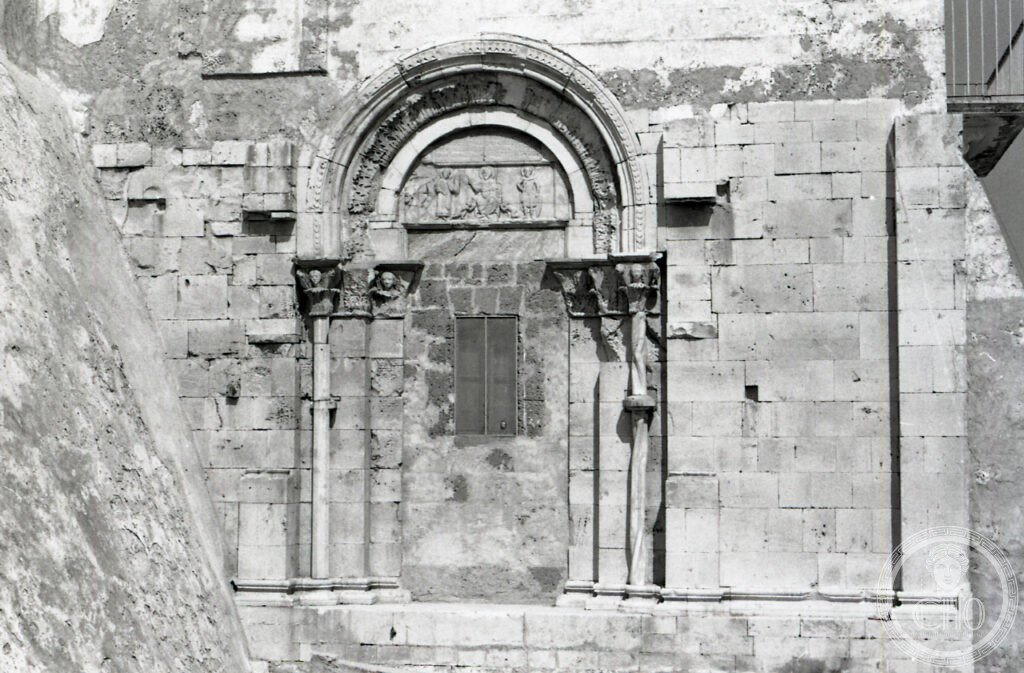
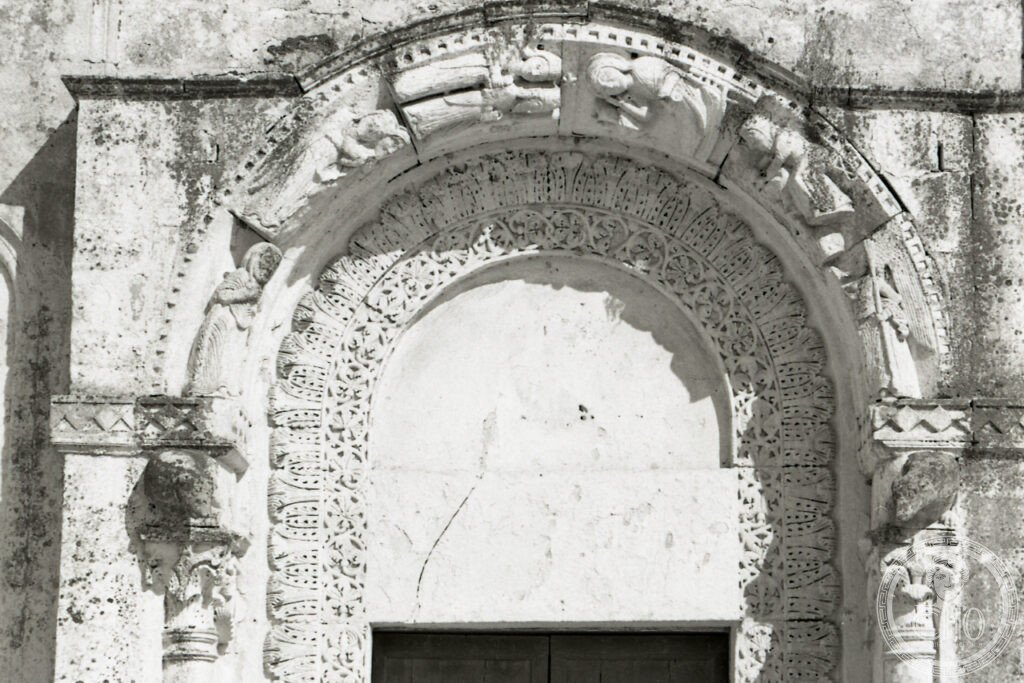
The church facade is Apulian Romanesque at its most vernacular: carved figures of animals and hybrid creatures in the portal archivolt, a lunette above the door with an enthroned Virgin flanked by angels in faded but legible fresco, and a blind arcade above that echoes the forms of Trani and Bitonto cathedrals without their scale. The atrium in front of the church has a portico of slender columns on the south side — a sheltered threshold space between the secular court and the sacred interior.
Inside, the fresco cycle covers the nave walls and apse in successive layers, the earliest twelfth-century work now visible beneath later additions where plaster has fallen. The programme follows Byzantine iconographic conventions — rows of standing saints, narrative scenes from the life of the Virgin, a Christ Pantocrator in the apse — but the painting style shows the flattening and elongation of late Salentine medieval work, distinct from Italian Gothic painting of the same period. A small frantoio ipogeo (underground olive press) beneath the abbey courtyard is the most unusual element: a complete medieval press carved from the living rock, still in its original configuration.
Gallery
Practical information
- Opening: Tuesday–Sunday; hours vary seasonally (roughly 10:00–18:00 in summer). Check fondoambiente.it for current times.
- Admission: Standard FAI rates; free for FAI members.
- Duration: 1–1.5 hours including museum and frantoio.
- Guided visits: Available at weekends and in summer; recommended for the fresco programme.
- Combined with: Lecce (10 km south) makes a natural full-day pairing — morning Cerrate, afternoon Lecce baroque.
Getting there
Squinzano is on the SS7 (Via Appia) between Lecce and Brindisi, 10 km north of Lecce. The abbey is 2 km east of Squinzano town centre via Via Cerrate. By car: from Lecce 15 minutes; from Brindisi airport (BDS) 25 minutes. No direct bus to the abbey; taxis available from Squinzano station (Ferrovie del Sud Est, FSE line Lecce–Brindisi). By train to Lecce (Trenitalia FS + Frecciarossa from Rome in 5h), then taxi or rent a car for the day.
Nearby
- Lecce — 10 km south; the Baroque capital of the Salento (Piazza del Duomo, Basilica di Santa Croce, museums)
- Brindisi — 30 km north-west; Roman column marking the Via Appia terminus, archaeological museum, ferry to Greece
- Otranto — 45 km south-east; the cathedral with its 1163–1165 mosaic floor (the most complex narrative floor mosaic in Europe)
Sources
- FAI – Fondo Ambiente Italiano: fondoambiente.it
- Wikipedia IT: Abbazia di Santa Maria di Cerrate
- Fonseca, Cosimo Damiano: Mezzogiorno Normanno-Svevo, Napoli, 1990
Find it on the map
See this place and what’s around it →📷 Become a Cultural Heritage Online photographer
Share your photos of places: they stay published under your name as the author. The more they're seen, the more you get noticed — and soon a contest will reward the most appreciated photos.
Log in or sign up free to add a photoDo you manage this place?
This page is read by travellers and heritage enthusiasts who find it on Google. Keep it accurate — and make it work for you. Free for non-profit heritage institutions.