
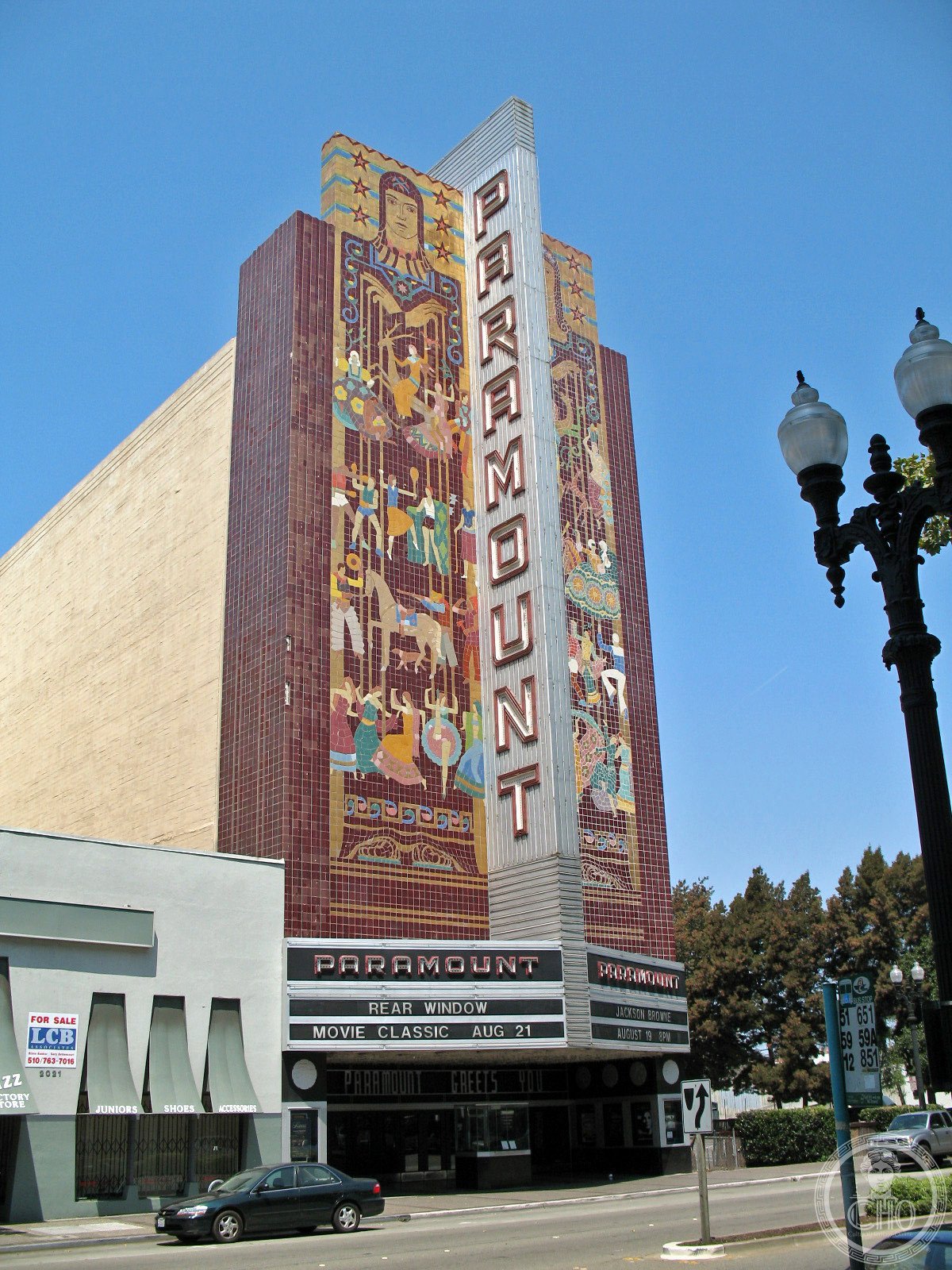
The Paramount Theatre, rising at 2025 Broadway in downtown Oakland, California, is one of the most complete and spectacular Art Déco cinema palaces surviving in the United States. Designed by architect Timothy L. Pflueger of Miller and Pflueger and opened on 16 December 1931 at a construction cost of three million dollars, it was celebrated as the largest multi-purpose theatre on the West Coast at its inauguration. Pflueger drew direct inspiration from the 1925 Exposition Internationale des Arts Décoratifs et Industriels Modernes in Paris, translating the Exposition’s vision of total decorative design into a building of overwhelming richness. The four-story Grand Lobby, with its gold ornamentation and the luminous “Fountain of Light,” remains among the defining interiors of the period. A designated U.S. National Historic Landmark since 1977, the Paramount continues to host the Oakland Symphony, the Oakland Ballet, and a celebrated series of classic film screenings.
At a glance
- Type
- Art Déco movie palace and performing arts theatre
- Period
- 1931 (opened 16 December 1931)
- Style
- Art Déco
- Location
- 2025 Broadway, Downtown Oakland, California, USA
- Coordinates
- 37.8095° N, 122.2681° W
- Architect(s)
- Timothy L. Pflueger (Miller and Pflueger)
Overview
The Paramount Theatre seats 3,040 patrons in an auditorium that retains its original Wurlitzer pipe organ (Publix I model, Opus 2164) and virtually all of its decorative program from 1931. When Pflueger unveiled the building it was heralded as the grandest entertainment venue on the Pacific Coast, a claim its sheer scale and visual intensity do nothing to contradict. After a decades-long period of decline the theatre underwent a landmark restoration beginning in 1973, which returned its interiors to full splendour. Today it operates as a full-service performing arts venue and is managed by the Oakland-based non-profit Paramount Theatre of the Arts.
History
Pflueger received the commission from the Paramount Publix Corporation, then the dominant force in American cinema exhibition, and construction proceeded through 1930 and 1931 at a cost that reflected the extraordinary ambition of the project. The theatre opened in December 1931, just as the Great Depression was tightening its grip on American public life, yet its programming of first-run films and live stage shows kept it profitable through much of the decade. By the 1960s changing audience habits and suburban competition had diminished its fortunes, and the building closed. A restoration campaign launched in 1973, recognised by listing on the National Register of Historic Places the same year, revived the theatre and established its present role as a civic cultural anchor.
Architecture & Design
Pflueger conceived the Paramount as an integrated Art Déco environment in which every surface, fixture, and fitting participated in a unified decorative vision. The Broadway facade is organised around a vast vertical pylon of polychrome terracotta rising above the marquee, its geometric ornament drawing on the vocabulary of Paris 1925. Inside, the four-story Grand Lobby is a sequence of compressed and expanding spaces animated by gold leaf, geometric grillework, and the spectacular “Fountain of Light” chandelier. The auditorium continues the scheme, its walls and ceiling carrying elaborate low-relief decoration in metallic finishes. The original Wurlitzer organ remains operational, a rare survival that adds acoustic authenticity to theatrical events.
Cultural significance
Listed on the National Register of Historic Places in 1973 and designated a U.S. National Historic Landmark in 1977, the Paramount is recognised at the highest level of American heritage protection. The California Historical Landmark designation of 1975 further anchors it within the state’s architectural memory. As the home of the Oakland Symphony and Oakland Ballet the building sustains a living cultural mission, ensuring that its preservation is not merely curatorial but genuinely civic. For scholars of the American movie palace tradition the Paramount is a primary document: few buildings of its type survive with comparable intactness of fabric and ornamental programme.
Visiting today
The Paramount Theatre offers guided public tours on the first and third Saturdays of each month (excluding holidays), providing access to spaces not normally open during performances. The building hosts a year-round programme of concerts, ballet, comedy, and classic film screenings. Tickets for events and tours are available through the theatre’s official website at paramounttheatre.com. The Grand Lobby is among the most photographically rewarding Art Déco interiors on the West Coast, and tour participants are encouraged to bring cameras.
Getting there
The Paramount Theatre is located at 2025 Broadway in downtown Oakland, served directly by BART via the 19th Street Oakland station on the Orange, Red, and Yellow Lines. Multiple AC Transit bus routes stop within a block of the theatre. By car, the venue is a short drive from Interstate 580 and Interstate 980, with several public parking structures nearby. The building is also accessible on foot from a number of downtown Oakland hotels.
Sources & resources
Find it on the map
See this place and what’s around it →Record researched and written by Luigi De Marchi for Cultural Heritage Online, 2026.
📷 Become a Cultural Heritage Online photographer
Share your photos of places: they stay published under your name as the author. The more they're seen, the more you get noticed — and soon a contest will reward the most appreciated photos.
Log in or sign up free to add a photoIs this page about you?
This page is read by travellers and heritage enthusiasts who find it on Google. Tell us how you are connected to this place and we will take it from there.