
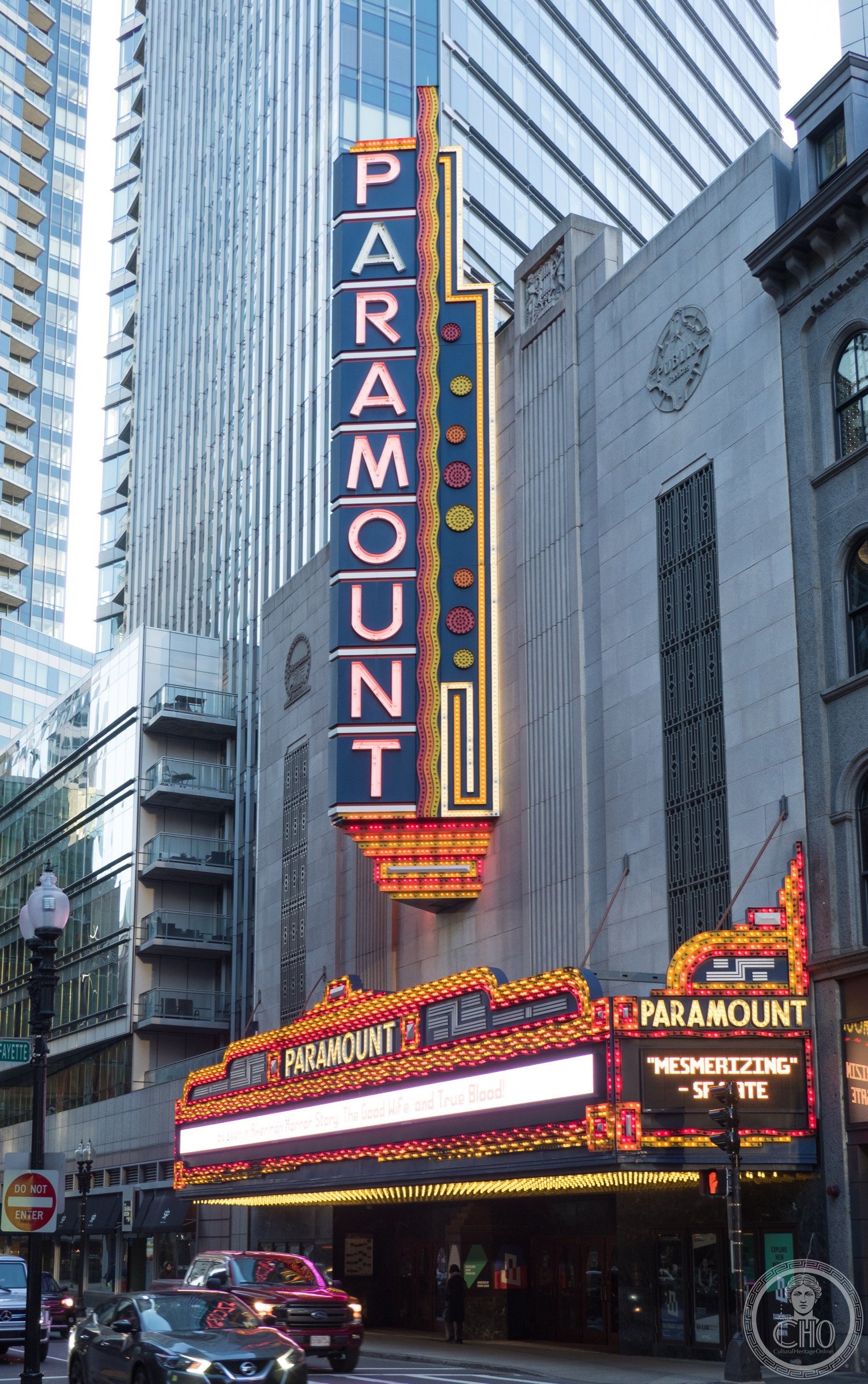
Opened in 1932 as Paramount Pictures’ flagship Boston cinema, the Paramount Theatre brought Art Deco movie palace architecture to Washington Street’s Theater District — a concentrated block of performance venues that had served Boston’s entertainment life since the turn of the twentieth century.
At a glance
Washington Street in Boston’s Theater District is one of the densest concentrations of historic performance venues in American theater history: the Colonial Theatre (1900), the Shubert Theatre (1910), and the former Keith Memorial are all within a short walk of the Paramount, and the district’s geography reflects the moment in the late nineteenth and early twentieth centuries when legitimate theater, vaudeville, and cinema competed for the same audience in the same block. The Paramount opened in 1932 as the studio system’s show of commitment to the Boston market — a 1,700-seat purpose-built cinema at the peak of the Art Deco period, designed to project the same architectural ambition that Paramount’s New York theaters expressed. After decades of decline and closure, the building was acquired by Emerson College and restored as a performing arts venue, a transformation that has placed the Paramount at the center of the educational theater programming that Emerson has made central to the South End campus it has developed along Washington Street since the early 2000s.
Key facts
- Built: 1932
- Style: Art Deco
- Capacity: approximately 1,700 seats at opening
- Address: 559 Washington Street, Boston, Massachusetts 02111
- Location: Theater District / South End corridor
- Current operator: Emerson College — Emerson Stage and college events
- GPS: 42.3538° N, −71.0628° W
History
The Paramount name carried specific commercial meaning in 1932: Paramount Pictures was one of the five major studios of the Hollywood studio system, and the Paramount Theatres chain was its exhibition arm, providing controlled distribution from production to screen. A Paramount Pictures flagship in Boston — a major market for the northeast United States — was a statement of the studio system’s vertical integration at its peak. The building’s design reflected this commercial ambition: Art Deco ornament, a prominent marquee on Washington Street, and an auditorium scaled to serve the maximum number of patrons in a single showing.
The Paramount’s commercial history followed the trajectory of the studio system itself: strong through the 1930s and 1940s, challenged by the antitrust consent decree of 1948 that required studios to divest their theater chains, further stressed by the rise of television and suburban entertainment in the 1950s and 1960s, and eventually closed as the Theater District itself declined in the 1970s and 1980s. The building’s later history as a venue for grindhouse and exploitation films before its eventual closure marked the descent of what had been a flagship cinema into a marginal operator in a neighborhood that had lost its entertainment infrastructure.
Emerson College’s acquisition and restoration of the Paramount in the 2000s represents one of the more significant theater preservation and reactivation stories in Boston history. The college, which had established itself on Boylston Street near the Common before expanding along Washington Street, brought the Paramount back into use as a college-operated performing arts venue, investing in technical and physical restoration that returned the Art Deco interior to a condition close to its original state while adapting its systems for contemporary theatrical production.
What you see
The Paramount’s Washington Street facade is an Art Deco composition in the vocabulary of the early 1930s: the vertical emphasis of the name display, the marquee canopy at street level, and the geometric ornamental program at the upper facade that signals the building’s purpose from the street. The facade’s scale is calibrated to Washington Street’s pedestrian traffic — a building designed to be readable from within the Theater District’s concentrated entertainment block, not from a distance.
Inside, the restoration has preserved the original Art Deco decorative program of the auditorium: the geometric ornament, the color palette, and the proportions of a single-screen 1,700-seat house that dates from the period when the movie palace was the definitive American commercial building type. The auditorium serves Emerson Stage’s productions with a mix of cinema and live performance capabilities that the original architects could not have foreseen but that the space accommodates with remarkable flexibility.
Practical information
- Events: Emerson Stage productions, film screenings, and guest events; check the Emerson Paramount Center schedule
- Tickets: available online through Emerson College box office
- Parking: public parking garages in the Theater District; the venue is 2 blocks from Downtown Crossing (Green/Orange Line) and accessible via multiple MBTA routes
- Time needed: allow time for the performance plus a walk through the Theater District’s concentration of historic performance venues
Getting there
Boston Logan International Airport (BOS) is approximately 3 miles northeast of downtown via the Ted Williams Tunnel; the MBTA Silver Line SL1 connects Logan’s terminals to South Station in approximately 20 minutes. The Theater District is most conveniently reached from the Boylston station (Green Line) or Downtown Crossing (Red/Orange Lines); Washington Street runs south from Downtown Crossing and the Paramount is 3 blocks south at the intersection with Stuart Street. Amtrak’s South Station serves Boston with Northeast Corridor service from New York (approximately 4 hours), Providence (45 minutes), and Washington D.C. (6.5 hours).
Nearby
- Colonial Theatre — Boston’s oldest continuously operating theater (1900), at 106 Boylston Street; a National Historic Landmark where many Broadway productions had their world premieres; 0.3 miles north
- Boston Common — the oldest public park in the United States (designated 1634); the 50-acre green at the northern end of the Theater District connects to the Public Garden and the historic downtown; 0.3 miles northwest
- Chinatown — Boston’s historic Chinatown, one of the oldest in the Northeast United States, is immediately south of the Theater District; the Chinatown Gate on Beach Street marks the neighborhood boundary 0.2 miles south
- Institute of Contemporary Art — major contemporary art museum in a Diller Scofidio + Renfro building on the South Boston waterfront; approximately 1.5 miles southeast via the waterfront walk or the Silver Line
Sources
- Emerson Paramount Center, Boston — venue history and programming
- Boston Landmarks Commission — Theater District historic documentation
- Boston Preservation Alliance — Washington Street theater history
- Massachusetts Historical Commission — commercial architecture surveys
- Wikimedia Commons — building image
Find it on the map
See this place and what’s around it →Record researched and written by Luigi De Marchi for Cultural Heritage Online, 2026.
📷 Become a Cultural Heritage Online photographer
Share your photos of places: they stay published under your name as the author. The more they're seen, the more you get noticed — and soon a contest will reward the most appreciated photos.
Log in or sign up free to add a photoIs this page about you?
This page is read by travellers and heritage enthusiasts who find it on Google. Tell us how you are connected to this place and we will take it from there.