
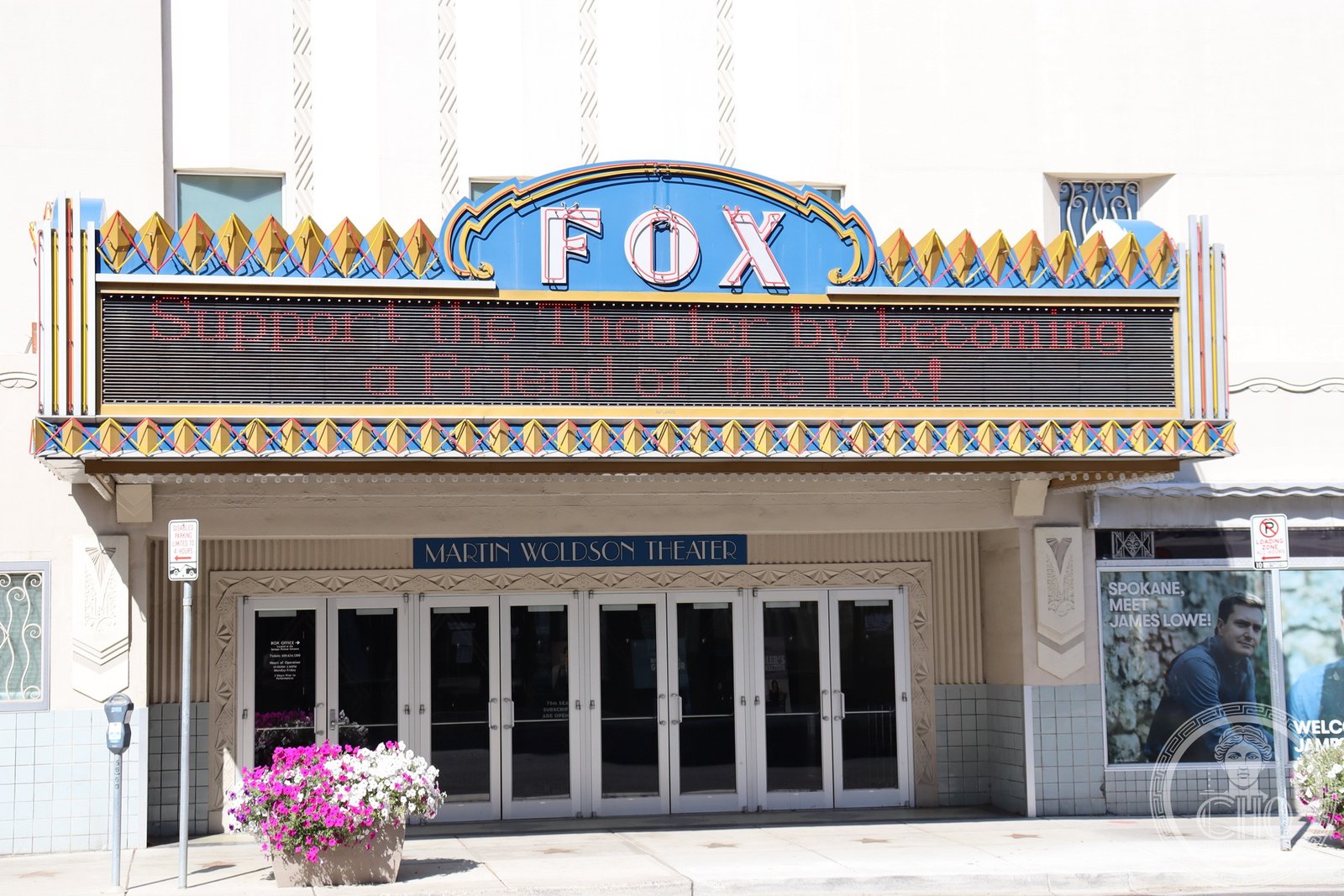
Spokane’s grandest movie palace opened on West Sprague Avenue in 1931, bringing the full spectacle of Hollywood’s golden age to the Pacific Northwest — and when the screen went dark decades later, a city-wide restoration campaign returned the Fox to life as home of the Spokane Symphony.
At a glance
The Martin Woldson Theater at the Fox — known during most of its first life simply as the Fox Theatre — is the finest surviving Art Deco movie palace in the inland Pacific Northwest. Built in 1931 as part of the Fox West Coast Theatres exhibition circuit, it served downtown Spokane through the studio system’s golden decades, declined through the multiplex era, and stood vacant for years before a community-driven restoration returned it to active use in 2007. Today it is the permanent home of the Spokane Symphony Orchestra, its ornate interior’s warm gilded plasterwork and layered decorative detail proving as suited to live orchestral performance as to the film premieres it once hosted.
Key facts
- Address: 1001 West Sprague Avenue, Spokane, WA 99201.
- Completed: 1931.
- Style: Art Deco with Baroque decorative interior.
- Original circuit: Fox West Coast Theatres.
- Current use: Home of the Spokane Symphony Orchestra; live events.
- Renamed: Martin Woldson Theater at the Fox (after major donor).
- Designation: National Register of Historic Places.
History
The Fox theatre chain expanded aggressively across the American West in the late 1920s, commissioning elaborate movie palaces in regional cities as anchors for its exhibition circuits. Spokane — the commercial capital of the Inland Empire, the agricultural and mining hinterland that stretches across eastern Washington, northern Idaho, and western Montana — warranted one of the chain’s more ambitious investments. The theater that opened on West Sprague Avenue in 1931 was built to impress: a large auditorium with richly layered ornamentation, designed to make Spokane audiences feel they were attending something worthy of a world city.
For decades the Fox was the preeminent cinema in Spokane’s downtown. It screened first-run Fox films and major studio releases, hosted live stage performances between screenings (a common practice of the era), and served as a social gathering point for a city that drew patrons from hundreds of miles across the region. The arrival of suburban multiplexes in the 1970s and 1980s eroded the downtown theater audience, and the Fox eventually closed, its ornate interior left to deteriorate.
Preservation advocates in Spokane recognized the building’s significance and mounted a sustained campaign to save it. A major gift from Spokane businessman Martin Woldson — whose name now adorns the theater — provided the financial foundation for a comprehensive restoration completed in 2007. The Spokane Symphony, previously without a permanent home of comparable acoustic quality and historic character, took up residency. The theater has since been expanded and upgraded, and it now draws audiences from across the region for symphony performances, touring productions, and special events.
What you see
The exterior on West Sprague Avenue presents a restrained Art Deco face to the street: flat vertical planes, geometric ornament in the cornice zone, and a marquee that retains the visual clarity of 1930s theater signage. The design draws the eye upward without the extravagant tower elements of the most ambitious movie palaces, reflecting the Fox chain’s preference for solid commercial confidence over theatrical excess on the exterior.
Inside, the auditorium reveals the era’s full decorative ambition. Gilded plasterwork covers the proscenium arch and the ornamental panels lining the side walls; the ceiling is elaborately coffered; balcony railings and box fronts continue the layered ornamental program. The overall effect belongs to the tradition of the great Baroque theater interiors filtered through the American movie palace’s democratic aspirations — grandeur available to anyone who could afford a ticket. The restoration work has brought the plasterwork back to close approximation of its original condition, so the theater communicates directly with its 1931 self.
Practical information
- Spokane Symphony: The symphony’s season runs September through May; tickets available at the Spokane Symphony website.
- Other events: The theater hosts touring productions, film screenings, and community events throughout the year.
- Tours: Occasional public tours; check the venue directly for availability.
- Best experience: An evening performance with the symphony restores the building’s original function — the acoustics, restored for live music, are superb.
Getting there
The Martin Woldson Theater sits in the heart of downtown Spokane, two blocks south of Riverside Avenue and five blocks from the Spokane Falls. Spokane International Airport is roughly seven miles southwest of downtown; the drive takes 15 minutes. Within downtown, the theater is easily walkable from the main hotels and the convention center. The Centennial Trail along the Spokane River and Riverfront Park, site of the 1974 World’s Fair, begin at the northern edge of downtown and extend both east and west along the river.
Nearby
- Spokane Falls and Riverfront Park — the dramatic waterfalls at the center of the city define Spokane’s geography; Riverfront Park, developed for the 1974 World’s Fair, surrounds them with green space, bridges, and the restored 1902 Washington Water Power Building.
- The Historic Davenport Hotel (1914) — an Italian Renaissance Revival landmark hotel one block east of the Fox, the Davenport was designed by architect Kirtland Cutter and has been in continuous operation for over a century.
- Spokane Art Museum — regional collection with significant Pacific Northwest art holdings, located downtown near the Fox.
- Northwest Museum of Arts and Culture — the region’s most comprehensive museum, covering the natural and cultural history of the Columbia Plateau and Inland Northwest.
Sources
- National Register of Historic Places nomination, Fox Theatre (Spokane).
- Spokane Symphony Orchestra, institutional history and theater documentation.
- Ben Zimmerman, Spokane: Architecture and Urban Design.
- Washington State Department of Archaeology and Historic Preservation records.
- Spokane Historic Preservation Office, commercial district survey.
Find it on the map
See this place and what’s around it →Record researched and written by Luigi De Marchi for Cultural Heritage Online, 2026.
📷 Become a Cultural Heritage Online photographer
Share your photos of places: they stay published under your name as the author. The more they're seen, the more you get noticed — and soon a contest will reward the most appreciated photos.
Log in or sign up free to add a photoIs this page about you?
This page is read by travellers and heritage enthusiasts who find it on Google. Tell us how you are connected to this place and we will take it from there.