
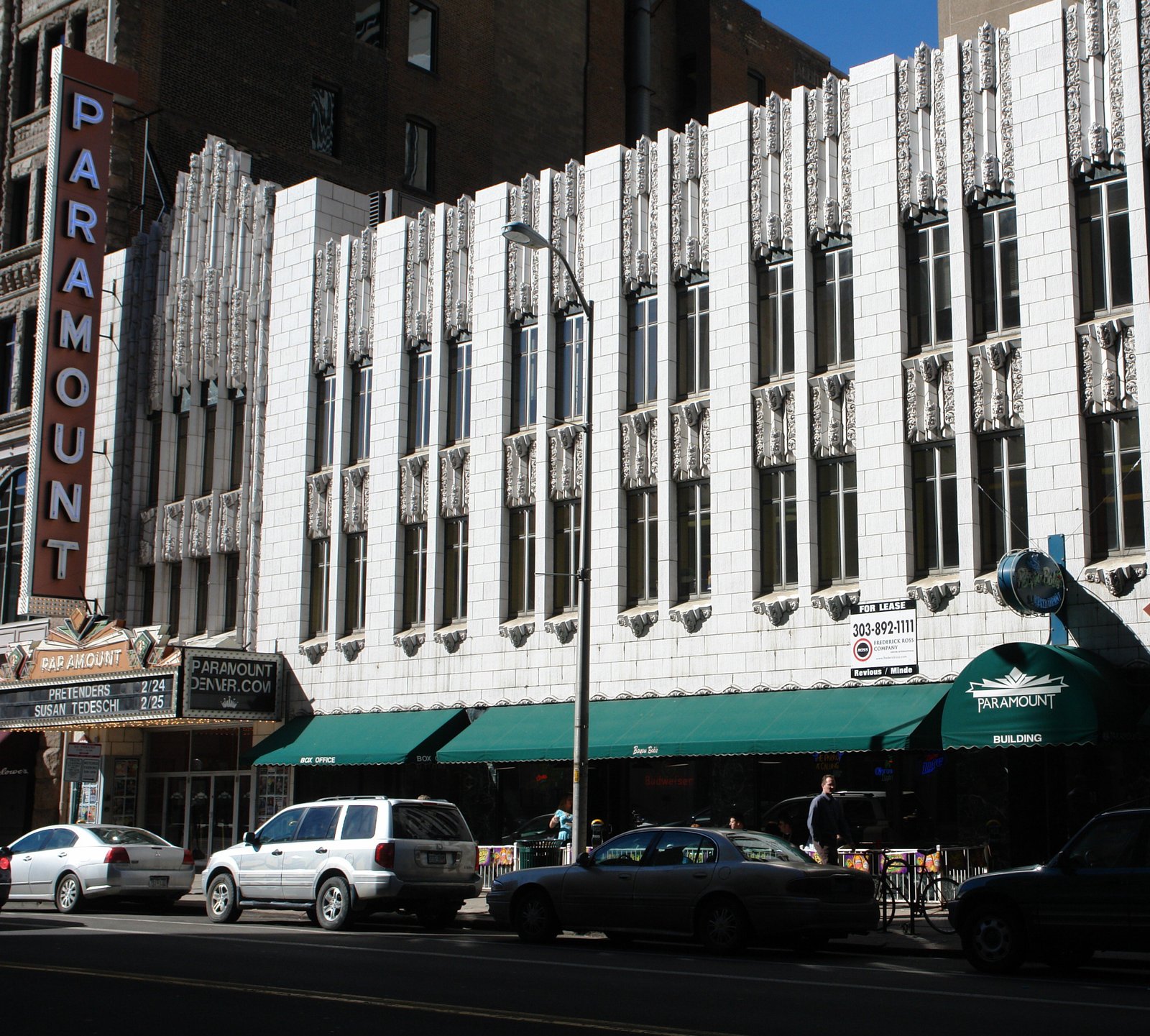
Designed by Temple H. Buell as a modernized Art Deco interpretation of Gothic architecture in cast concrete and white terra cotta, the Paramount Theatre opened on Denver’s Glenarm Place in 1930 as a Paramount-Publix movie palace and survives today as the city’s last standing original movie palace, now a 1,870-seat concert venue.
At a glance
The Paramount Theatre stands on Glenarm Place near Denver’s 16th Street Mall, occupying the ground floor of a three-story commercial block designed by local architect Temple H. Buell. Opened in 1930 as part of the Paramount-Publix Theatre Circuit — the exhibition arm of Paramount Pictures — the building was designed in an Art Deco style inflected with Gothic verticalism, executed in cast concrete and white terra cotta. Buell’s Glenarm Place facade became the main entrance after the original entry through 519 16th Street fell out of use. The theatre was listed on the National Register of Historic Places in 1980 and designated a Denver historic landmark in 1988. Today it operates as a live music venue under Kroenke Sports & Entertainment, and it houses one of only two surviving twin-console Wurlitzer theatre organs in the United States.
Key facts
- Opened: 1930
- Style: Art Deco (Gothic-inflected)
- Architect: Temple H. Buell (Glenarm Place facade); Rapp and Rapp (original 16th Street entry)
- Capacity: 1,870 seats
- NRHP listed: November 21, 1980 (#80000893)
- Denver landmark: 1988
- Current use: Concert and performance venue (Kroenke Sports & Entertainment)
- Special feature: One of two remaining twin-console Wurlitzer theatre organs in the US
- Address: Glenarm Place near 16th Street Mall, Denver, Colorado
- GPS: 39.74442, −104.99021
History
The Paramount opened in 1930 as one of the flagship venues in the Paramount-Publix Theatre Circuit, the exhibition network of Paramount Pictures. The circuit was building movie palaces across major American cities as the transition to sound film drove an explosion of entertainment spending in the late 1920s. The Paramount’s original 16th Street entry was cut through an existing commercial building; the secondary Glenarm Place entrance, designed by Temple H. Buell in the Art Deco style, became in time the more prominent facade and eventually the main public entry.
For several decades the Paramount was among the premier movie venues in the Rocky Mountain region, hosting Paramount Pictures releases alongside special events and stage presentations. Like most large downtown movie theaters, it lost patronage as suburban multiplexes drew audiences away from city centers. By 1978 it was the last surviving movie palace in Denver; that year the management pivoted to live performance, hosting a production of Puccini’s Madama Butterfly by the Denver Opera Company. The theatre passed through several ownership changes and in 2002 was acquired by what is now Kroenke Sports & Entertainment, which operates it as one of Denver’s principal mid-size concert venues.
What you see
Temple H. Buell’s Glenarm Place facade demonstrates the Art Deco use of Gothic form as compositional language: the vertical thrust of the Gothic pointed arch and pier is translated into the machine-age aesthetic of cast concrete, with white terra cotta ornament substituting for carved stone. The result reads simultaneously as historically informed and emphatically modern — a combination characteristic of the best American entertainment architecture of 1929–1931, when the economic and architectural optimism of the period had not yet been interrupted by the Depression.
Inside, the theatre retains significant original character including the balcony structure, the Wurlitzer organ installation, and decorative elements that connect the 1930 opening with the current performance program. The room’s acoustics and sightlines, designed for the unamplified stage presentations of the early sound era, translate well to contemporary amplified concert use — a reason the Paramount has survived where many comparable venues did not.
Practical information
- Operating as a concert and live music venue; tickets and schedule at the Paramount Denver website.
- Capacity: 1,870 (mixed standing floor and seating balcony depending on event configuration).
- Located one block from the 16th Street Mall Free MallRide and directly accessible by light rail (D, F, H, and L lines at 16th & California).
- The Wurlitzer organ is occasionally featured in special events and film screenings.
Getting there
The Paramount Theatre is on Glenarm Place in downtown Denver, one block from the 16th Street Mall. Denver International Airport (DEN) is approximately 25 miles east, served by the RTD University of Colorado A Line commuter rail to Denver Union Station, from which the 16th Street Mall is a short walk. Light rail lines D, F, H, and L stop at 16th and California, two blocks away. Parking is available in downtown Denver garages.
Nearby
- Denver Art Museum — one of the largest art museums between Chicago and Los Angeles, with collections spanning pre-Columbian, American West, and European art
- 16th Street Mall — Denver’s pedestrian commercial corridor, one block west, with the free MallRide shuttle connecting Union Station to Civic Center
- Colorado State Capitol — the domed Neoclassical capitol building in the Civic Center precinct, with free public tours
Sources
- Wikipedia: “Paramount Theatre (Denver)”
- National Register of Historic Places Nomination Form #80000893, National Park Service, June 18, 1980 (preparer: Tamra S. Ohan)
- Wikimedia Commons: Paramount_Theater_Denver_CO.jpg, CC BY-SA 3.0, Hustvedt
Find it on the map
See this place and what’s around it →📷 Become a Cultural Heritage Online photographer
Share your photos of places: they stay published under your name as the author. The more they're seen, the more you get noticed — and soon a contest will reward the most appreciated photos.
Log in or sign up free to add a photoDo you manage this place?
This page is read by travellers and heritage enthusiasts who find it on Google. Keep it accurate — and make it work for you. Free for non-profit heritage institutions.