
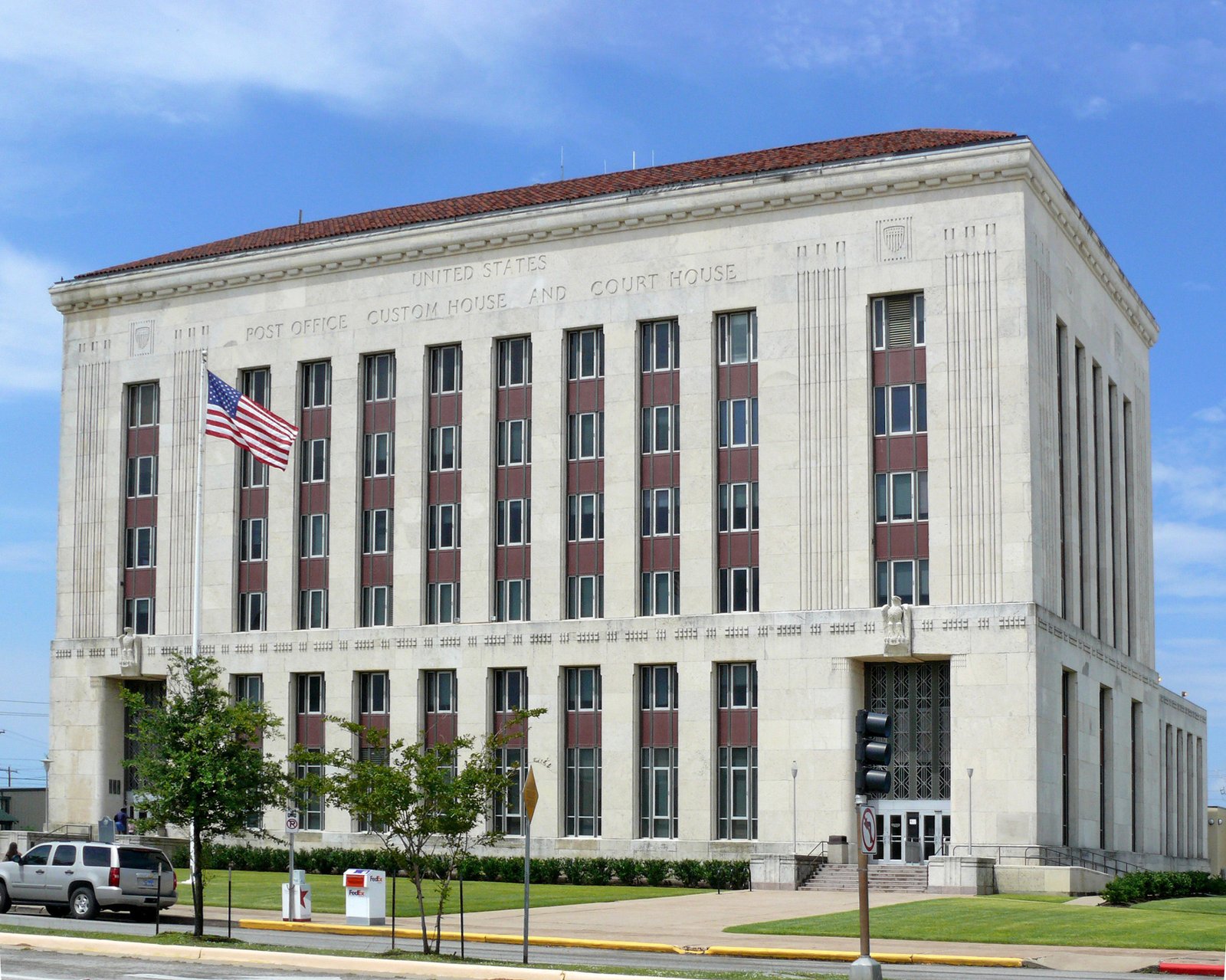
Completed in 1937 and clad in porous fossiliferous limestone quarried from coastal deposits — its surface embedded with marine shell fragments — the Galveston Federal Building is one of the most distinctive Art Deco federal buildings in the American South, designed by architect Alfred C. Finn to represent federal authority on the Texas Gulf Coast.
At a glance
The U.S. Post Office and Courthouse at 601 25th Street in Galveston, Texas, serves simultaneously as the city’s main post office, the federal court for the Galveston Division of the U.S. District Court for the Southern District of Texas, and the home of several federal agencies. Built in 1937 by the Algernon Blair Construction Company to a design by Houston architect Alfred C. Finn, the building was added to the National Register of Historic Places in 2001. Its defining characteristic is its exterior cladding of porous fossiliferous limestone — a regional material containing visible marine shell fossils — substituted at the insistence of local officials for the brick originally specified. The result is an Art Deco building whose surface texture is geologically unique to the Gulf Coast.
Key facts
- Built: 1937
- Style: Art Deco
- Architect: Alfred C. Finn
- Builder: Algernon Blair Construction Company
- NRHP listed: April 25, 2001 (#01000438)
- Current use: Active federal courthouse (Southern District of Texas) and US Post Office
- Distinctive feature: Fossiliferous limestone cladding with embedded marine shell fossils
- Address: 601 25th Street (Rosenberg Street), Galveston, Texas
- GPS: 29.30222, −94.79583
History
Galveston’s history as a federal port of entry and commercial hub made the presence of federal facilities essential, and the 1937 building replaced earlier federal structures on the island. Alfred C. Finn, a prominent Houston architect responsible for numerous civic and commercial buildings across Texas in the 1920s and 1930s, received the commission for a new Art Deco federal building suited to the city’s scale and its Gulf Coast setting.
The original design called for brick cladding, standard practice for federal buildings of the era. Local Congressman Joseph J. Mansfield and Galveston’s Collector of Customs, Fred Papst, intervened with the Treasury Department to advocate for limestone instead — a grander material, they argued, more befitting a federal building in a major Gulf port. The limestone ultimately selected was a porous, fossiliferous variety typical of coastal areas, its surface marked by the compressed shells of marine organisms. The choice gave the building a material identity closely tied to its Gulf Coast geography. The Galveston Federal Building has served continuously since 1937 as the federal courthouse for the Southern District’s Galveston Division and has housed weather service operations, customs offices, and multiple federal agencies over the decades.
What you see
The exterior is the building’s most remarkable attribute: the fossiliferous limestone cladding, porous and buff-colored, carries within it the visible outlines of marine shell fossils — a geological record of the sea floor compressed into the walls of a federal courthouse. Close examination of the facade reveals these shell fragments at eye level, a detail invisible in photographs and discoverable only in person. Alfred C. Finn’s Art Deco composition is expressed through the vertical emphasis of the central block, the geometric ornament at the cornice and entrance bays, and the discipline of the window rhythm across the limestone face.
The building reads as a federal presence — formally composed, permanently anchored — while the limestone gives it a regional specificity that separates it from the standard brick federal formula of the 1930s. Inside, the building retains its active institutional function as a working courthouse, and the public lobby preserves significant Art Deco interior elements characteristic of New Deal federal architecture.
Practical information
- The building operates as an active federal courthouse and post office; interior access may be limited to court and postal business during operating hours.
- The exterior and lobby are accessible during business hours; bring ID for courthouse entry.
- The fossiliferous limestone cladding is best examined at close range at street level on the 25th Street (Rosenberg Avenue) facade.
Getting there
Galveston is located on Galveston Island on the Texas Gulf Coast, approximately 50 miles southeast of downtown Houston via Interstate 45. The closest major airports are William P. Hobby Airport (HOU, approximately 35 miles northwest) and George Bush Intercontinental Airport (IAH, approximately 65 miles northwest). The federal building is at 601 25th Street (also called Rosenberg Street) in Galveston’s downtown historic district, walkable from the Strand National Historic Landmark District and the waterfront.
Nearby
- The Strand Historic District — Galveston’s Victorian commercial streetscape, designated a National Historic Landmark, two blocks north on Strand Street
- Galveston’s 1895 Bishop’s Palace — a National Historic Landmark Victorian mansion by Nicholas Clayton, one of the grandest surviving houses of the Texas Gilded Age
- Galveston Island Historic Pleasure Pier — the successor to the historic pleasure pier, on the Gulf beachfront
Sources
- Wikipedia: “Galveston United States Post Office and Courthouse”
- National Register of Historic Places, listing #01000438, April 25, 2001
- General Services Administration, Historic Buildings program documentation for Galveston U.S. Post Office and Courthouse
- Wikimedia Commons: Galveston_US_Post_Office,_Custom_House_and_Courthouse.jpg, CC BY-SA 4.0, Jim Evans
Find it on the map
See this place and what’s around it →📷 Become a Cultural Heritage Online photographer
Share your photos of places: they stay published under your name as the author. The more they're seen, the more you get noticed — and soon a contest will reward the most appreciated photos.
Log in or sign up free to add a photoDo you manage this place?
This page is read by travellers and heritage enthusiasts who find it on Google. Keep it accurate — and make it work for you. Free for non-profit heritage institutions.