

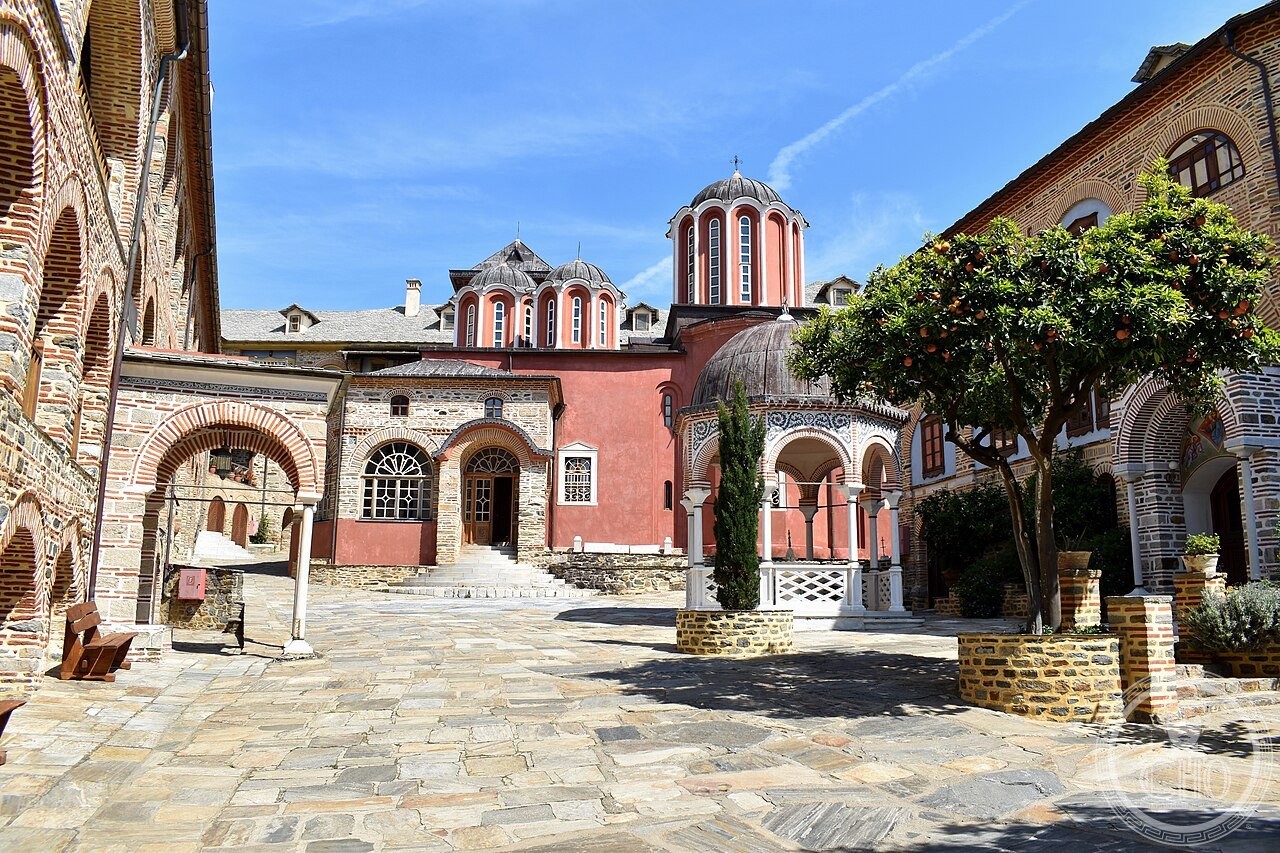
On Mount Athos, in Greece, the monastery of Pantokratoros was founded around 1357–1360, following an imperial chrysobull granted in March 1357 by the Byzantine emperor John V Palaiologos. The founders were two brothers, senior officers of the Byzantine army engaged in the fighting against Serbs and Ottomans in the regions of the Strymon valley, Kavala and Thasos: Alexios, who received the title of megas primikerios in 1357 and was promoted to megas stratopedarches in 1358, dead in 1368–69, and John, protosebastos in 1357 and then megas primikerios in 1358, who carried on the building and administration of the monastery after his brother’s death. Pantokratoros holds seventh place in the hierarchy of the twenty sovereign monasteries of Mount Athos. The monastery keeps the miraculous icon of the Virgin known as “Gerontissa” (the Elder): according to tradition, an old and virtuous abbot at the point of death asked the priest to hurry the liturgy so that he might receive communion before he died; the priest refused, but a voice from the icon ordered him to hasten the rite, letting the aged monk receive communion and die in peace. Two other episodes are linked to the same icon: the overnight disappearance of the building tools from the site originally chosen for the monastery, found again at the present site, read as a sign of the Virgin’s will, and a miracle of the multiplication of oil during a severe famine in the seventeenth century. The katholikon is dedicated to the Transfiguration of Christ, and the library holds around 350 manuscripts and 3,500 early printed books. Since 1988 the monastery has formed part of the UNESCO World Heritage of Mount Athos.
About Pantokratoros Monastery
Pantokratoros Monastery, on Mount Athos in Greece, was founded around 1357-1360, following an imperial chrysobull granted in March 1357 by the Byzantine Emperor John V Palaiologos. Its founders were two brothers, high-ranking Byzantine military officers who had fought against the Serbs and Ottomans in the Strymon Valley, Kavala and Thasos regions: Alexios, who held the title of megas primikerios in 1357 and was promoted to megas stratopedarches in 1358, dying in 1368/69, and John, protosebastos in 1357 and later megas primikerios in 1358, who continued the monastery’s construction and administration after his brother’s death. Pantokratoros ranks seventh in the hierarchy of Mount Athos’s twenty ruling monasteries. The monastery preserves the miracle-working icon of the Virgin known as “Gerontissa,” or the Eldress: according to tradition, an elderly and virtuous abbot near death asked the officiating priest to hasten the Divine Liturgy so he might receive Communion before he died; when the priest refused to rush, a voice from the icon itself instructed him to speed up the service, allowing the abbot to receive Communion and die in peace. Two further traditions are attached to the same icon: the overnight disappearance of the builders’ tools from the monastery’s originally intended site, later found at its present location and interpreted as a sign of the Virgin’s own will, and a 17th-century miracle in which oil multiplied to fill the monastery’s empty jars during a severe famine. The katholikon is dedicated to the Transfiguration of Christ, and the monastery’s library holds roughly 350 manuscripts and some 3,500 early printed books. Since 1988, Pantokratoros has formed part of the UNESCO World Heritage Site “Mount Athos.”
Key facts
- 1357-1360: founding by the brothers Alexios and John, Byzantine military commanders
- 7th in the hierarchy of Mount Athos’s twenty ruling monasteries
- Gerontissa icon: the miracle-working icon of the Virgin central to the monastery’s identity
- Katholikon dedicated to the Transfiguration of Christ
- ~350 manuscripts and ~3,500 early printed books in the monastery library
- 1992: the last Athonite monastery to switch from idiorrhythmic to communal monastic life
- 1988: becomes part of the UNESCO World Heritage Site “Mount Athos”
History
Pantokratoros’s founding by two brother-generals of the Byzantine military establishment, rather than by a monastic figure, reflects a distinctive pattern of aristocratic and military patronage that shaped several Mount Athos foundations during the empire’s turbulent 14th century, as Byzantium faced mounting pressure from Ottoman expansion. The monastery’s late transition to communal monastic life in 1992, the last of the twenty ruling monasteries to make that change, marks the final chapter in a broader 20th-century shift across Mount Athos away from the older idiorrhythmic system toward stricter cenobitic community life.
What you see
The monastery occupies rocky high ground on the northeastern coast of the peninsula, its katholikon dedicated to the Transfiguration of Christ standing at the heart of the fortified complex. Inside, the venerated Gerontissa icon draws pilgrims, while the extensive library preserves centuries of manuscripts and printed texts documenting the monastery’s long scholarly tradition.
Practical information
- Access: Mount Athos requires a special entry permit (diamonitirion); open only to men, following traditional Athonite restrictions; the Julian calendar is observed
- Address: Mount Athos peninsula, Chalkidiki, Greece
Getting there
Pantokratoros Monastery lies on the northeastern coast of the Mount Athos peninsula, reachable by boat along the coastline from Daphni, the peninsula’s port. GPS: 40.2836° N, 24.2666° E.
Nearby
- Stavronikita Monastery — another Athonite monastery along the same coast
- Vatopedi Monastery — major monastery further along the peninsula
- Karyes — the administrative capital of Mount Athos, inland
Sources
- Wikipedia — “Pantokratoros Monastery” (en.wikipedia.org)
- Monastiriaka — “Miraculous Icon of the Virgin Mary Gerontissa the Eldress, Holy Monastery of Pantokratoros” (monastiriaka.gr)
- UNESCO World Heritage Centre — “Mount Athos” (whc.unesco.org)
Find it on the map
See this place and what’s around it →📷 Become a Cultural Heritage Online photographer
Share your photos of places: they stay published under your name as the author. The more they're seen, the more you get noticed — and soon a contest will reward the most appreciated photos.
Log in or sign up free to add a photo