

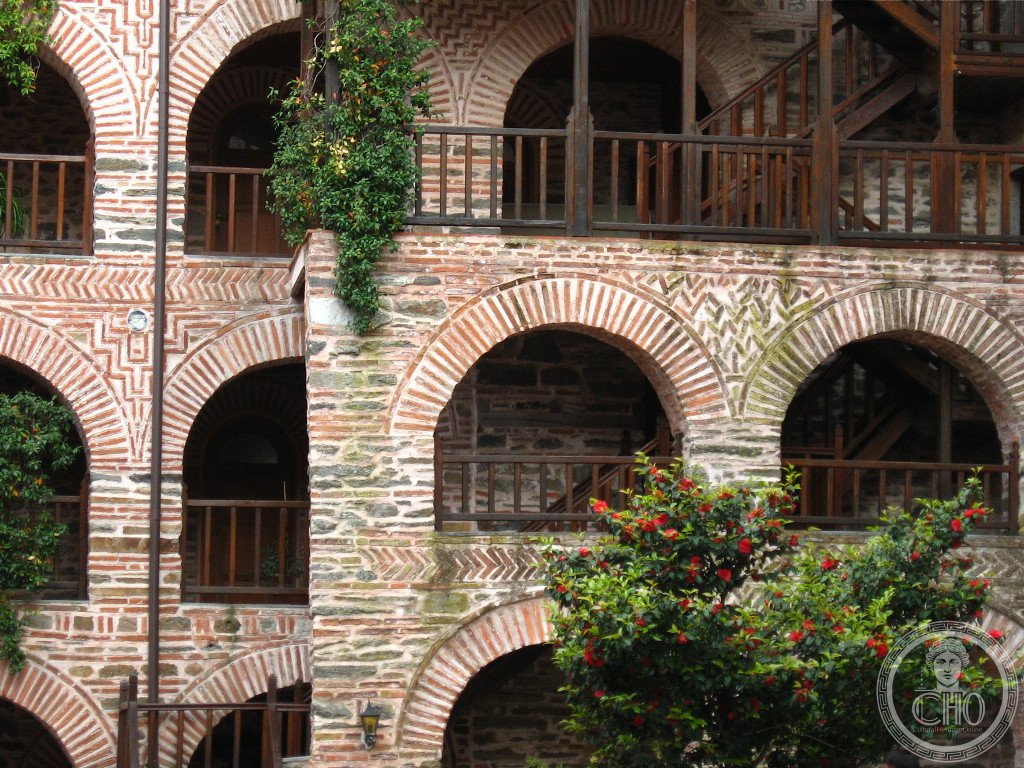
On Mount Athos, in Greece, the monastery of Koutloumousiou is documented from 1169; its unusual name is traditionally linked to a Christianised member of the Turkic-Seljuk Kutlumush dynasty, though the historical sources agree neither on the founder’s exact name nor on the precise date of foundation. In the fourteenth century the Wallachian voivode Vladislav I Vlaicu became its great benefactor, funding a major expansion around September 1369, under the abbot Chariton of Imbros, on the explicit condition that he be recognised as co-founder of the monastery alongside the original founders. Koutloumousiou holds sixth place in the hierarchy of the twenty sovereign monasteries of Mount Athos, a rank reached in 1574 and held ever since, and it is the monastery closest to Karyes, the administrative capital of the peninsula, linked to it by the so-called Koutloumousiou Bridge. The katholikon, dedicated to the Transfiguration of the Saviour, was built shortly after 1369 and frescoed in 1539–1540 under the abbot Maximos by an anonymous painter of the Cretan school, though much of the painted cycle visible today comes from a repainting of the early nineteenth century. Among the relics kept there are the left foot of Saint Anne, the left hand of Saint Gregory the Theologian, a fragment of the True Cross and, in the chapel of the Panagia Fovera Prostasia, a miraculous icon dated to the thirteenth or fourteenth century. Since 1988 the monastery has formed part of the UNESCO World Heritage of Mount Athos.
About Koutloumousiou Monastery
Koutloumousiou Monastery, on Mount Athos in Greece, is documented from 1169, its unusual name traditionally connected to a Christianized member of the Turkish Seljuk Kutlumush dynasty, though historical sources disagree on the founder’s precise identity and the exact founding date. In the 14th century, the Wallachian voivode Vladislav I Vlaicu became the monastery’s major benefactor, funding a significant expansion around September 1369 under abbot Chariton of Imbros, on the explicit condition that he be recognised as co-founder alongside the monastery’s original establishers. Koutloumousiou ranks sixth in the hierarchy of Mount Athos’s twenty ruling monasteries, a rank it achieved in 1574 and has held ever since, and stands as the closest of the twenty ruling monasteries to Karyes, the peninsula’s administrative capital, connected to it by the so-called Koutloumousiou Bridge. The katholikon, dedicated to the Transfiguration of the Saviour, was built shortly after 1369 and frescoed in 1539-1540 under abbot Maximos by an unnamed painter of the Cretan school, though much of the fresco cycle visible today reflects an early 19th-century repainting rather than the original 16th-century work. Among the monastery’s documented relics are the left foot of Saint Anne, the left hand of Saint Gregory the Theologian, a fragment of the True Cross, and, in the Chapel of Panagia Fovera Prostasia, a wonder-working icon dated to the 13th or 14th century. Since 1988, Koutloumousiou has formed part of the UNESCO World Heritage Site “Mount Athos.”
Key facts
- 1169: earliest documented reference to the monastery
- September 1369: major expansion funded by Wallachian voivode Vladislav I Vlaicu, recognised as co-founder
- 6th in the hierarchy of Mount Athos’s twenty ruling monasteries since 1574
- Closest ruling monastery to Karyes, the administrative capital of Mount Athos
- 1539-1540: katholikon frescoed by a Cretan-school painter, largely repainted in the early 19th century
- 1988: becomes part of the UNESCO World Heritage Site “Mount Athos”
History
Koutloumousiou’s traditional association with a Christianized member of the Seljuk Kutlumush dynasty, however imprecisely documented, reflects the broader religious and cultural crossings that characterised the medieval eastern Mediterranean, in which converts from Islam to Christianity occasionally rose to found or lead major monastic institutions. Its proximity to Karyes gave the monastery a practical and administrative significance beyond its own walls, positioning it close to the seat of Mount Athos’s governing council throughout its long history.
What you see
The monastery’s katholikon, dedicated to the Transfiguration of the Saviour and built shortly after 1369, displays a fresco cycle whose visible layer largely reflects early 19th-century restoration over the original mid-16th-century Cretan-school painting. Its treasury preserves relics including a fragment of the True Cross and the wonder-working icon in the Chapel of Panagia Fovera Prostasia, alongside a substantial manuscript and printed-book library.
Practical information
- Access: Mount Athos requires a special entry permit (diamonitirion); open only to men, following traditional Athonite restrictions; the Julian calendar is observed
- Address: Mount Athos peninsula, Chalkidiki, Greece
Getting there
Koutloumousiou Monastery stands immediately adjacent to Karyes, the administrative capital of Mount Athos, connected by the Koutloumousiou Bridge. GPS: 40.2531° N, 24.2478° E.
Nearby
- Karyes — the administrative capital of Mount Athos, directly adjacent
- Iviron Monastery — major monastery a short distance away
- Great Lavra — the oldest and highest-ranking monastery on Mount Athos, further along the peninsula
Sources
- Wikipedia — “Koutloumousiou Monastery” (en.wikipedia.org)
- UNESCO World Heritage Centre — “Mount Athos” (whc.unesco.org)
- Mount Athos official pilgrimage information site (mount-athos.org)
Find it on the map
See this place and what’s around it →📷 Become a Cultural Heritage Online photographer
Share your photos of places: they stay published under your name as the author. The more they're seen, the more you get noticed — and soon a contest will reward the most appreciated photos.
Log in or sign up free to add a photo