

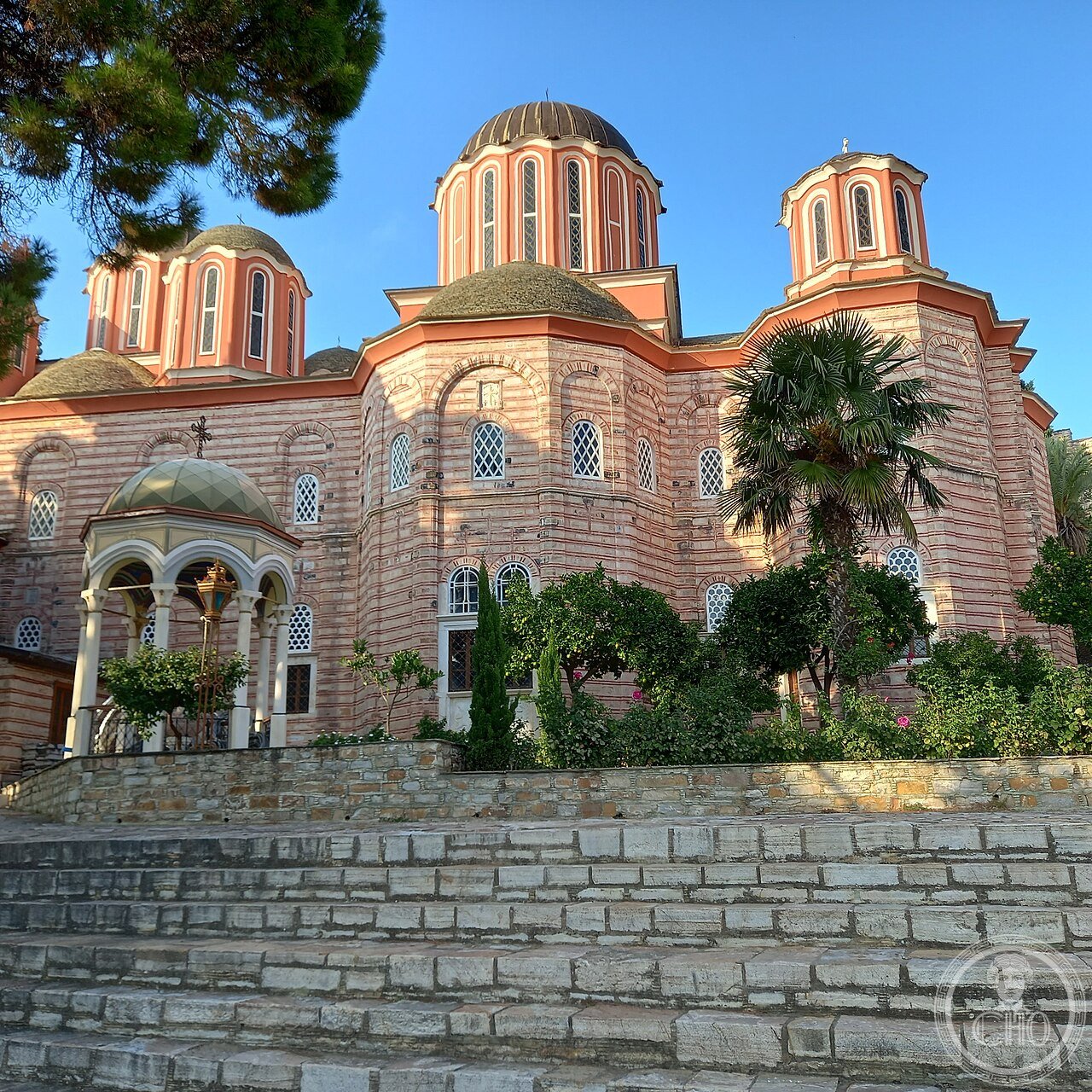
On Mount Athos, in Greece, the first documented mention of a monastery on the site dates from 998; the monk Xenophon is traditionally considered the founder of the monastery that bears his name, around 1010. Xenophontos holds sixteenth place in the hierarchy of the twenty sovereign monasteries of Mount Athos. The community went through a period of decline after the Fourth Crusade and the fall of Constantinople, suffering repeated pirate raids, including a sack in 1225, before being rebuilt with funding from eastern European sovereigns; the emperor Alexios I Komnenos is among the monastery’s chief benefactors, though he is linked above all to the donation of icons rather than to any specific rebuilding. Xenophontos’s most unusual feature, unique among the Athonite monasteries, is its two katholika, both dedicated to Saint George: the older one, with frescoes by the Cretan painter Antonios dated 1544, and a larger and more recent one, built between 1809/1817 and 1819 with finishing work until 1837–1839, in Neoclassical style with eight domes, considered the largest church on all of Mount Athos. The monastery holds a venerated icon of Saint George, which tradition links to the time of Byzantine iconoclasm, and a mosaic icon of Saint Demetrius given, by tradition, by Alexios I Komnenos himself. Since 1988 Xenophontos has formed part of the UNESCO World Heritage of Mount Athos.
About Xenophontos Monastery
Xenophontos Monastery, on Mount Athos in Greece, has its earliest documented reference in 998, with the monk Xenophon traditionally credited as founder of the monastery bearing his name around 1010. Xenophontos ranks sixteenth in the hierarchy of Mount Athos’s twenty ruling monasteries. The community endured a period of decline following the Fourth Crusade and the fall of Constantinople, suffering repeated pirate raids, including a documented 1225 attack, before being rebuilt with funding from rulers of eastern Europe; Emperor Alexios I Komnenos ranks among the monastery’s notable benefactors, primarily associated with the gift of icons rather than a specific rebuilding campaign. Xenophontos’s most distinctive feature, unique among the Athonite monasteries, is its possession of two main churches, or katholika, both dedicated to Saint George: an older church, its frescoes attributed to the Cretan painter Antonios and dated to 1544, and a larger, more recent church, built between 1809/1817 and 1819 with completion work continuing to 1837-1839, in Neoclassical style with eight domes, regarded as the largest katholikon anywhere on Mount Athos. The monastery preserves a venerated icon of Saint George, its tradition entwined with the era of Byzantine iconoclasm, alongside a mosaic icon of Saint Demetrios traditionally attributed as a gift from Alexios I Komnenos himself. Since 1988, Xenophontos has formed part of the UNESCO World Heritage Site “Mount Athos.”
Key facts
- 998/1010: earliest documented reference and traditional founding by the monk Xenophon
- 16th in the hierarchy of Mount Athos’s twenty ruling monasteries
- 1225: documented pirate raid during a period of post-Fourth Crusade decline
- Two katholika, both dedicated to Saint George — unique among Athonite monasteries
- 1809/1817-1819: construction of the newer, larger katholikon, the largest church on Mount Athos
- 1988: becomes part of the UNESCO World Heritage Site “Mount Athos”
History
Xenophontos’s decline and recovery following the disruptions of the Fourth Crusade reflects the broader instability that afflicted many Mount Athos communities during the 13th century, when piracy and the collapse of Byzantine central authority left the peninsula’s monasteries dangerously exposed. The monastery’s unusual decision to build a second, far larger katholikon in the early 19th century, rather than simply enlarging or replacing the older church, produced a rare architectural duality unmatched by any other community on the Holy Mountain.
What you see
The monastery’s older katholikon, its 1544 frescoes attributed to the Cretan painter Antonios, stands alongside the vastly larger 19th-century Neoclassical church, its eight domes making it the biggest single church structure on Mount Athos. Within the complex, the venerated icon of Saint George and the mosaic icon of Saint Demetrios remain central to the community’s devotional life and draw pilgrims to the monastery today.
Practical information
- Access: Mount Athos requires a special entry permit (diamonitirion); open only to men, following traditional Athonite restrictions; the Julian calendar is observed
- Address: Mount Athos peninsula, Chalkidiki, Greece
Getting there
Xenophontos Monastery lies on the southwestern coast of the Mount Athos peninsula, reachable by boat along the coastline from Daphni, the peninsula’s port. GPS: 40.2458° N, 24.1903° E.
Nearby
- Docheiariou Monastery — another coastal Athonite monastery, nearby
- Daphni — the port serving Mount Athos, reachable by boat
- Karyes — the administrative capital of Mount Athos, inland
Sources
- Wikipedia — “Xenophontos Monastery” (en.wikipedia.org)
- OrthodoxWiki — “Xenophontos Monastery (Athos)” (orthodoxwiki.org)
- Macedonian Heritage Society — “Xenophontos” (macedonian-heritage.gr)
Find it on the map
See this place and what’s around it →📷 Become a Cultural Heritage Online photographer
Share your photos of places: they stay published under your name as the author. The more they're seen, the more you get noticed — and soon a contest will reward the most appreciated photos.
Log in or sign up free to add a photo