
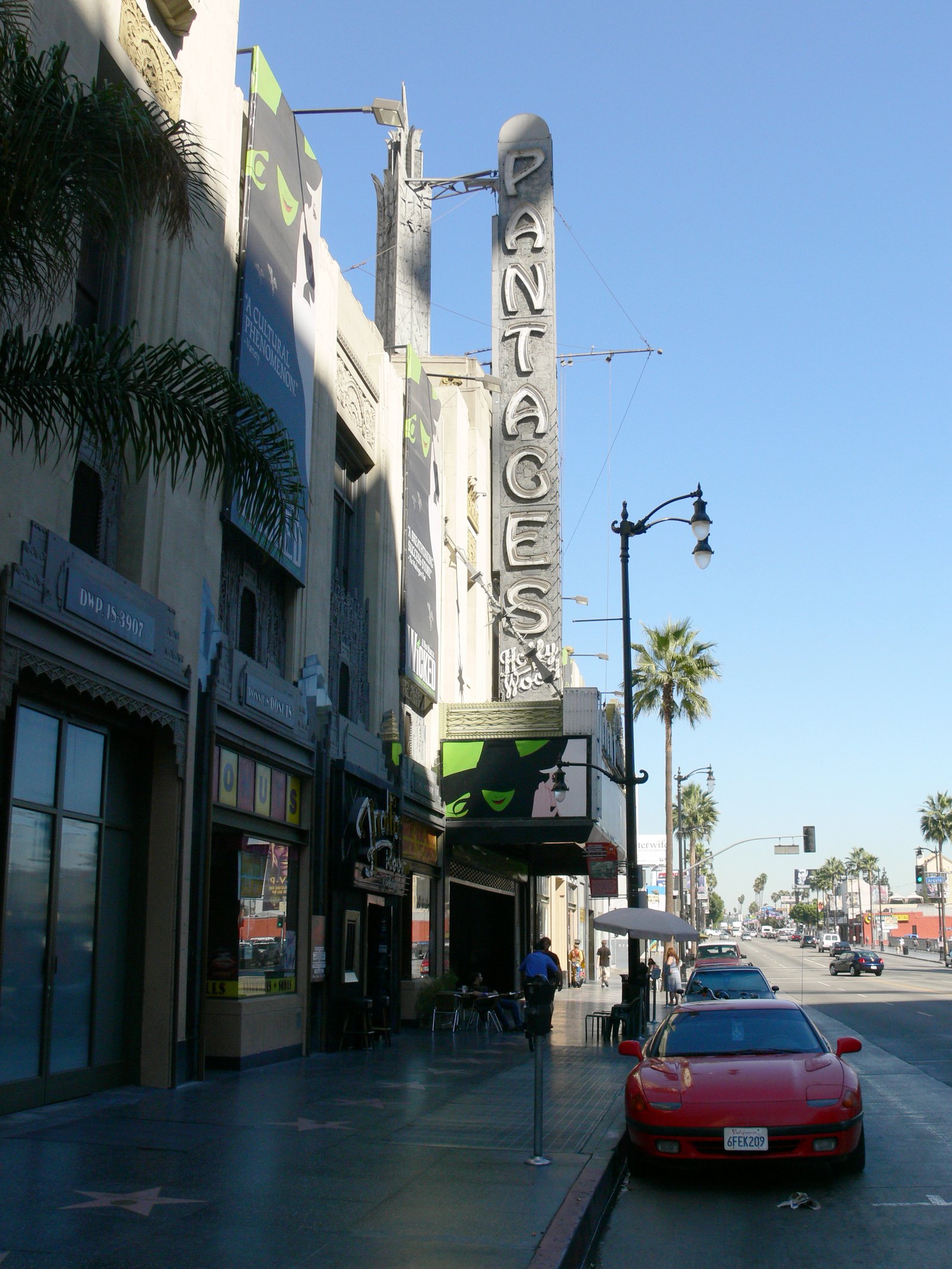
B. Marcus Priteca’s 1930 theatre on Hollywood Boulevard is the last surviving grand movie palace on its stretch of the boulevard—a 2,700-seat Art Deco auditorium whose ornamental bronze, polychrome terrazzo, and gilded plasterwork represent the West Coast movie palace tradition at its most technically accomplished.
At a glance
The Pantages Theatre at 6233 Hollywood Boulevard opened on June 4, 1930, as the flagship cinema of Alexander Pantages’s West Coast entertainment empire. Designed by B. Marcus Priteca, who had been the chief architect of the Pantages circuit since the 1910s, the Hollywood Pantages was the most ambitious project of his career and the most technically elaborate movie palace constructed on the West Coast. The building combines a striking vertically-oriented façade—the Pantages name in a tall illuminated sign above the marquee—with an interior of polychrome terrazzo floors, gilded plasterwork ceilings, and bronze ornament that rivals the most celebrated New York movie palaces in density and quality of finish. The theatre was the site of the Academy Awards ceremony from 1950 to 1959, and today operates as a major Los Angeles venue for touring Broadway productions.
Key facts
- Address: 6233 Hollywood Boulevard, Hollywood, CA 90028
- Architect: B. Marcus Priteca
- Opened: June 4, 1930
- Style: Art Deco
- Capacity: approximately 2,700 seats
- Landmark status: Los Angeles Historic-Cultural Monument; National Register of Historic Places
- Historic use: Academy Awards ceremony, 1950–1959
- Current use: Live entertainment venue (Broadway touring productions)
History
Alexander Pantages built a cinema and vaudeville circuit that by the late 1920s was one of the two or three largest in the United States, competing directly with the Loew’s and Marcus Publix chains for first-run film product and live performance bookings. His chief architect, B. Marcus Priteca, had designed dozens of Pantages houses across the Pacific Coast and Mountain West since the 1910s; the Hollywood Boulevard flagship was their most ambitious collaboration. Priteca developed an Art Deco vocabulary for the Pantages circuit that was distinct from both the Spanish Baroque of Thomas Lamb and the French Renaissance of Rapp & Rapp—a more angular, geometrically assertive mode that used bronze, terrazzo, and gilded plasterwork in a way that felt native to the California culture of conspicuous innovation.
Alexander Pantages sold the circuit in 1929—before the Hollywood Boulevard theatre opened—following a criminal conviction (later overturned) and financial pressure from the Depression. The RKO Pictures corporation acquired the building and operated it as the RKO Pantages Theatre through the late 1940s and into the 1950s. During this period, from 1950 to 1959, the Academy of Motion Picture Arts and Sciences held its annual ceremony at the Pantages; the building’s glamour, seating capacity, and Hollywood Boulevard address made it the ideal setting for the event. Howard Hughes purchased the building in 1949 and operated it as a first-run cinema until 1977.
Pacific Theatres acquired the building and operated it through the late twentieth century before a conversion to live theatre was completed. Today the Pantages is the primary Los Angeles venue for Broadway touring productions, operated by Nederlander Concerts. Its designation as an LACM and NRHP listing have supported successive restoration campaigns that have maintained the original ornamental programme.
What you see
The Hollywood Boulevard façade reads from a distance as a pure vertical composition: a narrow tower of the Pantages name in illuminated letters above the projecting marquee, the whole flanked by smooth stone piers that give the building a rectilinear clarity unusual among the contemporary movie palaces that favoured organic or historical ornament. The geometry of the façade is Priteca’s signature—a more intellectual engagement with the problem of the commercial front—and it gives the building a distinctive presence on a boulevard crowded with signage.
Inside, the transition from the street is abrupt and deliberate. The entrance lobby introduces polychrome terrazzo floors in a geometric programme of warm earth tones that continues through the auditorium. The ceiling of the main auditorium is a sequence of gilded plaster coffers and arched panels ornamented with bronze fittings; the side walls carry bronze reliefs in a flattened Art Deco vocabulary. The overall effect is of richness without excess: Priteca controlled the ornamental temperature more carefully than many of his contemporaries, producing a building that feels luxurious rather than overwhelming. The proscenium arch frames a stage that was designed from the beginning for live performance as well as film—a prescient programme that has sustained the building’s viability for nearly a century.
Practical information
- Open for scheduled performances; check the Pantages Theatre website (Nederlander) for current schedule; advance booking recommended for popular Broadway productions
- The lobby is accessible during box office hours; guided tours are offered periodically—check the website for availability
- Fully accessible; all seating levels including orchestra and balcony accessible by elevator
- Parking: Hollywood & Highland complex immediately to the west; multiple paid lots along Hollywood Boulevard
- The Hollywood Walk of Fame passes directly in front of the theatre; allow extra time to read stars on the pavement
Getting there
The Pantages Theatre stands at 6233 Hollywood Boulevard in Hollywood. The Metro B Line (Red Line) stops at Hollywood/Vine station, approximately 2 blocks east of the theatre. Los Angeles International Airport (LAX) is approximately 15 miles southwest; Burbank Hollywood Airport (BUR) is approximately 7 miles to the north. The theatre is 2 blocks east of the Hollywood & Highland entertainment complex (now Ovation Hollywood), which also houses the Dolby Theatre (formerly Kodak Theatre), the venue for the current Academy Awards ceremony.
Nearby
- Dolby Theatre (2001) — approximately 0.6 miles west at Hollywood & Highland; the current home of the Academy Awards; guided tours of the auditorium available daily
- Hollywood Museum (former Max Factor Building, 1935) — 2 blocks west; a 1935 Art Deco building housing a large collection of Hollywood memorabilia
- Capitol Records Tower (1956) — approximately 0.5 miles northeast on Vine Street; Welton Becket’s circular tower designed to resemble a stack of records; an LA landmark visible from much of Hollywood
Sources
- Los Angeles Historic-Cultural Monument designation report: Pantages Theatre, 1982
- National Register of Historic Places nomination: Pantages Theatre, Hollywood
- Valentine, Maggie. The Show Starts on the Sidewalk: An Architectural History of the Movie Theatre. New Haven: Yale University Press, 1994 (chapter on B. Marcus Priteca)
- Naylor, David. American Picture Palaces: The Architecture of Fantasy. New York: Van Nostrand Reinhold, 1981
Find it on the map
See this place and what’s around it →📷 Become a Cultural Heritage Online photographer
Share your photos of places: they stay published under your name as the author. The more they're seen, the more you get noticed — and soon a contest will reward the most appreciated photos.
Log in or sign up free to add a photoIs this page about you?
This page is read by travellers and heritage enthusiasts who find it on Google. Tell us how you are connected to this place and we will take it from there.