

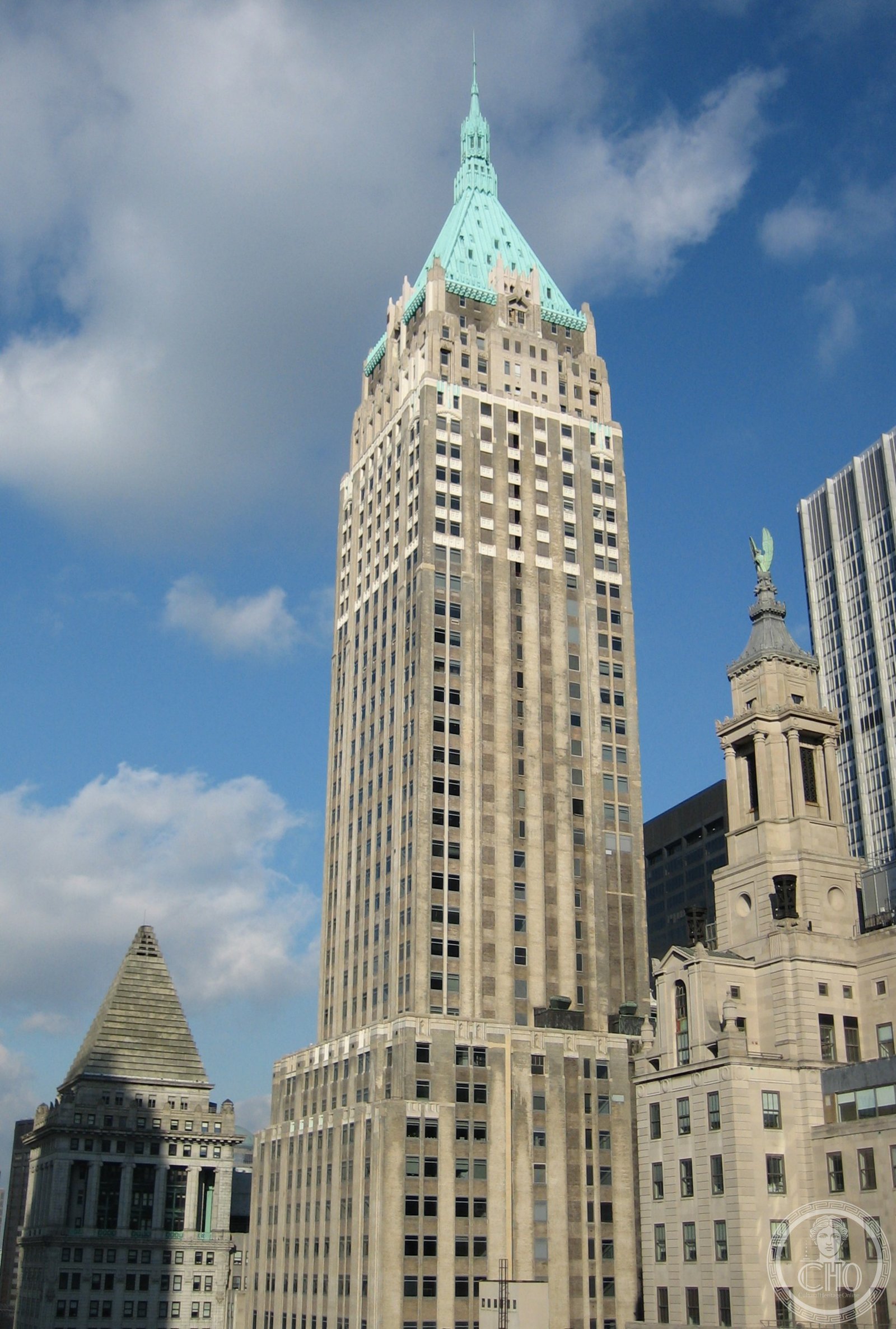
For two months in 1930 this was the world’s tallest building. Its blue-green copper pyramid still defines the downtown skyline — a monument to one of architecture’s most consequential rivalries.
At a glance
A 70-story Art Deco skyscraper at the corner of Wall Street and Nassau Street in Lower Manhattan. Its tapering pyramidal copper crown, now patinated to blue-green, has anchored the downtown skyline since 1930. Architects H. Craig Severance and Yasuo Matsui designed it as the Bank of Manhattan Trust Building — a skyscraper calculated to outlast every rival, until a concealed steel spire changed history.
Key facts
- Address: 40 Wall Street, New York, NY 10005
- Year completed: 1930
- Architects: H. Craig Severance; Yasuo Matsui (associate)
- Height: 927 ft (283 m), 70 stories
- Original name: Bank of Manhattan Trust Building
- Style: Art Deco, Gothic-inflected crown
- Designation: New York City Landmark; National Register of Historic Places
History
The competition between 40 Wall Street and the Chrysler Building is one of architecture’s most dramatic rivalries. H. Craig Severance and his former partner William Van Alen had ended their collaboration acrimoniously; the two found themselves racing to erect the world’s tallest structure. Severance, working with Yasuo Matsui, designed the Bank of Manhattan Trust Building to clear 900 feet. When word reached him that the Chrysler Building might surpass it, he added two more stories, bringing the tower to 927 feet (283 m). In April 1930 the building opened as the world’s tallest.
The claim lasted approximately two months. Van Alen had concealed a 185-foot stainless-steel spire inside the Chrysler Building’s crown, revealing it at the last moment to bring that tower to 1,046 feet. Forty Wall Street dropped from first to third tallest — behind both the Chrysler Building and the Empire State Building then under construction — before the end of 1930. The Bank of Manhattan later merged with Chase National Bank, eventually forming Chase Manhattan, which vacated the tower in 1961 for its own new headquarters. Donald Trump’s organization acquired the building in 1995.
What you see
The tower rises sheer for roughly sixty stories before stepping back into its distinctive pyramidal steeple, sheathed in blue-green patinated copper. The ornamental vocabulary is restrained for its era: flat pilasters, spandrels of darker brick, and a crown whose geometry reads as both Gothic pinnacle and pure 1930s abstraction. The banking hall at street level was originally among the grandest in Lower Manhattan, with coffered ceilings and marble detailing that survive in partial form behind later modifications.
The Wall Street and Nassau facades carry horizontal banding that disguises the structural setbacks required by the 1916 zoning envelope — a technique Severance deployed with more economy than drama. Look up at the crown at dusk, when low light catches the copper’s blue-green surface against the stone bulk below and the mass of the building seems to dissolve into sky.
Practical information
- The lobby is accessible during business hours (Monday–Friday). The building is primarily commercial office space.
- No public observation deck.
- The Financial District is walkable year-round; summers are humid, winters sharp. Comfortable shoes recommended for cobblestoned side streets.
- Allow 15–20 minutes to walk from the 9/11 Memorial area.
Getting there
The 2/3 and 4/5 subway lines stop at Wall Street station at the building’s door. The J/Z lines stop at Broad Street, one block west. JFK International Airport is approximately 17 miles southeast via the A train (Jamaica transfer) or express taxi. Newark Liberty (EWR) is approximately 14 miles west via NJ Transit to Penn Station. The 9/11 Memorial & Museum is approximately 0.4 miles west via Fulton Street; the New York Stock Exchange is half a block west on Broad Street.
Nearby
- New York Stock Exchange (1903) — Neoclassical temple half a block west at Broad and Wall Streets
- Trinity Church (1846) — Richard Upjohn Gothic Revival, approximately 0.2 miles west at Broadway
- Cunard Building (1921) — Beaux-Arts shipping palace, 0.3 miles west at 25 Broadway
- Chrysler Building (1930) — Van Alen’s rival tower, 1.5 miles north on 42nd Street at Lexington
Sources
- NYC Landmarks Preservation Commission designation report, 40 Wall Street, 1996
- National Register of Historic Places, #07000975
- Goldberger, Paul. The Skyscraper. Knopf, 1981
- Stern, Robert A.M., et al. New York 1930. Rizzoli, 1987
- Willis, Carol. Form Follows Finance: Skyscrapers and Skylines in New York and Chicago. Princeton Architectural Press, 1995
Find it on the map
See this place and what’s around it →📷 Become a Cultural Heritage Online photographer
Share your photos of places: they stay published under your name as the author. The more they're seen, the more you get noticed — and soon a contest will reward the most appreciated photos.
Log in or sign up free to add a photoIs this page about you?
This page is read by travellers and heritage enthusiasts who find it on Google. Tell us how you are connected to this place and we will take it from there.