
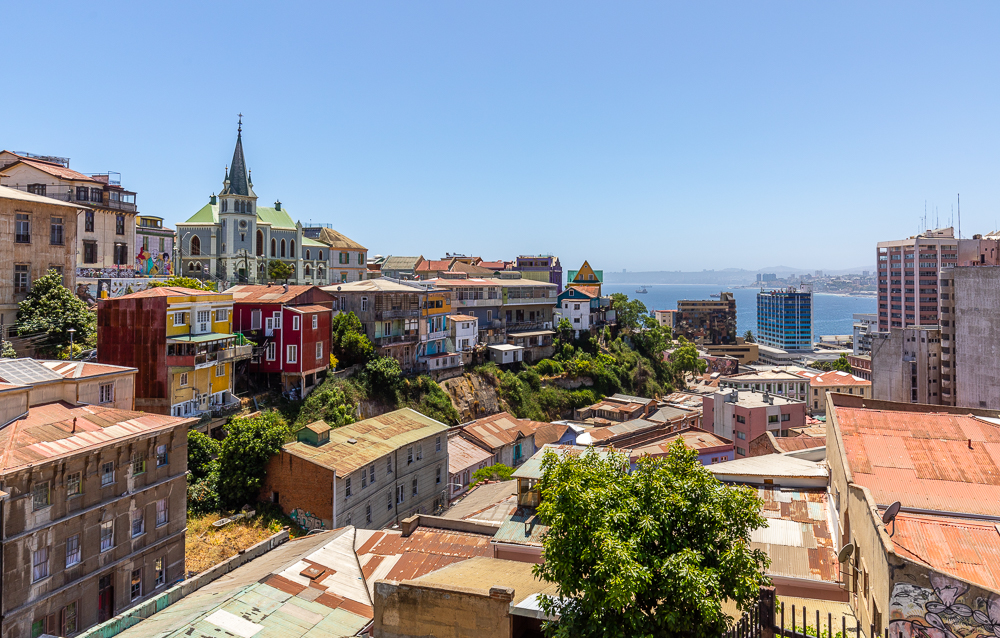
A port city unlike any other: 42 hills above the Pacific, each with its own character, connected by funicular elevators, covered in murals and multi-coloured tin-clad houses. The most important port on the Pacific for the entire 19th century — and UNESCO World Heritage Site since 2003.
At a glance
Valparaíso occupies one of the most dramatic urban settings in the world: a narrow flat strip along the Pacific shore (the “plan”) and 42 individual hills (cerros) that rise sharply behind it, each with its own distinct character, history, and immigrant community. The city was the dominant commercial hub for Pacific trade throughout the 19th century — serving as the main provisioning, banking, and insurance centre for trade between the Atlantic and Pacific coasts of South America. Before the Panama Canal opened in 1914, every ship rounding Cape Horn had to stop at Valparaíso. The historic quarter retains an exceptional density of late 19th century vernacular architecture reflecting this cosmopolitan heritage: British, German, Italian, Spanish, and Croatian merchants all built in their own styles, producing a rich architectural patchwork on the cerros. The city’s extraordinary vertical geography — accessible by 26 funicular elevators (ascensores), built from 1883 onwards into the hillsides — combined with a long tradition of bohemian culture and public art, makes Valparaíso one of the most visually compelling cities in South America. UNESCO inscribed the historic quarter in 2003 for its exceptional urban landscape and its reflection of the significant interchange of human values during the late 19th century.
Key facts
- UNESCO inscription: 2003, World Heritage Site
- Founded: 1536 by Juan de Saavedra (Spanish colonial settlement)
- Peak importance: 1840s–1914 (dominant Pacific port before Panama Canal)
- Geography: Flat lower city (plan) + 42 hills (cerros); elevation 0–500 m
- Ascensores: Funicular elevators built from 1883; up to 26 operational; now ~8 functioning
- Style: Late 19th century vernacular — tin-clad houses, cosmopolitan eclectic
- Location: Valparaíso Region, central Chile; 120 km northwest of Santiago
- Notable resident: Pablo Neruda — his house La Sebastiana is on Cerro Florida
History
Juan de Saavedra, a Spanish conquistador serving under Diego de Almagro, named the bay “Valparaíso” (Valley of Paradise) in 1536 after his home village in Spain. The city grew slowly under Spanish colonial rule as a secondary port to Callao (Lima), but its strategic position on the Pacific coast gave it increasing importance. After Chilean independence in 1818, Valparaíso rapidly became the commercial capital of the Pacific coast of South America. By the 1840s it was the dominant port for Pacific trade: every ship rounding Cape Horn stopped here to provision, refuel, and conduct banking and insurance business. British, German, Italian, Spanish, and Croatian merchants established themselves on the cerros, each community building in its own architectural tradition and creating its own social institutions — churches, clubs, cemeteries, and schools.
The city was also a centre of printing, publishing, and progressive politics. Chile’s first newspaper, the Aurora de Chile, was published in Valparaíso. The working-class port community developed a strong labour movement and a tradition of political radicalism that has persisted to the present. The ascensores — funicular elevators built directly into the hillsides — were invented here as a practical solution to the vertical topography: the first, Ascensor Concepción, was built in 1883. At their peak there were 30 operating elevators connecting the plan to the cerros.
The catastrophic earthquake of 1906 (magnitude 8.2) destroyed most of the lower plan district; the cerros and their hillside architecture survived largely intact. The opening of the Panama Canal in 1914 ended Valparaíso’s commercial dominance almost overnight — ships no longer needed to round Cape Horn, and Pacific trade was rerouted. The city entered a long economic decline, which paradoxically preserved its 19th-century urban fabric intact while other South American cities modernised. This combination of economic stagnation and preserved architecture eventually brought UNESCO recognition. Today Valparaíso is also the seat of the Chilean National Congress, relocated from Santiago in 1990.
What you see
The cerros and their ascensores — The 42 hills each have a distinct personality. Cerro Alegre and Cerro Concepción are the best-preserved and most visited, with streets lined by 19th century tin-clad houses in vivid colours, open staircases that become outdoor galleries, murals on every surface, and cafés and galleries in former merchants’ houses. Ascensor Concepción (1883) is the oldest functioning elevator; Ascensor Reina Victoria and Ascensor El Peral are among the most photographed.
The plan (lower city) — The commercial district contains the Plaza Sotomayor (with the former Intendencia building), the Palacio de la Aduana (customs house, 1854), and the former stock exchange. The port itself — still an active container terminal — defines the seaward edge of the plan.
La Sebastiana — Pablo Neruda’s house on Cerro Florida, now the Fundación Neruda museum. Built in the 1960s and filled with the poet’s eclectic collections, it offers extraordinary views over the bay. Open to visitors (entry fee applies).
Street art — Valparaíso is one of the world’s leading cities for outdoor muralism. Virtually every staircase, wall, and retaining structure on the cerros carries commissioned murals by Chilean and international artists. The city issues permits for murals; it is one of the few places where street art has become institutionally supported without losing its vitality.
Practical information
- Ascensor Concepción: Calle Prat / Cerro Concepción — operating hours vary; check locally; small fare (~CLP 200)
- La Sebastiana (Neruda’s house): Ferrari 692, Cerro Florida — open Tue–Sun; entry fee; book ahead in high season (Dec–Feb)
- Cerro Alegre / Cerro Concepción walking circuit: 2–3 hours; start at Plaza Sotomayor, take Ascensor El Peral to Cerro Alegre, walk to Cerro Concepción, descend via Ascensor Concepción
- Best time: Oct–Apr (Chilean spring/summer); avoid Aug (winter, some ascensores closed for maintenance)
- Safety: Stick to the main tourist cerros (Alegre, Concepción, Florida); some cerros have higher crime rates; locals can advise
Getting there
Valparaíso is 120 km northwest of Santiago by motorway (Ruta 68), a 1.5-hour drive or bus journey. Turbus and Pullman Bus run frequent express coaches from Santiago’s Alameda bus terminal. The nearest airport is Santiago Arturo Merino Benítez International (SCL), with connections to all major South American cities and intercontinental routes. There is no commercial airport in Valparaíso itself. Within the city, the historic quarter is best explored on foot, by ascensor, and by the city’s Trolebús (trolleybus) network on Avenida Argentina — one of the last operating trolleybus systems in South America.
Nearby
- Viña del Mar — neighbouring beach resort city, 10 km north; the Palacio Rioja, Casino Municipal, and Jardín Botánico Nacional are worth visiting
- Casablanca Valley wineries — 50 km east on Ruta 68; one of Chile’s leading wine valleys producing Sauvignon Blanc and Chardonnay; numerous wineries open for tours and tastings
- Isla Negra — 80 km south; site of Pablo Neruda’s main house (now the largest of the three Fundación Neruda museums), facing the Pacific at a remote coastal village
- Quintay — 45 km south; former whaling station (now museum) on a dramatic rocky headland with marine wildlife
Sources
- UNESCO World Heritage — Historic Quarter of the Seaport City of Valparaíso, whc.unesco.org, inscription 2003 (criterion iii)
- Hidalgo, Rodrigo. Valparaíso: The Eternal Port. Fundación Imagen de Chile, 2012
- Wikipedia — “Valparaíso” (en.wikipedia.org), consulted June 2026
Find it on the map
See this place and what’s around it →📷 Become a Cultural Heritage Online photographer
Share your photos of places: they stay published under your name as the author. The more they're seen, the more you get noticed — and soon a contest will reward the most appreciated photos.
Log in or sign up free to add a photo