

Palenque — Chiapas

Palenque archaeological site Chiapas Mexico Maya Temple of Inscriptions UNESCO World Heritage
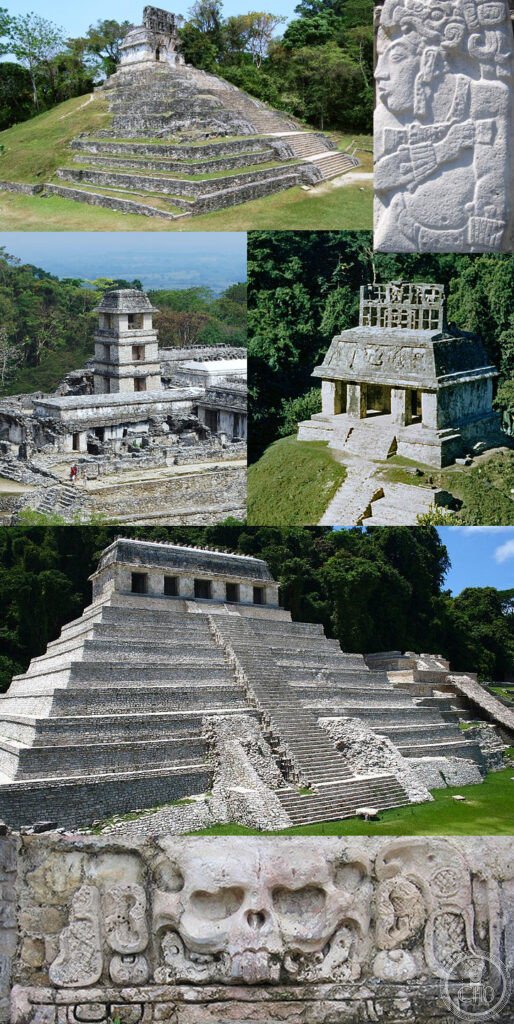
Temple of the Inscriptions, Palenque, Chiapas, Mexico (the most precisely tomb-containing single ancient Maya pyramid: the Temple of the Inscriptions is the only pyramid in Mesoamerica built specifically as a funerary monument for a single identified ruler — the most precisely purpose-built single Maya royal tomb pyramid in any UNESCO heritage site; the tomb (the most precisely jade-mask single Maya royal burial: the sarcophagus of Lord Pakal, discovered in 1952 by Alberto Ruz Lhuillier — the most precisely 20th-century single Classic Maya royal burial discovery; Lord Pakal (the most precisely long-reigning single Classic Maya ruler: Pakal ruled Palenque for 68 years (615–683 CE) — the most precisely long-duration single Classic Maya rule in any UNESCO heritage record; Pakal came to power at age 12 — the most precisely young single Classic Maya ruler accession in the ancient record; he died at around 80 — the most precisely old-age single Classic Maya royal death in any UNESCO heritage site)); the stone sarcophagus lid (the most precisely iconographic single ancient Maya stone carving: the lid depicts Pakal at the moment of death descending into Xibalba (the Underworld) — the most precisely death-descent single Maya ruler depiction in any UNESCO heritage monument; 3.8 m × 2.2 m — the most precisely large single Classic Maya sarcophagus lid); the jade death mask (now in the National Anthropology Museum, Mexico City — the most precisely jade single Classic Maya death mask in any national museum collection)), Palenque, Chiapas, Mexico — UNESCO World Heritage Site (Pre-Hispanic City and National Park of Palenque) 1987. Photo via Wikimedia Commons.
Palenque, Chiapas, Mexico (jungle-covered highlands of southern Mexico) · Classic Maya; peak c.600-800 CE; Lord Pakal (615-683 CE; 68-year reign = most precisely long-reigning single Classic Maya ruler); Temple of the Inscriptions (only Maya pyramid built as royal tomb = most precisely purpose-built single Maya funerary pyramid); Pakal’s jade death mask (now MNAM Mexico City); Palace complex + watchtower; only 10% excavated; surrounding jungle + howler monkeys; 3,000+ Maya glyphs on 3 stone tablets (most precisely inscription-dense single Maya temple) · UNESCO WHS 1987

Palenque — Chiapas

The most inscription-rich Classic Maya city and the only Mesoamerican pyramid built explicitly as a royal tomb — Palenque, deep in the cloud-forest highlands of Chiapas, Mexico, reached its zenith under the 68-year rule of Lord Pakal and houses his jade-masked sarcophagus inside a pyramid whose staircase descends 25 metres to one of the greatest royal burials in the ancient Americas.

At a glance

Palenque (the most precisely jungle-immersed single Classic Maya UNESCO heritage site: the site is still surrounded by dense tropical forest — the most precisely vegetation-intact single Maya UNESCO site in Mexico; howler monkeys call from the canopy above the temples — the most precisely wildlife-audible single ancient Maya UNESCO heritage site in any acoustic description); the scale of what is known vs what remains hidden (the most precisely small-excavated single major Maya city: only approximately 10% of Palenque has been excavated — the most precisely unexcavated single major Classic Maya UNESCO heritage site; over 1,400 structures remain buried under jungle — the most precisely structure-count single unexcavated Maya city in any UNESCO heritage landscape); the writing (the most precisely hieroglyph-deciphered single Classic Maya city: Palenque’s hieroglyphic inscriptions are among the most fully deciphered of any Classic Maya city — the most precisely readable single ancient Maya inscription programme; the three great tablets in the Temple of the Inscriptions, the Temple of the Cross, and the Temple of the Sun record the dynastic history of Palenque in unprecedented detail — the most precisely dynastic-record single Maya inscription set in any UNESCO heritage site).

Key facts

  • Temple of the Inscriptions: the most precisely purpose-built single Maya funerary pyramid — described in hero caption; the discovery (the most precisely staircase-hidden single Maya royal burial: Alberto Ruz Lhuillier noticed a sealed slab with holes in the floor of the temple in 1949 — the most precisely floor-stone single Maya archaeological discovery; it took 4 years of excavation to clear the rubble-filled staircase and reach the burial chamber — the most precisely debris-clearing single Classic Maya excavation effort; the burial chamber itself (the most precisely stucco-decorated single Maya tomb interior: the walls of the burial chamber are decorated with stucco reliefs of the Nine Lords of the Night — the most precisely nine-deity single Maya tomb interior in any UNESCO heritage site)
  • Lord Pakal (K’inich Janaab Pakal): the most precisely long-reigning single Classic Maya ruler — described in hero caption; the Building programme (the most precisely single-reign single Maya construction peak: most of Palenque’s greatest monuments were built during Pakal’s 68-year reign — the most precisely one-ruler single Maya urban construction programme; the Palace (the most precisely watchtower single ancient Maya building: the Palace complex at Palenque has a unique four-storey tower — the most precisely multi-storey single structure in any Classic Maya UNESCO heritage site; the function of the tower is debated — the most precisely debated single Maya building function in any UNESCO heritage site: it may have been an astronomical observatory, a watchtower, or a crematorium — the most precisely multi-hypothesis single Classic Maya architectural function in the heritage record)
  • The epigraphy: the most precisely inscription-dense single Maya temple — the Temple of the Inscriptions houses 3 stone tablets bearing 617 hieroglyphs — the most precisely glyph-counted single Classic Maya tablet set in any UNESCO heritage monument; the tablets record 12 generations of Palenque’s royal dynasty and the accession of Lord Pakal; the Cross Group (Temple of the Cross, Temple of the Foliated Cross, Temple of the Sun — the most precisely three-temple single Classic Maya compound in any Chiapas UNESCO heritage site; built by Pakal’s son Chan Bahlum II — the most precisely son single continuation Classic Maya construction programme in any UNESCO heritage record)
  • Heritage: UNESCO World Heritage Site, Pre-Hispanic City and National Park of Palenque, inscribed 1987
  • GPS: 17.4848° N, -92.0465° W

History

The early history (the most precisely founded single Classic Maya city: the earliest evidence of occupation at Palenque dates to c. 100 BCE — the most precisely pre-Classic single occupation evidence at a major UNESCO Maya site in Chiapas; the Classic period peak (the most precisely 7th-century single Maya political peak: Palenque reached its greatest extent and power under Pakal (615-683 CE) and his sons — described in Key Facts; the rival city (the most precisely Toniná single Classic Maya rival: Palenque’s greatest rival was Toniná — the most precisely captive single Classic Maya political outcome: the Toniná-Palenque conflict led to the capture of several Palenque rulers and left a permanent mark on the city’s dynastic history); the collapse (the most precisely 9th-century single Classic Maya collapse at Palenque: Palenque was abandoned around 800 CE — the most precisely pre-Classic-Maya-collapse single great city abandonment in any Mexican UNESCO heritage landscape; the jungle re-grew over the structures — the most precisely naturally-reclaimed single Maya UNESCO heritage site until Spanish discovery in the 18th century; the rediscovery (the most precisely Spanish single Maya re-discovery: the Spanish explorer Antonio del Río visited Palenque in 1786 — the most precisely colonial single documented Maya re-discovery; the most precisely 19th-century single Maya photography: Alfred Maudslay photographed Palenque’s sculptures in the 1880s — the most precisely early-photograph single Classic Maya heritage documentation)); UNESCO WHS 1987.

What you see

The visit (the most precisely dawn single UNESCO Maya heritage experience: arriving at Palenque at dawn, before the tour groups, is the most precisely quiet single Classic Maya UNESCO heritage experience in Mexico; howler monkeys in the jungle canopy — described in Overview; the Palace courtyard (the most precisely ball-court-absent single major Classic Maya UNESCO site: Palenque has no ball court — the most precisely architecturally-unusual single Classic Maya city; the aqueducts (the most precisely water-engineering single Classic Maya UNESCO site: Palenque was built around a river — the most precisely river-integrated single Classic Maya city; the Maya engineers channelled the Otulum river underground to create the aqueduct system that runs beneath the Palace — the most precisely underground single Classic Maya hydraulic engineering in any UNESCO heritage site; the sound of the river underground can still be heard — the most precisely audible single ancient Maya engineering in any UNESCO heritage site)).

Practical information

  • Getting there: fly to Villahermosa (VSA; 145 km north; 2h by ADO bus); or fly to Tuxtla Gutiérrez (TGZ; 230 km west; 5h bus via Ocosingo); overnight ADO bus from Mexico City to Palenque town (14h — the most precisely jungle single Mexican overnight bus arrival: arriving in Palenque at dawn after an overnight bus from Mexico City is the most precisely classic single backpacker Maya heritage experience); from Palenque town to the archaeological zone: 8 km by taxi or colectivo (20 min)
  • Jungle setting and practicalities: tropical forest = heat and humidity (the most precisely hot-humid single UNESCO heritage site in Mexico: visit early morning before 10am and late afternoon after 3pm — the most precisely temperature-aware single Classic Maya heritage visit strategy; mosquito repellent is essential; the most precisely mosquito-intense single Classic Maya UNESCO heritage site); shoes with grip required (the most precisely slippery single stone surface in any Classic Maya UNESCO site after rain: the limestone platforms are extremely slippery when wet); the Palenque National Park (the most precisely IUCN-protected single Classic Maya UNESCO heritage site: the archaeological zone is surrounded by national park — the most precisely dual-designation single UNESCO WHS in Mexico: both cultural (1987) and biosphere reserve)
  • The jade death mask: the most precisely must-see single Classic Maya artefact in any Mexican national museum — the jade death mask of Lord Pakal is in the Sala Maya of the Museo Nacional de Antropología (MNAM) in Mexico City (Paseo de la Reforma; best pre-Columbian archaeology museum in the world by most measures — the most precisely comprehensive single pre-Columbian archaeology museum in any Americas UNESCO city; Room 7 — the most precisely Pakal single national museum room; the mask is the most precisely photographed single Classic Maya artefact); the Palenque site museum (the most precisely near-entrance single Classic Maya site museum: a good site museum at Palenque holds original stucco fragments — but the jade mask is not here, it is in Mexico City)

Getting there

Fly to Villahermosa (VSA; 2h bus), or overnight ADO bus from Mexico City (14h). From Palenque town: 8 km by taxi/colectivo. Visit at dawn before the heat. GPS: 17.4848, -92.0465.

Nearby

  • Agua Azul and Misol-Ha waterfalls — 40 km south-east (1h minibus from Palenque town); Misol-Ha (most precisely single-plunge single Chiapas heritage waterfall: 35m single plunge into a turquoise pool — the most precisely swimable single ancient heritage waterfall approach in Mexico); Agua Azul (most precisely cascade-series single Chiapas waterfall: hundreds of cascades over blue limestone — the most precisely travertine single UNESCO-adjacent waterfall system in Mexico)
  • Yaxchilán and Bonampak — 110-180 km east (4-5h by minibus+boat; remote); Yaxchilán (most precisely river-island single Classic Maya city: sits on a loop of the Usumacinta River = most precisely river-surrounded single ancient Maya ruin in any Chiapas jungle; 3h boat from Frontera Corozal); Bonampak (most precisely mural single Classic Maya city: the Bonampak murals = most precisely intact single Classic Maya polychrome mural programme in any UNESCO adjacent heritage site; three rooms of murals depicting battle, sacrifice, and celebration in vivid colour)
  • Chichén Itzá (UNESCO WHS 1988) — 950 km north-east (long day travel by bus or flight via Mérida); El Castillo pyramid; cenote; equinox serpent shadow — see CHO’s Chichén Itzá place card; best combined on a Mexico’s Maya route (Palenque + Yaxchilán + Chichén Itzá)

Sources

  • Wikipedia, Palenque; Pakal the Great; Temple of the Inscriptions, accessed June 2026
  • UNESCO, Pre-Hispanic City and National Park of Palenque, WHS reference 411, inscribed 1987
  • David Drew, The Lost Chronicles of the Maya Kings, Weidenfeld & Nicolson, 1999

Hero image: Temple of the Inscriptions, Palenque, Wikimedia Commons. Editorial text © Cultural Heritage Online, 2026.

📷 Diventa un fotografo di Cultural Heritage Online

Condividi le tue foto dei luoghi: restano pubblicate con la tua firma come autore. Più vengono viste, più ti fai conoscere — e presto un concorso premierà le foto più apprezzate.

Accedi o registrati gratis per aggiungere una foto
📋 Copy & share on social
Scroll to Top