

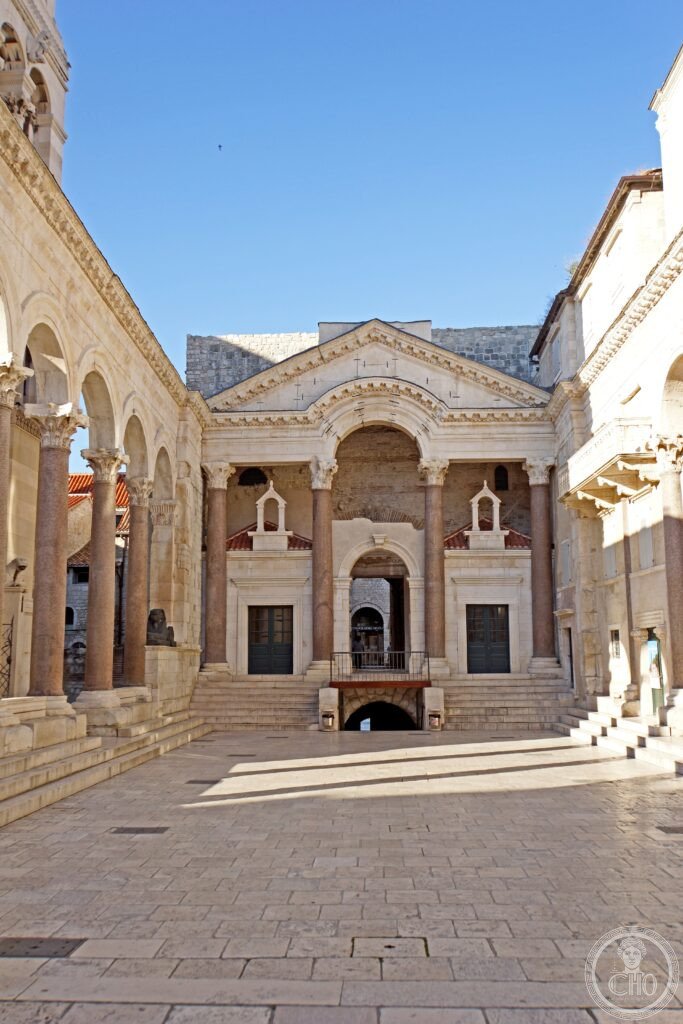
Diocletian’s Palace is not a ruin visited from the outside but a working quarter of Split, where several thousand people still live, shop and worship inside the walls the Roman emperor built for his retirement. Its converted mausoleum now serves as the city’s cathedral, and its cellars once stood in for a dragon’s lair on screen.
At a glance
Diocletian’s Palace occupies a rectangular site of roughly 215 by 180 metres on the Dalmatian coast, enclosed by outer walls about two metres thick and guarded by four corner towers and four gate towers. Rather than a monument set apart, it forms the historic core of modern Split: restaurants, bars, apartments and hotels operate within the ancient perimeter alongside the Cathedral of St Domnius.
The palace was built as the retirement residence of the Roman emperor Diocletian, a figure remembered both for his systematic persecution of Christians and, by one of history’s odder turns, for having his own mausoleum converted after his death into a Christian cathedral.
Key facts
- Built: c. 295–305 CE, as Diocletian’s retirement residence
- Dimensions: approximately 215 m × 180 m, with outer walls around 2 m thick and eight towers
- Abdication: Diocletian abdicated in 305 CE and retired to the palace, reportedly telling those who urged his return to power that he preferred tending the cabbages he had planted with his own hands
- Cathedral of St Domnius: converted from Diocletian’s own octagonal mausoleum after his remains were removed by his successors; in continuous use since the 7th century CE, with the palace’s small Temple of Jupiter serving as its baptistery
- Population today: the old town within the walls remains inhabited, with residents, businesses and the cathedral occupying the historic fabric
- Heritage status: UNESCO World Heritage Site, inscribed in 1979 as the Historic City of Split with the Palace of Diocletian (WHS reference 97)
History
Diocletian, born near Split in the Roman city of Salona, restructured the empire’s government by dividing it among four co-emperors before abdicating in 305 CE, an almost unheard-of act for a Roman ruler. He spent his retirement in the palace he had built for the purpose, famously preferring his cabbage garden to any return to power.
After Salona was sacked in the 7th century CE, its survivors fled into the palace and settled within its walls, an event usually taken as the origin of the modern city of Split. Diocletian’s own mausoleum was stripped of his remains and converted into a Christian church, later becoming the Cathedral of St Domnius.
Split passed under Venetian rule from 1420 to 1797, a period during which Venetian palaces were built directly into and against the Roman walls. It later formed part of Habsburg Austria until 1918, before being incorporated into Yugoslavia. UNESCO inscribed the historic city and palace as a World Heritage Site in 1979.
What you see
The streets inside the palace walls, some dating from the 7th century, form a dense network of narrow, high-walled alleys where a map is often more hindrance than help. At the centre lies the Peristyle, the palace’s colonnaded courtyard, now a public square lined with café tables rather than imperial guards.
Beneath the palace, the cellars preserve the exact footprint of the rooms that once stood above them; used for storage and later forgotten, they were eventually rediscovered and opened to visitors. They also gained a further layer of fame as the setting used for the dragon-keeping dungeons of Daenerys Targaryen in HBO’s Game of Thrones. Above ground, the Cathedral of St Domnius occupies Diocletian’s former mausoleum, with the adjoining Temple of Jupiter serving as its baptistery.
Practical information
- Access: the palace forms Split’s old town and is entered on foot; current opening arrangements for the cathedral, baptistery and cellars are best checked with the site’s official visitor information before travelling
- Ferry arrival: ferries from Ancona, Italy, dock in the port immediately adjacent to the palace, making the old town accessible directly on foot
- Orientation: the internal street layout is irregular by design; visitors are better served by exploring on foot than relying on digital navigation
Getting there
Split is reached by air via Split Airport, with connections from a number of major European cities, and by sea via the Jadrolinija overnight ferry or hydrofoil services from Ancona in Italy. The palace sits at the centre of Split’s old town and is easily reached on foot from the ferry terminal; current timetables and journey times should be checked with the relevant carriers.
Nearby
- Salona — 7 km from Split, the Roman city of Diocletian’s birth, with the Manastirine necropolis among its ruins
- Klis Fortress — above the ancient route from Split into inland Dalmatia, and used as the city of Meereen in Game of Thrones
- Hvar and Brač Islands — reached by ferry from Split; Hvar combines Venetian heritage with lavender fields, while Brač is known for its marble quarries and the Zlatni Rat beach
- Dubrovnik Old City — a walled medieval city on the Adriatic, also inscribed as a UNESCO World Heritage Site in 1979, reachable from Split by road or air
- Plitvice Lakes — a UNESCO World Heritage Site of sixteen terraced lakes linked by waterfalls, with turquoise water and wooden boardwalks over the water
Sources
- UNESCO, Historic City of Split with the Palace of Diocletian, WHS reference 97, inscribed 1979
- J.J. Wilkes, Diocletian’s Palace, Split, Shepton Mallet, 1986
Find it on the map
See this place and what’s around it →📷 Become a Cultural Heritage Online photographer
Share your photos of places: they stay published under your name as the author. The more they're seen, the more you get noticed — and soon a contest will reward the most appreciated photos.
Log in or sign up free to add a photoIs this page about you?
This page is read by travellers and heritage enthusiasts who find it on Google. Tell us how you are connected to this place and we will take it from there.