
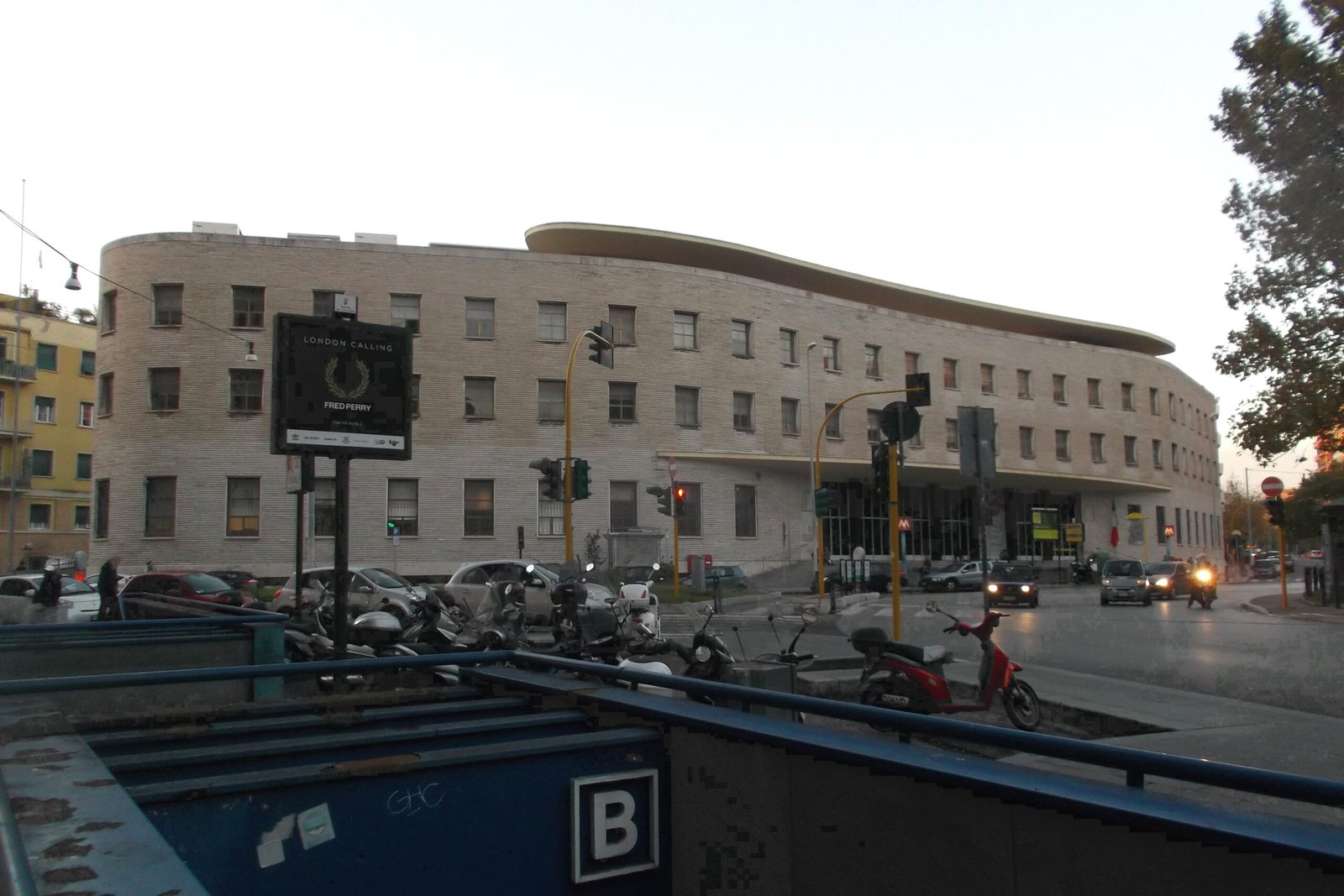
A double-curved travertine front wrapping the south side of Piazza Bologna, the Roma Nomentano post office is the building that won Mario Ridolfi the 1932 ministerial competition and that still anchors his place in Italian Rationalism. Built between 1933 and 1935 with Mario Dell”’Arco and engineer Gioacchino Luigi Mellucci, it was inaugurated on 28 October 1935 and remains in daily use as Poste Italiane office Roma Nomentano (frazionario 55647).
At a glance
Of the four post offices commissioned in 1932 by the Ministero delle Comunicazioni to decentralise postal services into the new residential quarters of Rome — Piazza Bologna in the Nomentano district, viale Mazzini in the Della Vittoria district, via Marmorata in Testaccio and via Taranto in Tuscolano — the Piazza Bologna building is the smallest in plan but the most discussed in twentieth-century architectural writing. Its double curvature in travertine cladding gave Ridolfi a way to mediate between two streets meeting at an oblique angle and, at the same time, between the rigour of Italian Rationalism and the lingering taste for masonry continuity. The interior public hall was substantially modified in 1976; the curved external envelope survives.
Key facts
- Architects: Mario Ridolfi (competition winner, 1932) with Mario Dell”’Arco; engineer Gioacchino Luigi Mellucci; construction firm Mannajuolo.
- Built: 1933–1935; inaugurated 28 October 1935.
- Style: Italian Rationalism (razionalismo italiano), with a curved travertine cortina cladding.
- Function: active post office, Poste Italiane Roma Nomentano (frazionario 55647).
- Floors: 3.
- Modifications: 1976 refurbishment, most invasive in the public hall.
- Address: Piazza Bologna 39, Rome (Nomentano quarter).
History
The 1932 competition belonged to a wider programme of urban decentralisation under the Governatorato di Roma, which set out to push public services out of the historic core into the residential expansions taking shape east and north of the railway lines. Four new post offices were to be built in four different new districts, and each commission was awarded through a separate competition. The Piazza Bologna brief went to a young Mario Ridolfi, then in his early thirties, working with Mario Dell”’Arco and supported by the engineer Gioacchino Luigi Mellucci; the contract for execution went to the Mannajuolo firm.
Construction proceeded between 1933 and 1935. The building opened on 28 October 1935. From the outset it was discussed alongside the other three Roman post offices of the same programme: Adalberto Libera and Mario De Renzi”’s via Marmorata, Giuseppe Samonà”’s via Taranto, and Angiolo Mazzoni”’s viale Mazzini. The four buildings became a recurring case study for the way Italian Rationalism negotiated, building by building, the boundary between strict modern abstraction and the continuing demand for civic monumentality.
The Piazza Bologna office was significantly altered in 1976, with the heaviest interventions in the public banking hall. The exterior envelope and its curved travertine cladding were preserved, and the office continues to function in its original role as a neighbourhood post office under Poste Italiane.
What you see
The clearest reading of the building is from the centre of Piazza Bologna, looking south. Ridolfi solved the awkward geometry of the corner — where the streets meet the piazza at an oblique angle — not with a single straight front but with a double curve, a long convex sweep cladding the principal facade. The curve is faced in narrow listelli of travertine laid as a cortina, a rain-screen of thin stone strips that turns the wall into a tightly grained, almost textile surface. The effect changes with the time of day: at midday the cladding flattens into a single warm plane; in low light the small horizontal joints catch shadow and the curve reads as a continuous ripple along the piazza.
Inside, the public hall has lost most of its 1935 detailing to the 1976 refurbishment, so the architectural interest today lives almost entirely on the outside — which, together with the via Marmorata office of Libera and De Renzi, is the most photographed rationalist post office in Rome.
Practical information
- Visit: the exterior is freely visible from Piazza Bologna at any hour; the public hall is accessible during Poste Italiane opening times.
- Best light: mid-morning and late afternoon, when low sun rakes the travertine cortina.
- Time needed: 15–20 minutes for the exterior; a full architectural circuit of the four 1933–35 Roman post offices can be done in a day.
- Photography: the curved facade is best framed from the western side of the piazza.
Getting there
Piazza Bologna sits in the Nomentano quarter, north-east of Termini station. The Bologna stop on Metro line B is on the piazza itself, two minutes”’ walk from the post office. From Roma Termini the journey takes about ten minutes by metro or twenty on foot along via Nomentana. Rome–Fiumicino and Rome–Ciampino airports both connect to Termini.
Nearby
- Città Universitaria (La Sapienza): Marcello Piacentini”’s 1932–1935 university campus, ten minutes south on foot.
- Quartiere Coppedè: Gino Coppedè”’s eclectic 1915–1927 residential ensemble, fifteen minutes west.
- Other 1933–35 Roman post offices: Libera and De Renzi”’s office on via Marmorata, Samonà”’s on via Taranto, Mazzoni”’s on viale Mazzini — together with Piazza Bologna they form the canonical itinerary of Roman Rationalism in postal architecture.
Sources
- AA.VV., Il moderno attraverso Roma — Guida a 200 architetture e alle loro opere d”’arte, Croma Quaderni 9, Rome, 2000, ISBN 88-7621-099-7, p. 158.
- Claudio Rendina, Donatella Paradisi, Le strade di Roma. Volume primo A–D, Newton Compton Editori, Rome, 2004, ISBN 88-541-0208-3.
- Stefano Vigolo, “Palazzo delle Poste e Telegrafi di Roma Nomentano”, beniculturalionline.it.
- Wikipedia (IT), Edificio postale di Roma Nomentano.
- Wikimedia Commons, File:Roma PT Piazza Bologna.jpg (CC BY-SA 4.0, Sergio D”’Afflitto).

Find it on the map
See this place and what’s around it →Record researched and written by Stefano Vigolo for Cultural Heritage Online, 2026.
📷 Become a Cultural Heritage Online photographer
Share your photos of places: they stay published under your name as the author. The more they're seen, the more you get noticed — and soon a contest will reward the most appreciated photos.
Log in or sign up free to add a photoIs this page about you?
This page is read by travellers and heritage enthusiasts who find it on Google. Tell us how you are connected to this place and we will take it from there.