
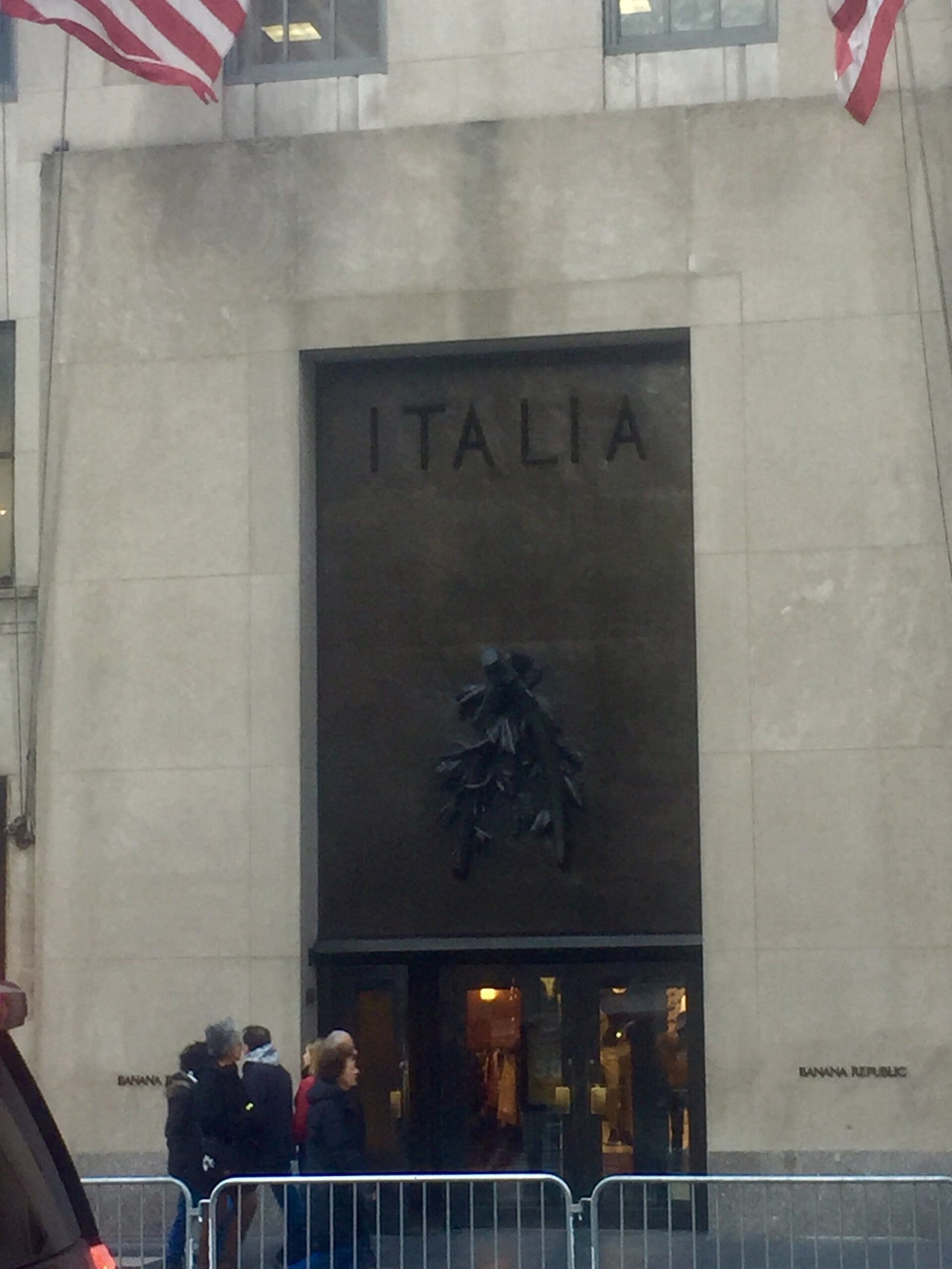
The Italian building of Rockefeller Center: a six-story palazzo on Fifth Avenue whose entrance tells, in two artworks and one erasure, the story of Italy’s twentieth century in America.
At a glance
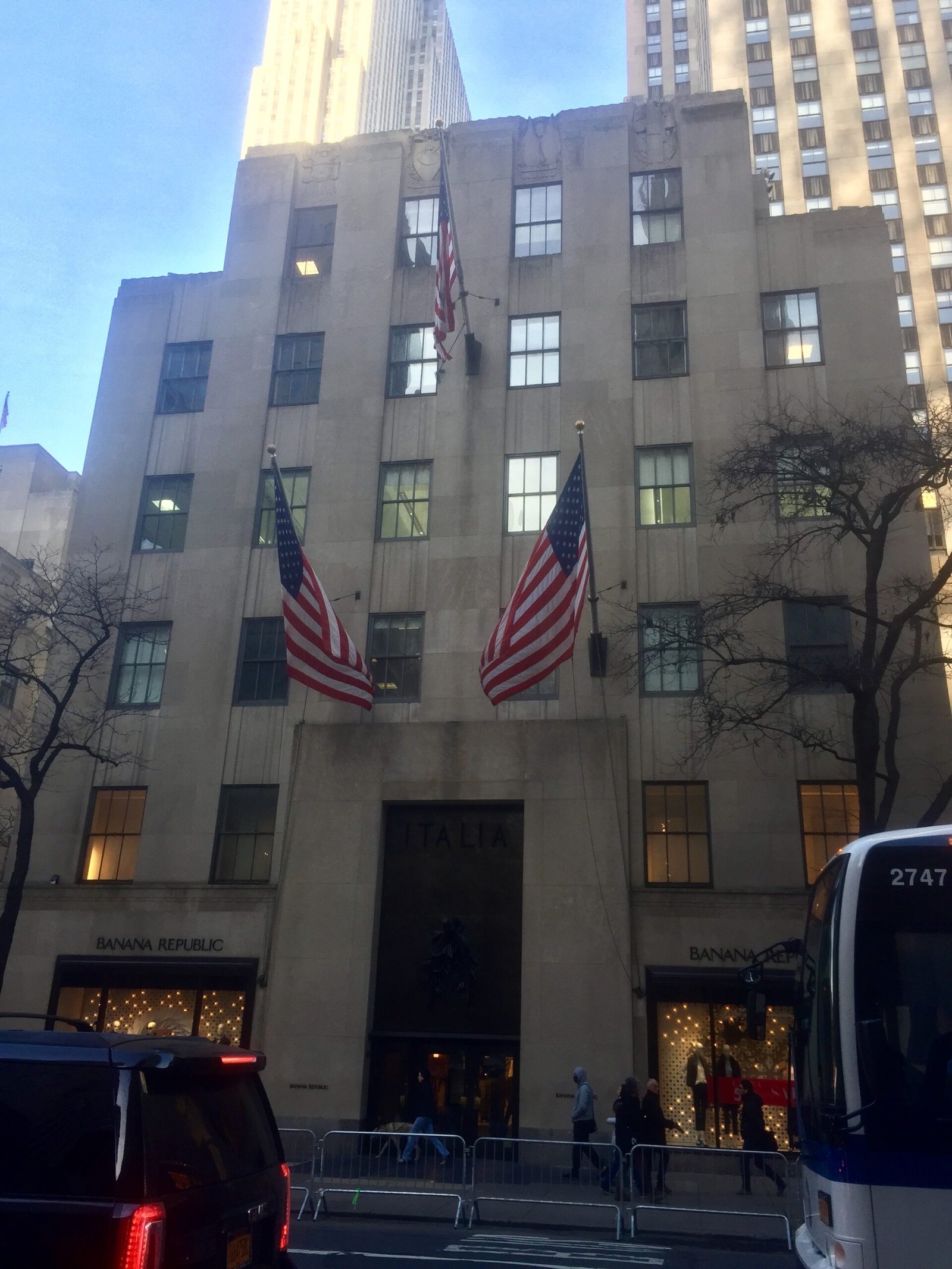
The Palazzo d’Italia stands at 626 Fifth Avenue, the southern of two six-story wings flanking the 41-story International Building. Completed in 1935 to designs by the Associated Architects of Rockefeller Center under Raymond Hood, it was conceived as the Italian address of the complex’s international ensemble, with consular offices and trade bureaus behind its limestone front. Its name is carved where Fifth Avenue can read it. So is its history: the entrance art has been made, censored and remade with the century.
Key facts
- Address: 626 Fifth Avenue, between 50th and 51st Streets, Manhattan
- Completed: 1935, part of the International Building complex
- Architects: Associated Architects of Rockefeller Center, led by Raymond Hood
- Entrance relief: Italia by Giacomo Manzù, 1965 — bronze, about 4.7 × 3.2 m, grapevine and wheat under the word ITALIA
- Landmark status: New York City landmark (23 April 1985); Rockefeller Center is a National Historic Landmark (1987)
- GPS: 40.75908, -73.97703 — open in Google Maps
History
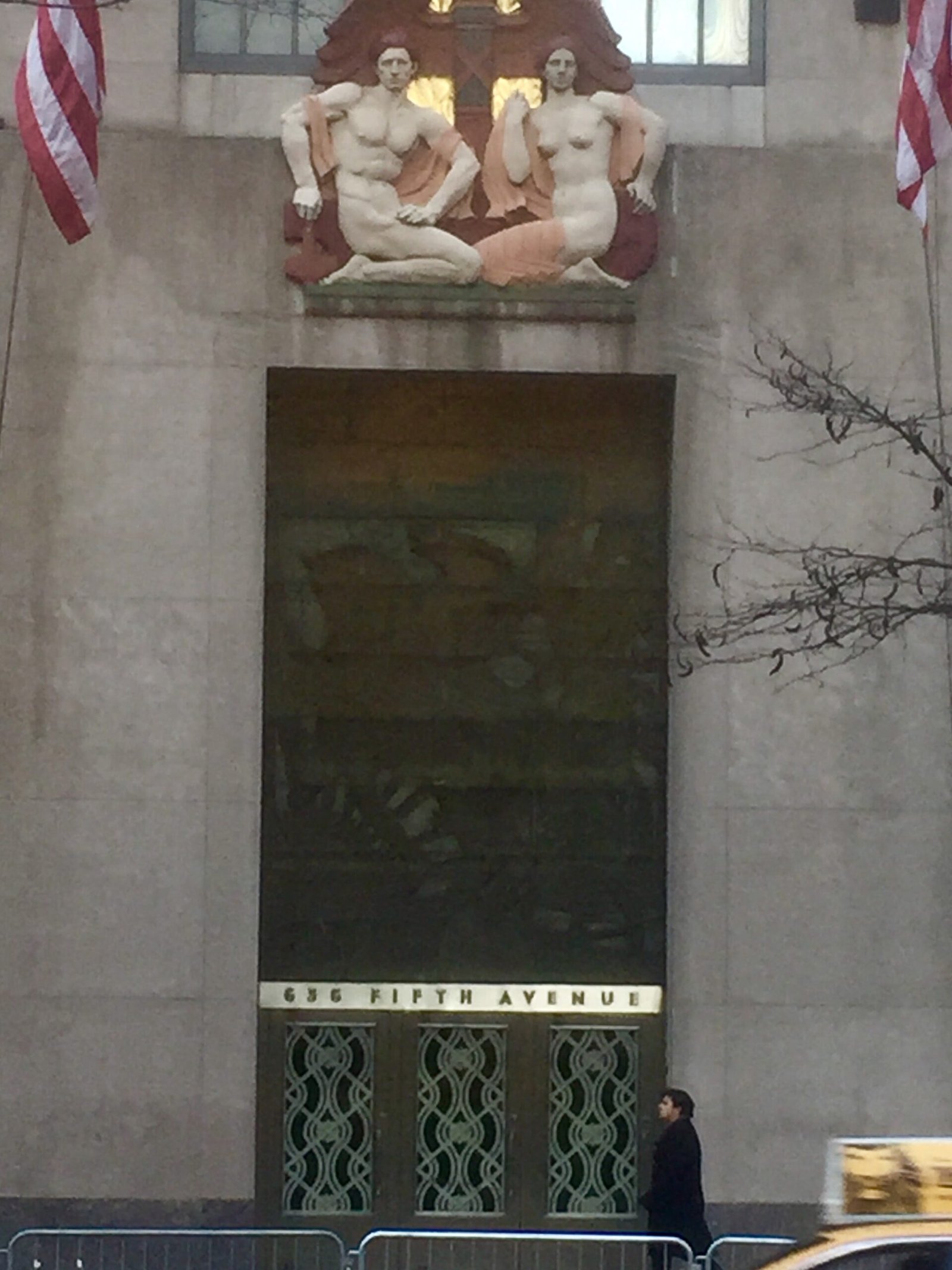
The Palazzo d’Italia was leased before it was built. In March 1933 a company led by the Roman jurist Vittorio Scialoja was formed to operate the Italian wing, and by early July of that year some 40,000 square feet had been taken by Italian government and commercial tenants. The building opened in 1935, and that July a cast-glass panel by Attilio Piccirilli — a man with a spade, framed by Italian inscriptions — was installed over the Fifth Avenue doors.
The panel did not survive the decade’s politics. It was covered in 1941 because it overtly celebrated fascism; the Italian consulate closed in June of that year, and after the United States entered the war the wing lost its name altogether, becoming simply the International Building South. The Italian tourism bureau returned in 1949, and the old name with it.
The doorway stayed bare for a generation. In 1965 a group of Italian businessmen presented Rockefeller Center with a bronze relief by Giacomo Manzù, then fresh from the monumental doors of St. Peter’s in the Vatican. Manzù’s Italia is deliberately un-heroic: the name of the country in plain Roman capitals, and under it a hanging bundle of grapevine, leaves and wheat. The same year he added a second bas-relief for the building, The Immigrant.
What you see
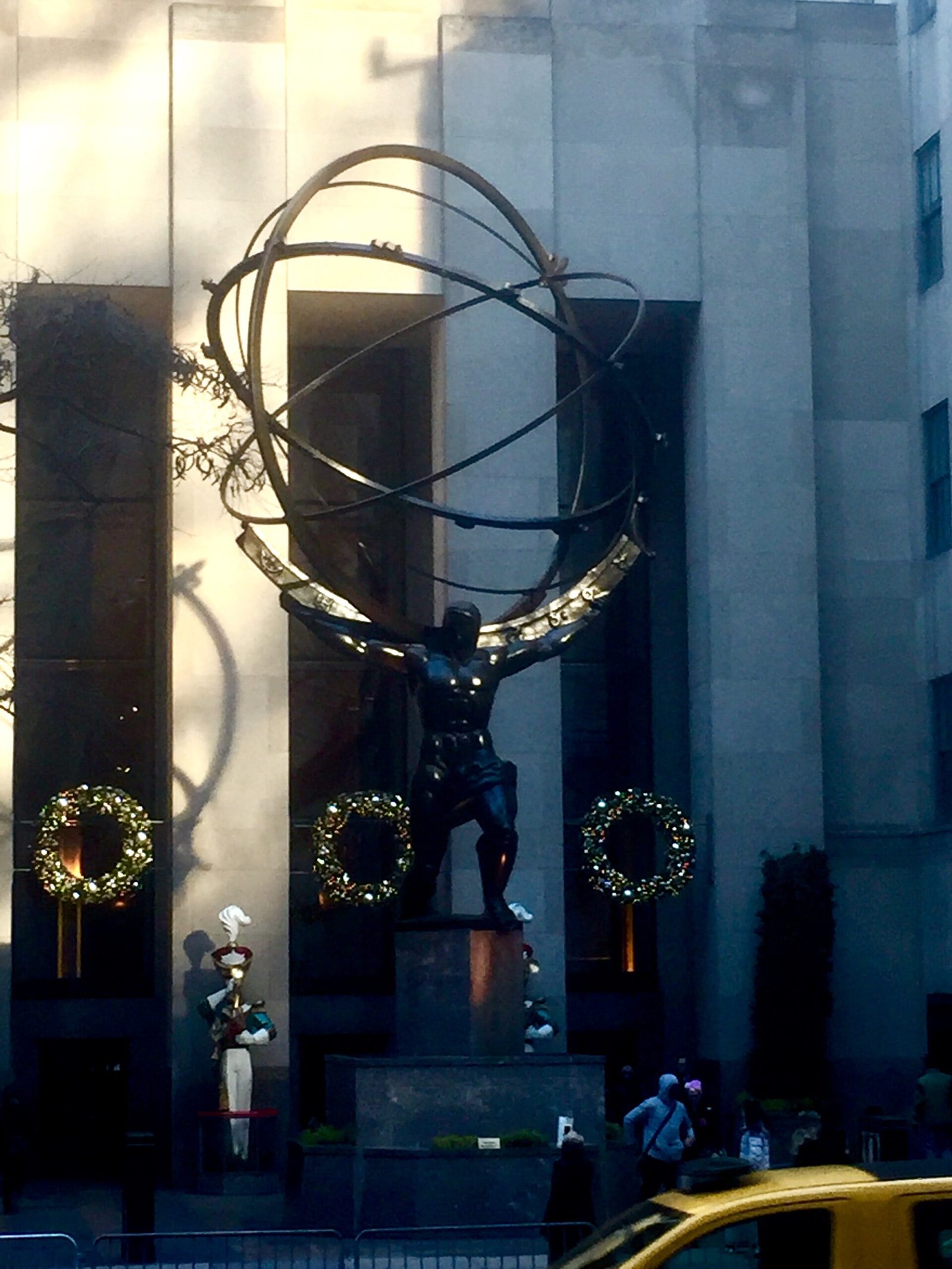
From the sidewalk the palazzo reads as a restrained limestone block, six stories against the International Building’s tower behind. The interest is concentrated at the entrance bay, a tall recess of dark granite. Manzù’s bronze carries a golden-brown patina that catches the afternoon light against the grey stone; the grapevine and wheat are modelled so loosely they seem to sway. One door north, past the forecourt where Lee Lawrie’s bronze Atlas has shouldered its armillary sphere since 1937, the twin wing at 636 Fifth Avenue answers with Piccirilli’s surviving cast-glass screen — the pair make a ten-minute lesson in what the 1930s kept and what they had to take down.
Gallery
Practical information
- The entrance artworks face the public street and can be seen year-round, free of charge.
- The ground floor houses retail; the lobbies of the complex are protected as designated interiors.
- December is the most atmospheric — and most crowded — season, with the Rockefeller Center tree a block west.
Getting there
The palazzo faces Fifth Avenue between 50th and 51st Streets, directly opposite St. Patrick’s Cathedral. The 47–50th Streets–Rockefeller Center subway station (B, D, F, M) is a short walk west along 50th Street.
Nearby
- 30 Rockefeller Plaza — the centerpiece slab of the complex
- St. Patrick’s Cathedral — directly across Fifth Avenue
- Radio City Music Hall — two blocks northwest
Frequently asked questions
What is the Palazzo d’Italia in New York?
It is the six-story Italian wing of Rockefeller Center’s International Building complex, at 626 Fifth Avenue. Completed in 1935, it originally housed the Italian consulate and Italian trade and tourism offices.
Who made the ITALIA relief at Rockefeller Center?
Giacomo Manzù (1908-1991). His bronze relief Italia, presented in 1965 by a group of Italian businessmen, carries the word ITALIA above entwined grapevine, leaves and stalks of wheat. It replaced a 1935 glass panel by Attilio Piccirilli that was covered in 1941 because it overtly celebrated fascism.
Can you see the Palazzo d’Italia artworks for free?
Yes. Manzù’s relief faces Fifth Avenue at street level, and Lee Lawrie’s bronze Atlas stands in the open forecourt of the neighbouring International Building, one door to the north.
Sources
- Wikipedia: International Building (Rockefeller Center)
- Rockefeller Center — Italia, Giacomo Manzù (official art guide)
- New York City Landmarks Preservation Commission designation, 23 April 1985
Find it on the map
See this place and what’s around it →📷 Become a Cultural Heritage Online photographer
Share your photos of places: they stay published under your name as the author. The more they're seen, the more you get noticed — and soon a contest will reward the most appreciated photos.
Log in or sign up free to add a photoDo you manage this place?
This page is read by travellers and heritage enthusiasts who find it on Google. Keep it accurate — and make it work for you. Free for non-profit heritage institutions.