
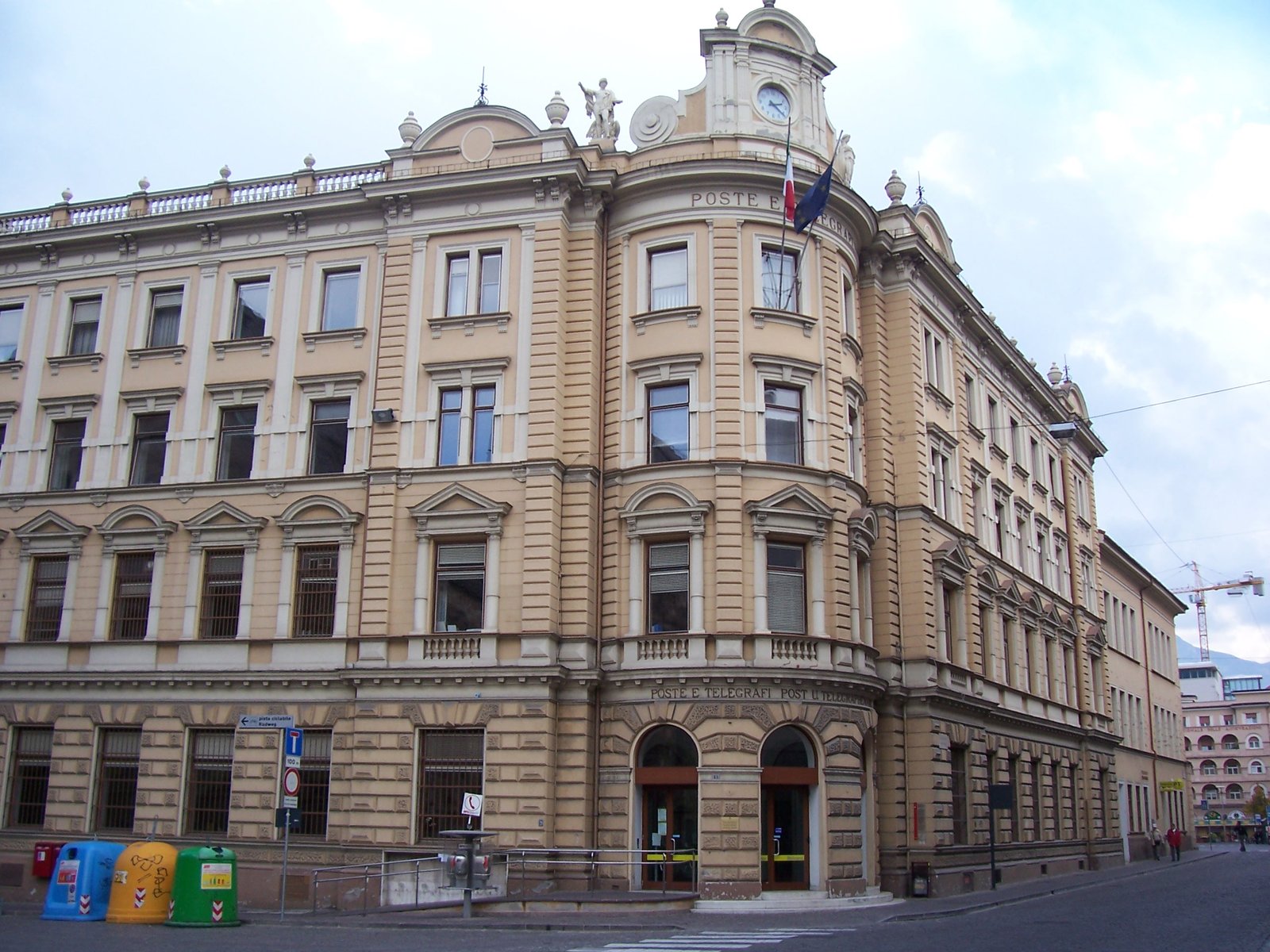
Bolzano’s main post office was built in 1889 for the Austro-Hungarian state in a Viennese neo-Renaissance style; the fascist regime in the 1930s removed its glass dome, added a storey, and made it a pillar of the Italianised administrative city.
At a glance
The Palazzo delle Poste occupies a prominent block at Piazza Parrocchia 13, south of the historic centre and a short walk from Piazza Walther. The building was commissioned by the Austro-Hungarian Ministry of Posts in 1889 and designed by local builder Albert Canal in a neo-Renaissance style informed by Vienna’s Ringstraße. It originally had three floors and a glazed dome that drew light into the lower levels. Under the fascist administration in the 1930s, the dome was demolished to accommodate a fourth floor — an architectural intervention that erased the most distinctive Habsburg-era element of the building. It remains Bolzano’s working central post office.
Key facts
- Address: Piazza Parrocchia 13 / Pfarrplatz 13, 39100 Bolzano
- Coordinates: 46.4980°N, 11.3530°E (Google Maps)
- Original construction: 1889–1890
- Original architect/builder: Albert Canal
- Commission: Austro-Hungarian Ministry of Posts
- Style: Neo-Renaissance (Ringstraße Vienna influence); fourth floor added 1930s without original dome
- Current use: Central post office (Poste Italiane); Ministry of Economic Development offices in upper floors
- Previous occupant (1924–c. 1971): Classical Lyceum of Bolzano (in upper floors)
History
In 1889 the Austro-Hungarian state needed a modern postal headquarters for Bolzano, then one of the main commercial centres of the southern Tyrol. Albert Canal designed a three-storey neo-Renaissance building on the site of the old Heilig-Geist-Spital (Hospital of the Holy Spirit), using the architectural vocabulary of Vienna’s Ringstraße — articulated facades, rusticated lower floors, arched windows on the piano nobile — to project imperial authority and administrative modernity. The glazed dome at the crown of the building was both functional, providing natural light to the lower halls, and symbolic, a gesture toward the grand postal and railway stations of the Habsburg capital.
When South Tyrol was transferred to Italy in 1919, the building passed to the Italian state and the Ministry of Communications. Through the 1920s it continued to function as a postal centre, now renamed in Italian, its German-language signage removed. From 1924 onwards, parts of the upper floors were used by the Classical Lyceum of Bolzano — a sign of the building’s absorption into Italian civic and educational life under fascism. The most visible physical intervention came in the 1930s, when the regime authorised the removal of the original glass dome and the addition of a fourth floor. The loss of the dome erased the most distinctively Habsburg element of the structure, flattening the silhouette and making the building read as a generic multi-storey block rather than a distinctive piece of public architecture.
The building today is one of the few in Bolzano’s city centre where Habsburg and Italian fascist interventions are physically layered in the same structure. The Ringstraße base remains visible in the window articulation and the stonework of the lower floors; the blunt fourth floor, without dome, registers the moment the regime decided that erasure was simpler than adaptation. A trilingual explanatory panel — installed by the municipality in recent years and visible at street level — documents this history for pedestrians.
What you see
The building occupies the entire north side of Piazza Parrocchia, a quiet square off the main pedestrian axis. The three Habsburg-era floors are immediately legible from the street: rusticated stonework at ground level, arched windows on the first floor, smaller rectangular windows on the second, all in the restrained neo-Renaissance palette that Canal borrowed from Vienna. The fourth floor — added in the 1930s — sits above the original cornice line and is noticeably different in character: plainer stone, smaller windows, no ornamental detail. The roofline is flat where the dome would have risen.
At street level, the main entrance is recessed behind a shallow arcade. A trilingual explanatory panel (Italian, German, Ladin) on the exterior wall documents the building’s Austro-Hungarian origins and its 1930s modifications; this is one of several such panels the municipality has installed around the city as part of its programme of historical contextualisation. The post office counters are accessible during business hours and give some sense of the original interior spaces, though the lower floors have been substantially adapted over the decades.
Cultural significance
The Palazzo delle Poste is a less dramatic site than the Monumento alla Vittoria or the Casa del Fascio, but it illustrates a different mode of fascist intervention in the built environment: not the construction of new totemic buildings, but the appropriation and physical alteration of existing ones. The removal of the Habsburg dome was not only functional — it was a demolition of visual memory, an act of architectural de-Austrianisation that the regime performed on dozens of buildings across the annexed territories. That the building continues as a working post office, and that it now carries multilingual historical panels explaining what was changed and why, makes it a legible example of how Bolzano manages the layered legibility of its past.
Practical information
- Post office hours: Monday–Friday 08:20–19:05; Saturday 08:20–12:35 (hours subject to change; verify locally)
- Exterior access: Piazza Parrocchia is publicly accessible at all hours
- Time needed: 10–15 minutes to examine the facade, the explanatory panel, and the contrast between original and 1930s fabric
Getting there
Piazza Parrocchia is a 3-minute walk south of Piazza del Tribunale (this itinerary’s previous stop): take Via dei Portici south and turn right at Via della Posta. From Piazza Walther, it is a 5-minute walk east. The square is pedestrianised and easy to find.
Nearby
- Piazza Walther (Waltherplatz) — 5-minute walk west; the statue of Walther von der Vogelweide here was relocated by the fascists in 1935 and returned in 1945
- Museo Civico di Bolzano — 10-minute walk north; the city museum documents the full history of Bolzano including the fascist period
- BZ ’18–’45 Museum (inside the Monumento alla Vittoria) — 15-minute walk west; the best contextualisation of the period available in the city
Sources
Find it on the map
See this place and what’s around it →📷 Become a Cultural Heritage Online photographer
Share your photos of places: they stay published under your name as the author. The more they're seen, the more you get noticed — and soon a contest will reward the most appreciated photos.
Log in or sign up free to add a photoIs this page about you?
This page is read by travellers and heritage enthusiasts who find it on Google. Tell us how you are connected to this place and we will take it from there.