

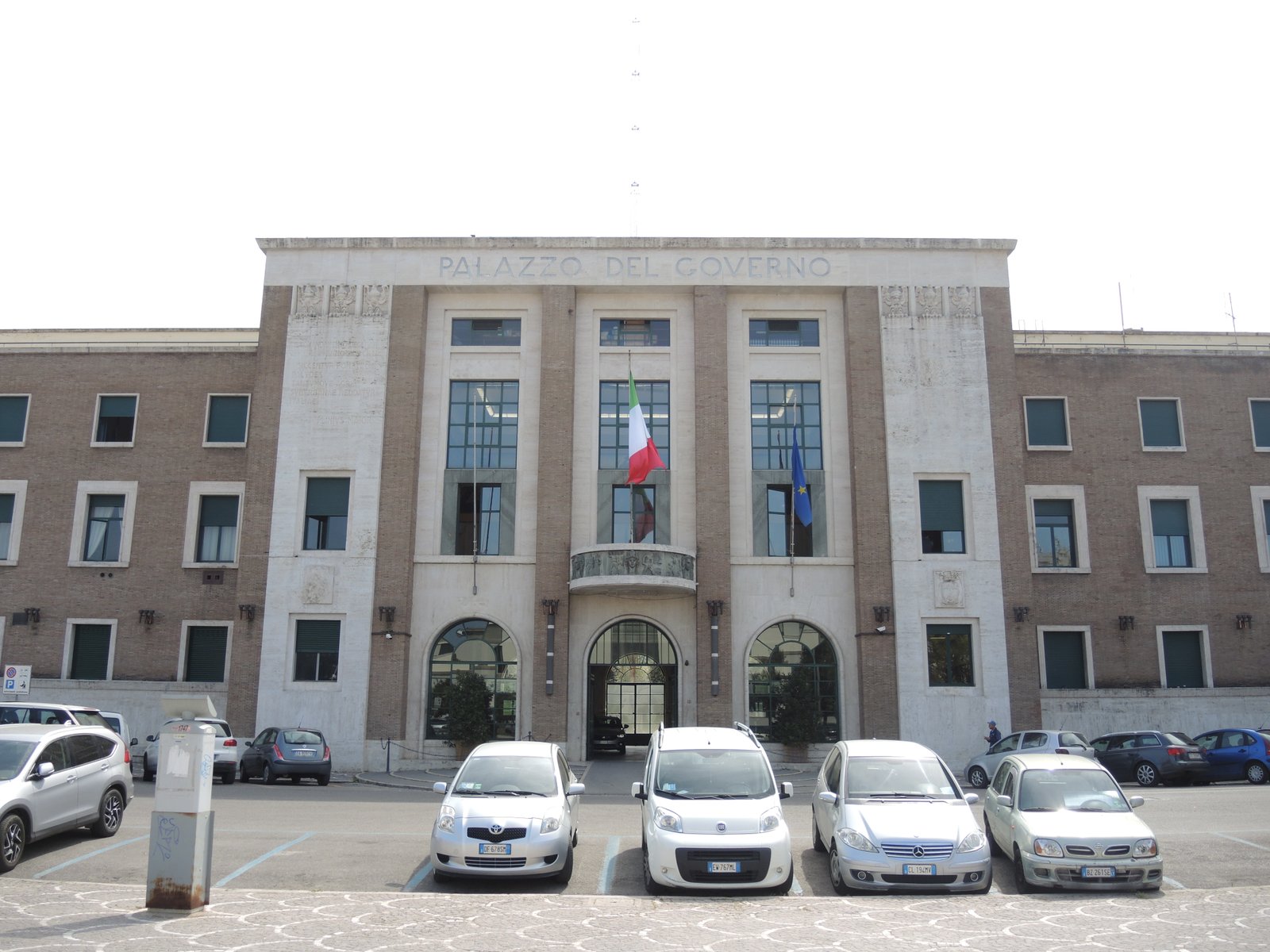
Built in 1932 as the administrative heart of brand-new Littoria, the Palazzo del Governo still anchors Piazza della Liberta with the sober monumentality Oriolo Frezzotti gave Italy’s most ambitious twentieth-century new town.
At a glance
The Palazzo del Governo — today the seat of the Prefettura of Latina — is one of the founding buildings of the city the Fascist regime carved from the reclaimed Pontine Marshes. The Opera Nazionale Combattenti commissioned Oriolo Frezzotti in 1931 to design the entire urban plan of Littoria, and this building was among the first stones laid when the cornerstone of the city was set on 30 June 1932. It faces Piazza della Liberta, the civic square Frezzotti placed at the centre of his radial scheme, and remains the institutional symbol of provincial power in southern Lazio.
Key facts
- Architect: Oriolo Frezzotti (Rome, 1888–1965)
- Date: 1932 (city foundation year)
- Style: Italian Rationalism, monumental civic strand
- Location: Piazza della Liberta (former Piazza XXIII Marzo), Latina
- Function: Seat of the Prefettura (formerly Palazzo del Governo)
- Commissioned by: Opera Nazionale Combattenti
History
Latina was founded as Littoria on 30 June 1932 on land drained from the malarial Pontine Marshes, the largest land-reclamation project of interwar Italy. The Opera Nazionale Combattenti, the state body that resettled war veterans on the new fields, entrusted Frezzotti with both the master plan and the principal public buildings. He had trained at the Accademia di Belle Arti in Rome and had collaborated with Florestano Di Fausto before taking on the commission that would define his career.
The Palazzo del Governo was conceived together with the adjoining Palazzo Comunale, the Cinema Teatro Aquila and the cathedral of San Marco — all delivered by Frezzotti between 1932 and 1933 — as a coordinated civic ensemble. The square in front, originally named Piazza XXIII Marzo after the date of the founding of the Fasci di Combattimento, was later rededicated as Piazza della Liberta after the Second World War. The building survived the war and the transition from Littoria to Latina (the city was renamed in 1946) without major alteration to its institutional role.
What you see
The Palazzo del Governo reads as a long, low block aligned with the geometry of the square, its volume broken at the centre by a taller vertical mass that lifts the entrance and signals the administrative function. Frezzotti opted for a stripped, simplified classical language — smooth rendered surfaces, regularly spaced rectangular windows, no historicist ornament — that is closer to the disciplined civic strand of Italian Rationalism than to the experimental Modernism of his contemporaries in Como or Milan.
The composition is deliberately calm. Horizontals dominate; the symmetry is strict; the cornice line runs unbroken. The vocabulary is the same Frezzotti used a year later for the cathedral and the Palazzo Comunale, giving Piazza della Liberta the visual unity that still distinguishes the centre of Latina from the surrounding sprawl.
Practical information
- External viewing only — the building is an active prefecture, interiors are not open to visitors
- Best light: late morning on the south-facing facade
- Time needed: 15–20 minutes for the full square (Palazzo del Governo + Palazzo Comunale + cathedral of San Marco)
- Photography: free from the public square
Getting there
Latina is roughly 70 km south of Rome on the SS148 Pontina. From Rome Termini, regional trains reach Latina Scalo station in about 40 minutes, from which local bus 2 or a 15-minute taxi covers the 8 km to Piazza della Liberta. Drivers will find paid parking on Viale Giulio Cesare and along the streets fanning off the square.
Nearby
- Palazzo Comunale — Frezzotti, 1932, the city hall closing the same square
- Cattedrale di San Marco — Frezzotti, 1933, the founding cathedral of Latina
- Palazzo M — Frezzotti, 1938, the M-shaped former Casa del Fascio
- Parco Nazionale del Circeo — 25 km south, dunes and primeval forest of the Pontine coast
Sources
- Wikipedia — Oriolo Frezzotti (architect biography, dates, Littoria commission)
- Wikipedia — Latina (Piazza della Liberta, Palazzo della Prefettura)
- Wikipedia — Latina, Lazio (city foundation, rationalist architecture)
- Wikimedia Commons (hero image, EXIF coordinates)
Find it on the map
See this place and what’s around it →Record researched and written by Stefano Vigolo for Cultural Heritage Online, 2026.

📷 Become a Cultural Heritage Online photographer
Share your photos of places: they stay published under your name as the author. The more they're seen, the more you get noticed — and soon a contest will reward the most appreciated photos.
Log in or sign up free to add a photoIs this page about you?
This page is read by travellers and heritage enthusiasts who find it on Google. Tell us how you are connected to this place and we will take it from there.