
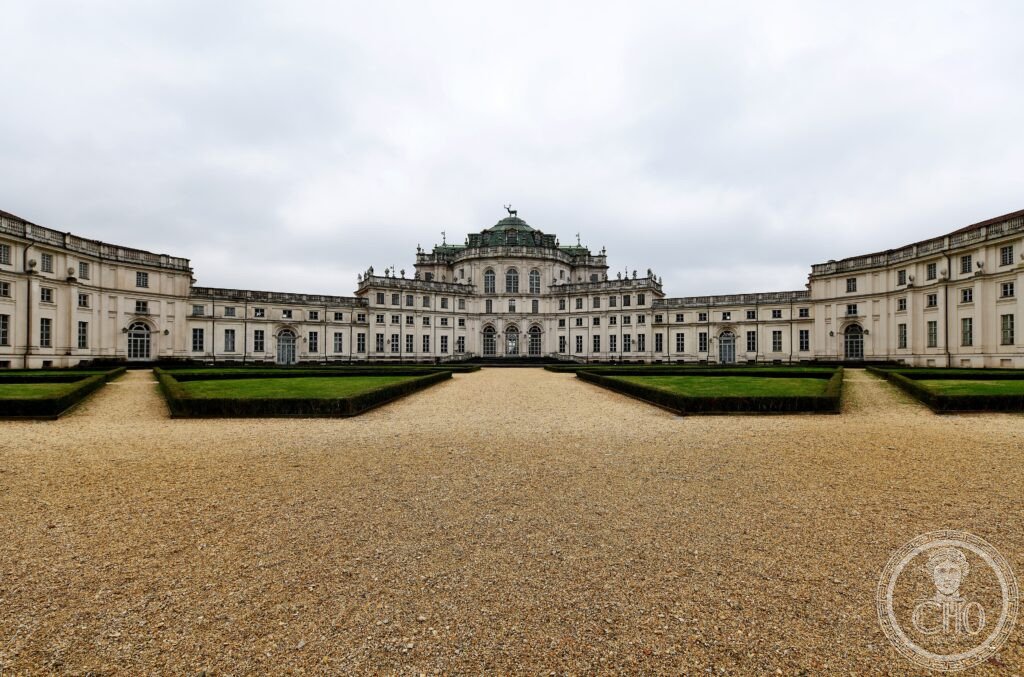
A hunting lodge built for a king, shaped like a cross of diagonal wings around an oval hall painted to dissolve into open sky. Juvarra’s Stupinigi mixes architectural bravado with the practical business of horses, kitchens and hounds, and still carries a gilded stag on its roof to prove it.
At a glance
The Palazzina di Caccia di Stupinigi stands outside Turin as one of the more unusual buildings of the Piedmontese baroque: a hunting lodge planned around a cruciform, X-shaped layout rather than the conventional courtyard or block. Four long wings radiate from a central oval hall at forty-five degrees, a plan Filippo Juvarra devised so that each wing looked straight out onto the surrounding hunting grounds and forest.
The wings were never purely decorative. One held the kitchens and stores, one the stables for the court’s horses, one the officers’ apartments, and one the coach houses, so the building worked as a functioning hunting estate as well as a royal showpiece.
Key facts
- Architect: Filippo Juvarra, commission given in December 1729
- Built: main structure 1729–1735, interior decoration continuing until 1780
- Central hall: the oval Sala Centrale, painted by Giovanni Battista Crosato in 1731–32
- Owner today: the Ordine Mauriziano
- Recognition: part of the serial UNESCO World Heritage inscription for the Residences of the Royal House of Savoy, listed in 1997
History
Vittorio Amedeo II, first King of Sardinia, commissioned Filippo Juvarra in 1729 to replace an older, more modest sixteenth-century hunting lodge at Stupinigi with something fit for the ceremonial needs of the royal court. Juvarra produced the X-shaped plan and the central oval salon in a matter of weeks, and construction of the main structure ran through to 1735 with a large workforce on site. He died in Madrid in January 1736, only months after leaving Stupinigi, and never saw the interior decoration finished; that work continued for decades afterwards.
The building later drew Napoleon Bonaparte, who used it as his headquarters for ten days in June 1800 after the Battle of Marengo, staying in the King’s Apartment in the south wing. He returned briefly in 1805 on his way to be crowned King of Italy in Milan. Stupinigi’s archives record that he admired the Savoy furniture enough to have several pieces sent to Paris, where they remain today at the Château de Fontainebleau. In 1997 the Palazzina was included, alongside other Savoy residences, in a serial UNESCO World Heritage inscription.
What you see
The visit centres on the Sala Centrale, the oval hall that forms the hinge of the whole cruciform plan. Its ceiling, painted by Crosato between 1731 and 1732, is a trompe l’oeil composition calculated to work from one specific viewpoint: standing on the marked rosette at the centre of the parquet floor and looking straight up, the painted tiers of sky and figures resolve correctly, as if the room opened onto the heavens above a painted balustrade. The hall is ringed with scagliola pilasters and painted lunettes showing hunting trophies.
Beyond the central hall, the south wing holds the royal apartments, including the rooms Napoleon used, furnished with eighteenth-century Piedmontese pieces that make up an important surviving collection of Savoy court furniture. The east wing houses the Museo dell’Arte e dell’Arredamento, a large permanent collection of furniture, objects and applied arts from the Savoy royal household, including original design drawings by Juvarra donated to the Ordine Mauriziano in 2018.
Outside, the roofline carries two emblematic sculptures: a gilded bronze stag on the attic of the main facade, the heraldic animal of both the Palazzina and the Savoy dynasty as hunters, and a gilded bronze figure of Fortune by Giovanni Tantardini, added in 1766, which turns with the wind on a rotating base.
Practical information
- Opening days: the Palazzina is closed on Tuesdays; check the Ordine Mauriziano’s official channels for current times
- Tickets and tours: combined tickets covering Stupinigi and the Reggia di Venaria are available; audio guides are offered in several languages
- Access: the main entrance sits on the north-south axis reached along a long tree-lined avenue
Getting there
Stupinigi lies in Nichelino, on the southern edge of the Turin metropolitan area, and is reached from the city by road, with the SS23 towards Pinerolo offering a clear frontal view of the facade and its roofline sculptures.
Nearby
- Turin — the nearby city, seat of the House of Savoy and home to further Savoy residences
- Reggia di Venaria — another Savoy residence, often visited on a combined ticket with Stupinigi
Sources
- Ordine Mauriziano
- UNESCO
Find it on the map
See this place and what’s around it →📷 Become a Cultural Heritage Online photographer
Share your photos of places: they stay published under your name as the author. The more they're seen, the more you get noticed — and soon a contest will reward the most appreciated photos.
Log in or sign up free to add a photoIs this page about you?
This page is read by travellers and heritage enthusiasts who find it on Google. Tell us how you are connected to this place and we will take it from there.