
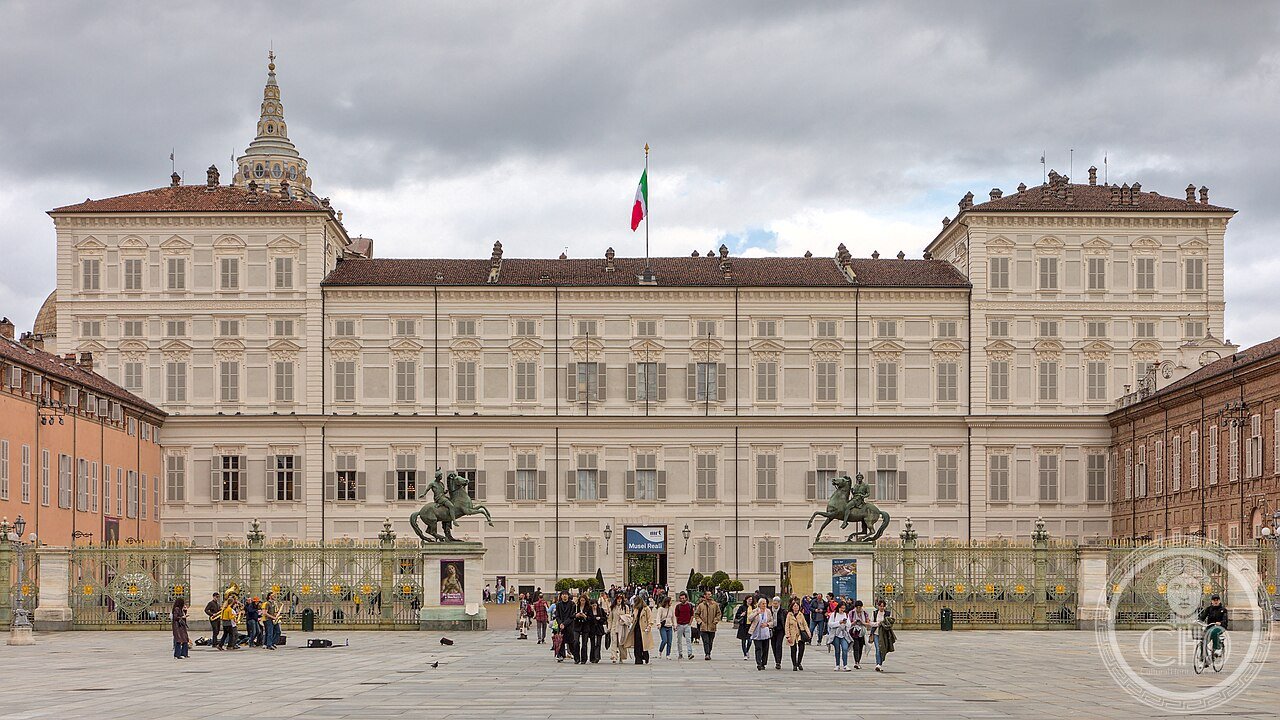
The Palazzo Reale was the seat of the House of Savoy and, briefly, of the newly unified Kingdom of Italy. Its royal apartments, Juvarra’s double-helix staircase, the Royal Armoury and Guarino Guarini’s extraordinary chapel dome make it one of the densest concentrations of Savoy history and Baroque engineering in Turin.
At a glance
The Palazzo Reale stands on Piazza Castello, the rectangular square laid out by Duke Emanuele Filiberto I in 1584 as Turin’s parade ground. The palace’s main block, seven storeys and 168 metres long, presents a facade designed by Amedeo di Castellamonte and Carlo Morello and built between 1646 and 1658, replacing an earlier medieval nucleus begun under Carlo di Castellamonte. At the main entrance stand two granite groups known as the Dioscuri, neoclassical sculptures of Castor and Pollux by Abbondio Sangiorgio dating from 1842, which have become emblems of the city; marble fountains by Gaetano Albertoni from 1793 flank the courtyard.
Attached to the palace is the Cappella della Sacra Sindone, designed by Guarino Guarini and built between 1668 and 1694, whose dome in dark stone from Frossasco is regarded as one of the most structurally daring achievements of Italian Baroque architecture.
Key facts
- Facade: designed by Amedeo di Castellamonte and Carlo Morello, built 1646–58, 168 metres long, seven storeys.
- Piazza Castello: laid out by Duke Emanuele Filiberto I in 1584, roughly 196 by 139 metres.
- Sacra Sindone Chapel: designed by Guarino Guarini, built 1668–94, completed after his death by Gian Francesco Re and Antonio Bertola.
- Dome: built in dark Frossasco stone with six rings of arches, each rotated 30 degrees from the one below, creating a spiralling hexagonal pattern.
- Royal Armoury: one of the largest collections of arms and armour in Europe, held in the Galleria Beaumont.
- Recognition: included in the UNESCO World Heritage List in 1997 as part of the serial site ‘Residences of the Royal House of Savoy’ (reference 823).
History
Turin became the permanent capital of the Duchy of Savoy in 1563, when Duke Emanuele Filiberto I moved the seat of government there from Chambéry following the Savoy-Spanish victory at the Battle of Saint-Quentin in 1557. He judged Turin easier to defend against French pressure and set in motion the radial street plan still visible in the city centre today.
The Palazzo Reale’s present facade was commissioned by Duke Carlo Emanuele II and built between 1646 and 1658 to designs by Amedeo di Castellamonte and Carlo Morello; the interior decoration continued through the rest of the seventeenth century and much of the eighteenth. Guarino Guarini’s chapel for the Holy Shroud was begun in 1668; Guarini died in 1683 before its completion, and the work was finished by his collaborators Gian Francesco Re and Antonio Bertola in 1694 under the patronage of Carlo Emanuele II.
Turin briefly served as the first capital of the unified Kingdom of Italy, and the Palazzo Reale was the residence of King Vittorio Emanuele II from the proclamation of the kingdom in March 1861 until the capital moved to Florence in February 1865. In the Salone degli Svizzeri the king formally received Garibaldi, who had surrendered command of his forces in southern Italy following their meeting at Teano in 1860. The palace and the wider group of Savoy residences were inscribed on the UNESCO World Heritage List in 1997.
The Sacra Sindone chapel suffered serious damage in a fire on the night of 11–12 April 1997, which broke out during restoration work and spread to the scaffolding around the dome. Firefighters reached the chapel through a window of the adjoining palace, and the Holy Shroud itself was rescued by a firefighter who broke open its glass case with a sledgehammer. The dome survived without collapsing; the chapel reopened only partially in 2018 and restoration of the dome was still under way as of 2026.
What you see
The visit takes in the piano nobile of the palace, with some thirty staterooms. The Guardia Svizzera room displays life-size portraits of the Savoy dukes and kings spanning from 1563 to 1946, and the Sala dei Paggi holds a set of eight Flemish tapestries woven in Bruges in the 1620s. The King’s and Queen’s apartments, each of twelve rooms, contain eighteenth-century Savoy furniture, including lacquered cabinets in the so-called lacca piemontese, a local variant of European chinoiserie painted in black and gold on a grey ground.
The Scala delle Forbici, designed by Filippo Juvarra in 1720, is a double-helix staircase whose two flights, one ascending and one descending, share the same outer walls without ever crossing; its ceiling was painted by Giovanni Battista Crosato around 1730.
The Cappella della Sacra Sindone occupies a position linking the palace to Turin Cathedral. Its dome, built entirely from dark stone quarried near Frossasco, rises through six rings of arches, each rotated thirty degrees from the ring beneath, producing a spiralling effect that draws the eye upward towards the central oculus and creates an illusion of far greater height than the structure actually has.
The Royal Armoury, housed in the Galleria Beaumont, a former palace gallery converted for the purpose in the eighteenth century, holds several thousand pieces, among them the armour worn by Duke Emanuele Filiberto at the Battle of Saint-Quentin in 1557, its black-lacquered steel breastplate considered one of the most significant surviving examples of sixteenth-century armour outside Germany. The collection also includes ceremonial armour made for Savoy princes as young children, worn when they were presented to foreign ambassadors to underline the dynasty’s military character.
Practical information
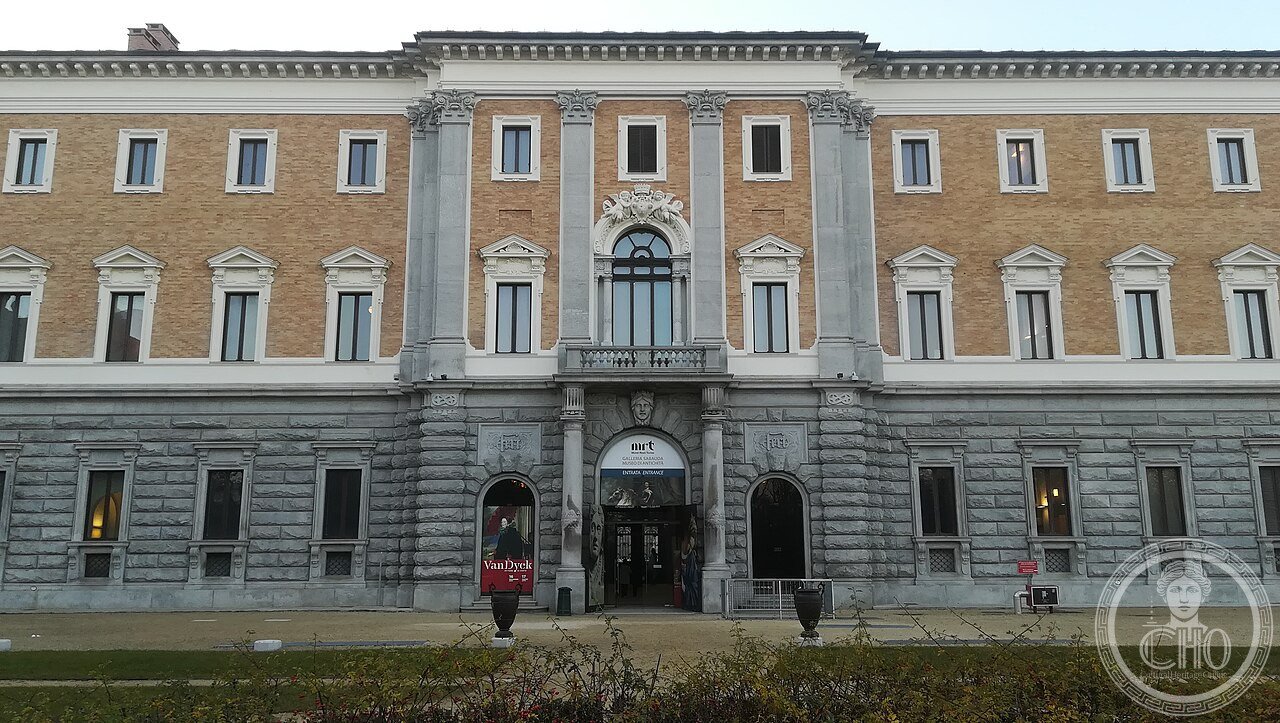
- Tickets: the Palazzo Reale is visited as part of the Musei Reali di Torino, a combined itinerary covering the royal apartments, the Armoury, the Galleria Sabauda and the Museum of Antiquities; check current admission arrangements on the official Musei Reali website.
- Visiting the chapel: the Sacra Sindone chapel reopened only partially after long restoration; visitors should confirm current access before travelling.
- Guided routes: an audio guide is available for the standard tour of the staterooms.
- Location: the entrance faces Piazza Castello, at the historic centre of Turin.
Getting there
The Palazzo Reale stands directly on Piazza Castello in the centre of Turin, within easy walking distance of the city’s main historic sights, and is well served by local public transport into the centre.
Nearby
- Turin Cathedral (Duomo di San Giovanni Battista) — adjoining the palace complex, linked directly to the Sacra Sindone chapel.
- Piazza Castello — the square on which the palace fronts, laid out in 1584 as the city’s parade ground.
- Galleria Sabauda — housed within the Musei Reali complex alongside the Palazzo Reale.
Sources
- UNESCO World Heritage List (reference 823, Residences of the Royal House of Savoy)
- Musei Reali di Torino
Gallery
Find it on the map
See this place and what’s around it →📷 Become a Cultural Heritage Online photographer
Share your photos of places: they stay published under your name as the author. The more they're seen, the more you get noticed — and soon a contest will reward the most appreciated photos.
Log in or sign up free to add a photoIs this page about you?
This page is read by travellers and heritage enthusiasts who find it on Google. Tell us how you are connected to this place and we will take it from there.