
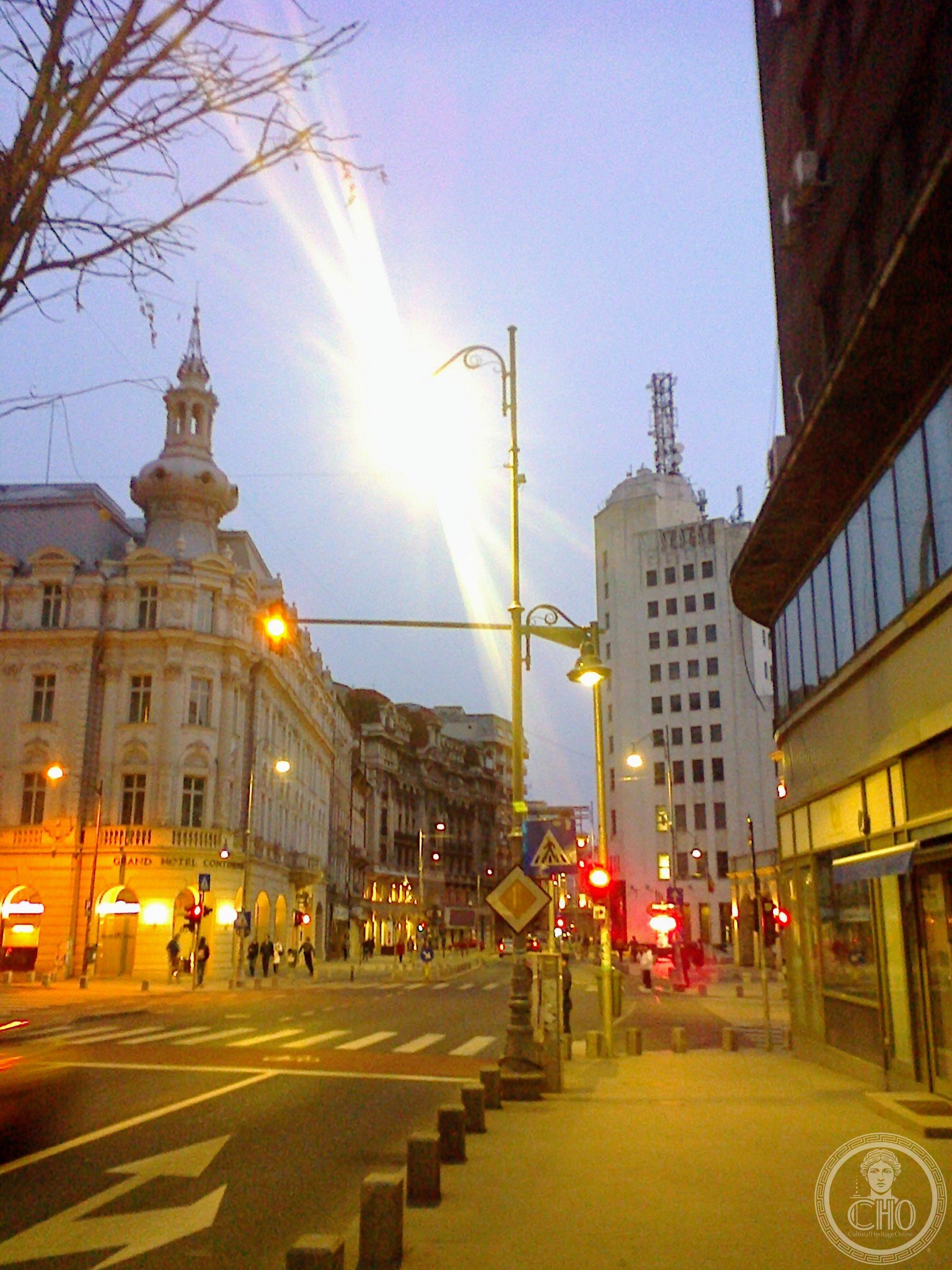
Palatul Telefoanelor—the Telephones Company Building—rises 52.5 metres above Calea Victoriei, Bucharest's grandest boulevard, as the Romanian capital's defining interwar Art Déco landmark. Designed by American architect Louis S. Weeks and Romanian-Dutch architect Edmond van Saanen Algi for the International Telephone and Telegraph Corporation (ITT), the building was constructed between 1931 and 1933 and inaugurated in 1934 in the presence of King Carol II. Until 1956 it was the tallest building in Bucharest at 52.5 metres. Its bold massing, vertical limestone pilasters and ornamental crown made it the first major modernist structure on Calea Victoriei and established Art Déco as the architectural language of interwar Bucharest's commercial ambitions.
At a glance
- Type
- Office building
- Period
- 1929–1934 (construction 1931–1933)
- Style
- Art Déco
- Location
- Calea Victoriei 37, Bucharest, Romania
- Coordinates
- 44.436° N, 26.098° E
- Architect(s)
- Louis S. Weeks; Edmond van Saanen Algi; Walter Froy
Overview
Standing at the heart of Calea Victoriei, Bucharest's most celebrated thoroughfare, Palatul Telefoanelor was commissioned by the Societatea Anomână Română de Telefoane (SART), a subsidiary of ITT formed following a Romanian government agreement with J.P. Morgan & Co. The American financial arrangement gave ITT a 20-year monopoly on Romanian telephony in exchange for the capital to modernise the national telephone network and construct the palace. The result was Bucharest's first and most prominent Art Déco skyscraper, visible along Calea Victoriei from blocks away and today owned by Telekom România.
History
The global economic crisis that began with the Wall Street Crash of 1929 prompted the Romanian government to seek American capital. The resulting ITT deal financed not only the telephone infrastructure but also the flagship palace on Calea Victoriei. Construction ran from 1931 to 1933, with the steel skeleton supplied by the Reşiţa steelworks. The building was inaugurated in 1934. It was subsequently extended both vertically and horizontally in 1940 and 1946, and survived the devastating 1977 Bucharest earthquake without collapse. The structure was added to the list of historic monuments of Romania, protecting its Art Déco exterior for future generations.
Architecture & Design
The design synthesises American skyscraper typology with Art Déco ornamentation, a combination characteristic of the ITT Corporation's prestige buildings across Europe and Latin America in the 1930s. The façade is clad in limestone, with strong vertical pilasters drawing the eye upward to a decorated cornice and ornamental crown. Setbacks and geometric detailing create the rhythmic vertical emphasis typical of Art Déco commercial architecture. The building was the first major modernist structure on Calea Victoriei, introducing an urban scale and aesthetic vocabulary that quickly became a model for interwar Bucharest's commercial centre.
Cultural significance
Palatul Telefoanelor is the defining symbol of Bucharest's interwar modernisation and its aspiration to join the cosmopolitan capitals of Europe. Inaugurated by a king and financed by American capital, it embodied Romania's ambition to transform Bucharest into 'the Paris of the East.' Today it is a listed historic monument and one of the most photographed Art Déco buildings in Southeast Europe. Its profile on Calea Victoriei anchors the stretch between Piaţa Victoriei and Piaţa Unirii that remains the most architecturally significant in Bucharest.
Visiting today
The building is occupied by Telekom România and functions primarily as an office tower; public access to the interior is limited. The exterior is freely accessible and the ground-floor street level offers excellent viewing of the Art Déco façade. The adjacent stretch of Calea Victoriei contains the National Museum of Art of Romania, the Creţulescu Palace and other significant historic buildings, making this one of Bucharest's most rewarding architectural walks.
Getting there
The nearest metro station is Piaţa Victoriei (M1/M3 lines) or Piaţa Unirii (M1/M2/M3), both a short walk along Calea Victoriei. Numerous bus and tram routes serve the boulevard. From Bucharest Henri Coandă International Airport, a taxi or rideshare takes approximately 30–45 minutes to the city centre depending on traffic.
Sources & resources
Find it on the map
See this place and what’s around it →Record researched and written by Luigi De Marchi for Cultural Heritage Online, 2026.
📷 Become a Cultural Heritage Online photographer
Share your photos of places: they stay published under your name as the author. The more they're seen, the more you get noticed — and soon a contest will reward the most appreciated photos.
Log in or sign up free to add a photoIs this page about you?
This page is read by travellers and heritage enthusiasts who find it on Google. Tell us how you are connected to this place and we will take it from there.