
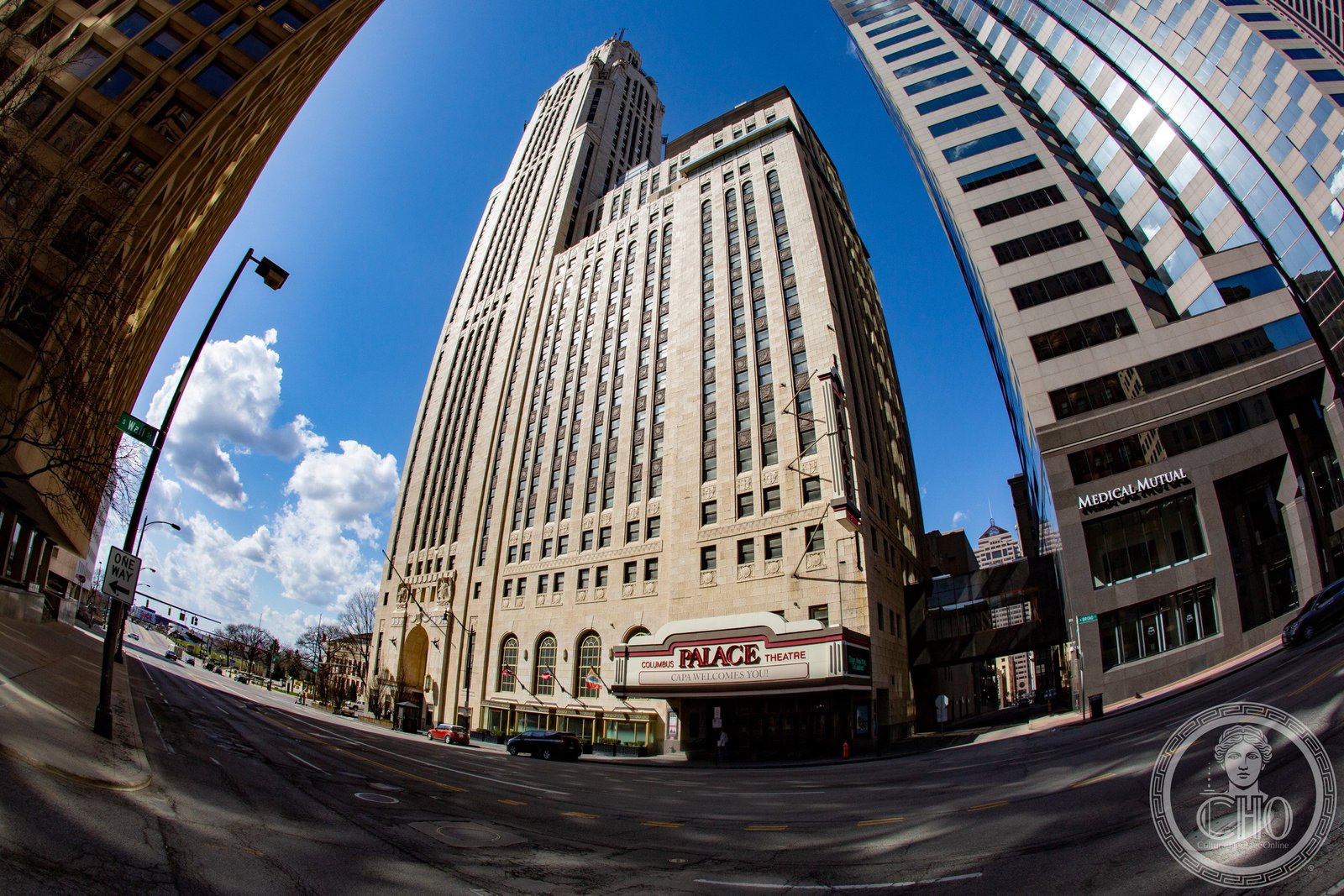
The Palace Theatre opened in 1926 on West Broad Street in Columbus as one of the most lavishly decorated picture palaces in Ohio, its Baroque Revival interior designed by Thomas Lamb offering one of the richest ornamental programs of the 1920s picture palace era, flanked by the LeVeque Tower — which would rise above the site the following year as one of the tallest buildings in Ohio.
At a glance
The Palace Theatre in Columbus was designed by Thomas Lamb, the Scottish-born architect who designed more picture palaces than any other architect of the 1920s. Lamb’s practice was prolific across the United States and Canada, and his work ranged from modest neighborhood theaters to the most ambitious downtown palaces; the Columbus Palace belongs to the upper tier of his work. The theater shares its site with the LeVeque Tower — an Art Deco skyscraper built in 1927 that rises beside the theater at the corner of Broad and High Streets — creating a paired composition that anchors the western approach to Columbus’s downtown.
Key facts
- Address: 34 West Broad Street, Columbus, OH 43215
- Opened: 1926
- Architect: Thomas Lamb (1871–1942)
- Style: Baroque Revival / Picture Palace
- Listed: National Register of Historic Places
- Seating: Approximately 2,800 seats
- Current operator: CAPA (Columbus Association for the Performing Arts)
History
Thomas Lamb came to the United States from Scotland and built a practice in New York City before expanding to commissions across the country. His prolific output — encompassing hundreds of theaters over a career spanning from the early silent film era to the sound era — made him the defining figure of picture palace architecture in North America. Lamb’s work ranged stylistically from Louis XIV Baroque to Moorish to Adamesque Neoclassical, adapting to client preferences while maintaining a consistent level of ornamental detail that his competitors rarely matched.
The Columbus Palace was designed during the peak years of picture palace construction, when the major theater circuits — Loew’s, Balaban & Katz, RKO — were investing heavily in urban flagship theaters that would carry the visual identity of their brands. The Palace was built for the B. F. Keith circuit, one of the principal vaudeville and film chains of the era. Its Baroque Revival interior — with gilded plasterwork, painted ceiling panels, crystal chandeliers, and the theatrical layering of ornament that characterized Lamb’s grandest work — represented the standard of luxury that circuit theaters aimed for in the 1920s.
The Palace survived the decline of the picture palace era and was eventually taken over by CAPA (Columbus Association for the Performing Arts), the nonprofit that also operates the Ohio Theatre, the Southern, and other historic Columbus venues. CAPA’s restoration returned the Palace to use as a venue for Broadway touring productions and major entertainment events in downtown Columbus.
What you see
The Palace Theatre’s West Broad Street facade is framed by the LeVeque Tower rising to its right — a 47-story Art Deco skyscraper completed in 1927 whose Gothic crown is the signature of the Columbus skyline. The visual relationship between the low horizontal mass of the theater and the vertical thrust of the tower creates one of the more distinctive urban compositions in Ohio, the two buildings working together as a single architectural event on Broad Street.
The auditorium interior is Thomas Lamb’s Baroque vocabulary at full intensity: gilded surfaces, painted ceiling panels in the grand tradition of Baroque ceiling decoration, ornamental plasterwork covering the walls and balcony faces, and the overall effect of theatrical richness that Lamb achieved through the accumulation of detail. The Palace’s interior is one of the more complete surviving examples of Lamb’s American Baroque work, preserved through CAPA’s ongoing stewardship.
Practical information
- Access: 34 West Broad Street at High Street, downtown Columbus
- Transit: COTA bus serves Broad Street and High Street; Columbus Convention Center and downtown hotels within walking distance
- Hours: Open for scheduled performances; check CAPA website for current programming
- Best for: Thomas Lamb Baroque Revival theater architecture, Ohio picture palace heritage, Columbus downtown exploration
- Tip: The Ohio Theatre (1928, also by CAPA) at 39 East State Street, one block north at High and State, is the companion landmark of the Columbus palace theater district; both are worth visiting on the same trip
Getting there
The Palace is at Broad and High Streets in the heart of downtown Columbus, the intersection of the two main axes of the city’s grid. John Glenn Columbus International Airport (CMH) is approximately 15 miles east via I-670. Amtrak’s Cardinal line serves Columbus (limited frequency, three days per week). By car, I-70 and I-71 provide access from east-west and north-south respectively, converging just south of downtown. The Ohio Statehouse is one block west of the theater on Broad Street.
Nearby
- LeVeque Tower (1927) — the 47-story Art Deco skyscraper immediately adjacent, now converted to residential use, whose Gothic crown dominates the Columbus skyline — one of the finest Art Deco towers in the Midwest
- Ohio Statehouse — one block west, the 1861 Greek Revival state capitol building set in a large square park, a National Historic Landmark and one of the most significant antebellum public buildings in the Great Lakes region
- Columbus Museum of Art — on East Broad Street east of the theater, with a strong collection of American and European modern art and a dedicated Wonder Gallery for creative exploration
- Short North Arts District — 10 minutes walk north on High Street, a mile-long stretch of galleries, restaurants, and boutiques that makes Columbus one of the more culturally active mid-size American cities
Sources
- National Register of Historic Places — Palace Theatre, Columbus, Ohio
- CAPA (Columbus Association for the Performing Arts) — official history and programming
- Hall, Ben M. The Best Remaining Seats — reference for Thomas Lamb picture palace architecture
Find it on the map
See this place and what’s around it →Record researched and written by Luigi De Marchi for Cultural Heritage Online, 2026.
📷 Become a Cultural Heritage Online photographer
Share your photos of places: they stay published under your name as the author. The more they're seen, the more you get noticed — and soon a contest will reward the most appreciated photos.
Log in or sign up free to add a photoIs this page about you?
This page is read by travellers and heritage enthusiasts who find it on Google. Tell us how you are connected to this place and we will take it from there.