
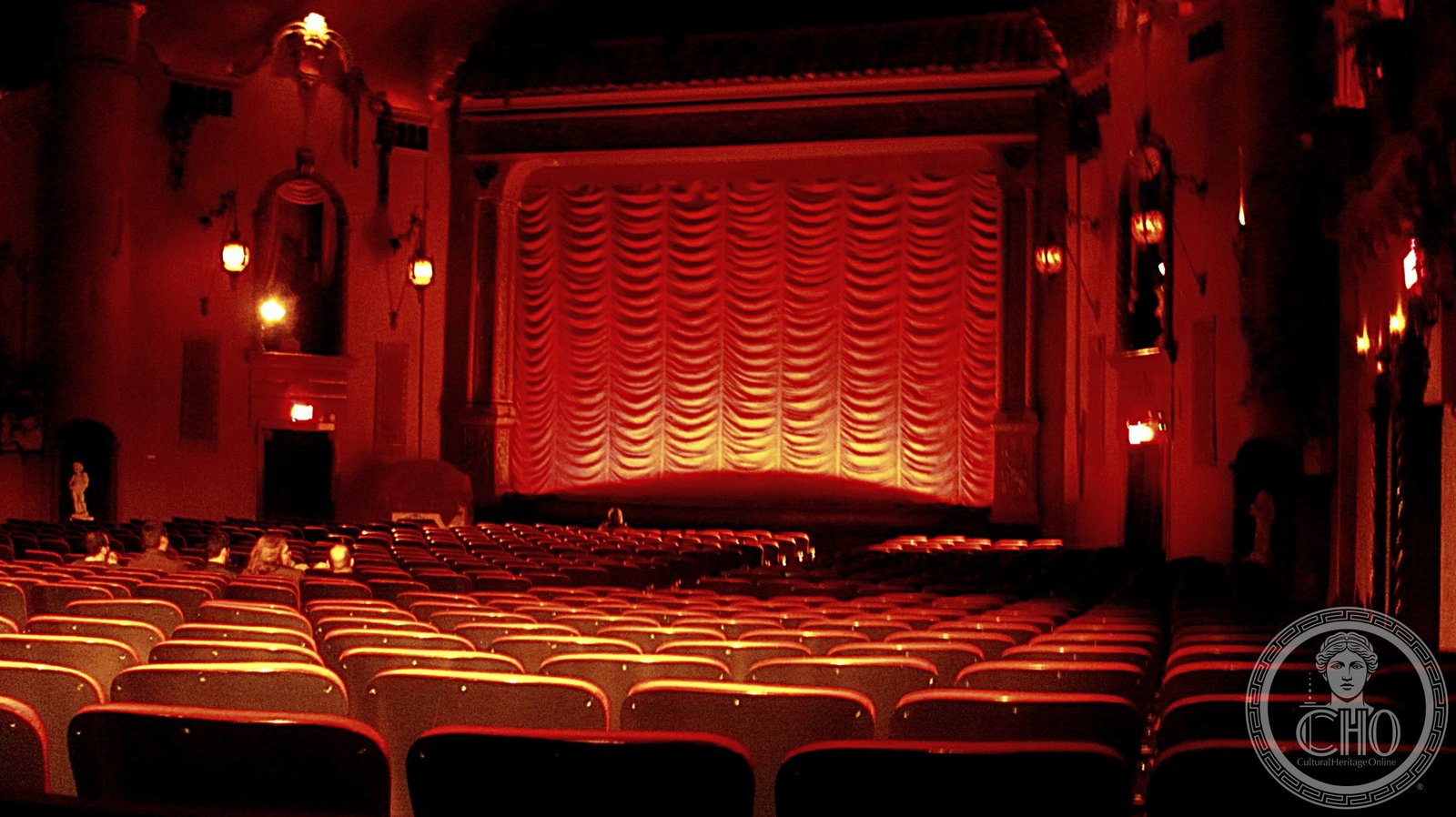
The Music Box Theatre has operated continuously as an independent movie theater in Chicago’s Wrigleyville neighborhood since 1929, its intimate atmospheric interior — a plaster Italian courtyard beneath a twinkling artificial sky — surviving where hundreds of similar theaters across the country were demolished or converted, making it one of the last atmospheric theaters in Chicago in original operation.
At a glance
The Music Box opened in 1929 on North Southport Avenue in the Lakeview neighborhood, within walking distance of Wrigley Field — the famous Cubs ballpark that gives the surrounding neighborhood its informal name. Designed in the atmospheric style popularized by John Eberson, the Music Box features a small auditorium that creates the illusion of an Italian courtyard, with plaster architecture, sculptural figures in niches, and a ceiling that projects moving stars and drifting clouds. The theater’s survival as an independent cinema makes it one of the culturally significant small music and film venues in Chicago, known for its programming of independent, foreign, and documentary films.
Key facts
- Address: 3733 North Southport Avenue, Chicago, IL 60613
- Opened: 1929
- Style: Atmospheric (Italian courtyard interior)
- Listed: National Register of Historic Places; Chicago Landmark
- Current programming: Independent, foreign, documentary, and classic films; special events
History
The Music Box opened in 1929, the same year the atmospheric theater genre was at its commercial peak and just months before the Wall Street Crash of October 1929 would end the era of speculative theater construction. The atmospheric theaters of the 1920s — interiors designed to make audiences feel transported to outdoor settings in Mediterranean or Middle Eastern countries — were the most ambitious and expensive of the picture palace genres, and their survival rate has been low. Of the many atmospheric theaters that opened in the Chicago area during the 1920s, the Music Box is among the few remaining in anything like original condition.
The Lakeview neighborhood on Chicago’s North Side developed in the late nineteenth century as an independent village before annexation to Chicago in 1889. Southport Avenue was the commercial main street of the neighborhood’s western section, and the Music Box was built to serve the residential population of this dense urban district. Wrigley Field, which opened in 1914 as Weeghman Park and became Cubs Park before taking its current name in 1926, had by 1929 given the area around Addison Street its characteristic identity as a sports and entertainment district.
The Music Box has operated under successive ownership while maintaining its character as an independent art cinema, resisting the conversion to mainstream multiplex programming that ended most neighborhood theaters’ lives as single-screen houses. Its programming of independent, foreign, and revival films has made it a cultural institution for Chicago’s film community, and its atmospheric interior has been preserved as a complement to that programming identity.
What you see
The Music Box’s Southport Avenue facade is a modest composition compared to the great downtown picture palaces: a brick and terra cotta street front with a marquee announcing current programming, distinguished by the architectural detail of its upper stories and the neon signage that marks the building in the Southport Avenue streetscape. The building’s scale reflects its function as a neighborhood cinema rather than a regional destination.
The auditorium interior is the experience the Music Box exists for. The Italian courtyard atmosphere — plaster walls articulated with arches, niches containing sculptural figures, trompe-l’oeil balconies suggesting the upper floors of a Renaissance palazzo — creates an enclosure that is simultaneously intimate and theatrical. The star projector still fills the ceiling with drifting clouds and moving stars during screenings, maintaining one of the signature atmospheric effects intact nearly a century after the theater’s opening. The Music Box is a small theater; every seat is close to the screen, and the atmosphere is one of attention rather than spectacle.
Practical information
- Access: 3733 North Southport Avenue at Wayne Avenue, Lakeview/Wrigleyville
- Transit: CTA Brown Line: Southport station (on Southport Ave, 5 minutes walk north)
- Hours: Daily screenings; check the Music Box Theatre website for current programming and showtimes
- Best for: Atmospheric theater heritage, independent cinema culture, Wrigleyville neighborhood exploration
- Tip: The Music Box hosts an annual 24-hour horror film marathon (Music Box of Horrors, late October) that has become a beloved Chicago tradition; the atmospheric interior is particularly effective for late-night programming
Getting there
The Music Box is on North Southport Avenue in Chicago’s Lakeview neighborhood, accessible via CTA Brown Line to Southport Station (approximately 5 minutes walk south along Southport Avenue) or CTA Red Line to Addison Station (approximately 10 minutes walk west along Addison Street to Southport). O’Hare International Airport (ORD) is approximately 30 minutes northwest via CTA Blue Line; Midway International Airport (MDW) is approximately 40 minutes south. From Wrigley Field, the Music Box is approximately 6 blocks south on Southport Avenue.
Nearby
- Wrigley Field — 6 blocks north, the 1914 baseball stadium and home of the Chicago Cubs, one of the most beloved sports venues in the United States and a storied historic landmark
- Southport Corridor — the commercial strip along North Southport Avenue from Belmont to Irving Park, with an unusual concentration of independent restaurants, boutiques, and entertainment venues
- Chicago History Museum — in Lincoln Park, 15 minutes walk east, with collections spanning the Great Fire, the 1893 World’s Fair, and Chicago’s architectural history
- Peggy Notebaert Nature Museum — also in Lincoln Park, a natural history museum with a nationally recognized butterfly house
Sources
- National Register of Historic Places — Music Box Theatre, Chicago, Illinois
- Commission on Chicago Landmarks — Music Box Theatre designation
- Music Box Theatre — official history and programming
Find it on the map
See this place and what’s around it →Record researched and written by Luigi De Marchi for Cultural Heritage Online, 2026.
📷 Become a Cultural Heritage Online photographer
Share your photos of places: they stay published under your name as the author. The more they're seen, the more you get noticed — and soon a contest will reward the most appreciated photos.
Log in or sign up free to add a photoIs this page about you?
This page is read by travellers and heritage enthusiasts who find it on Google. Tell us how you are connected to this place and we will take it from there.