
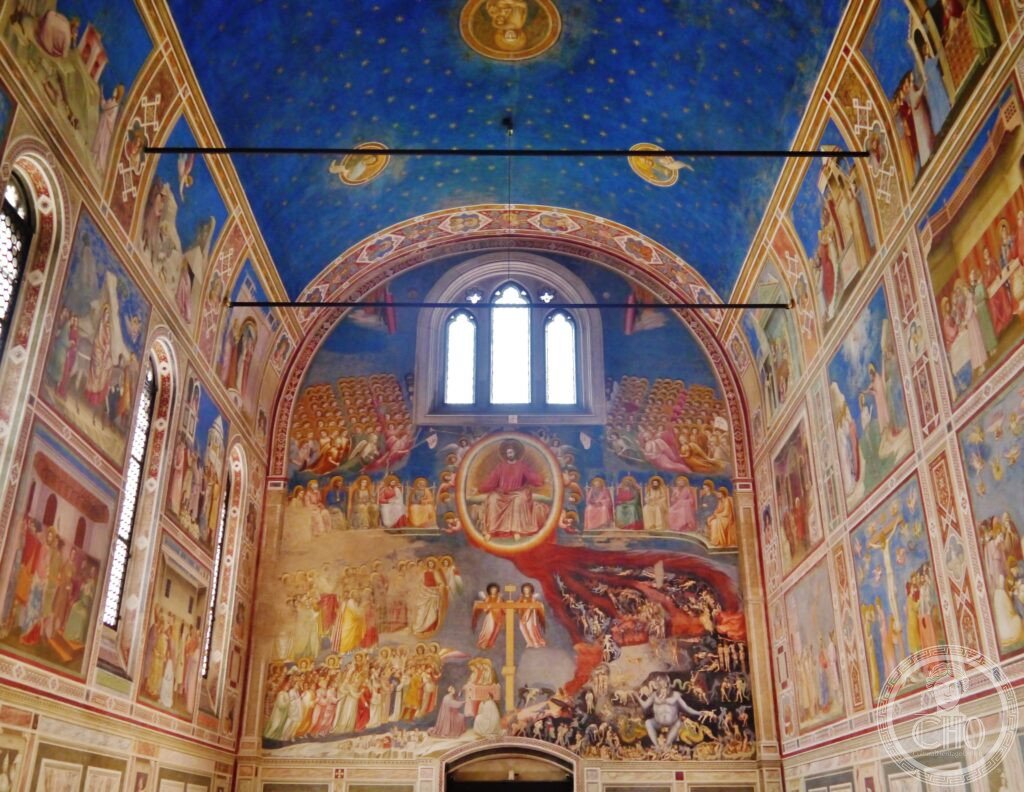
The Cappella degli Scrovegni holds the most complete surviving fresco cycle by Giotto, painted for a Paduan banker seeking to atone for his father’s sins. It forms part of a wider group of fourteenth-century painted cycles across the city, recognised together by UNESCO in 2021.
At a glance
The Cappella degli Scrovegni in Padua contains Giotto’s most complete fresco cycle, painted in the early fourteenth century inside a single chapel built over the ruins of the city’s Roman arena. It is the best known of eight Trecento fresco cycles in Padua that were inscribed together on the UNESCO World Heritage List in 2021.
The other cycles named alongside it include the Baptistery of the Cathedral, the Palazzo della Ragione, the Oratorio di San Giorgio, the Oratorio di San Michele, the Basilica di Sant’Antonio and the surviving basement paintings of the Reggia Carrarese, together with the remains of the Roman arena itself.
Key facts
- The chapel: a single hall measuring 25.7 by 8.4 metres, 12.8 metres high, entirely covered in fresco.
- The painted surface: around 880 square metres across three registers and a starry vault, telling 39 episodes from the lives of Christ and the Virgin.
- The Last Judgement: the west wall scene, roughly 10 by 8.4 metres, is the largest single fresco Giotto painted.
- The blue pigment: analysis by the Getty Conservation Institute in 2001 confirmed around 154 kilograms of lapis lazuli were used for the blue throughout the cycle.
- UNESCO listing: inscribed in 2021 as part of a group of eight fourteenth-century fresco cycles across Padua.
History
Enrico Scrovegni bought the site of Padua’s Roman arena in 1300 and began building the chapel the following year. His father Reginaldo had been named by Dante among the usurers of the seventh circle of Hell in the Divina Commedia, and in his own will of 1303 Enrico stated that the chapel was built for the remission of his father’s sins. Giotto di Bondone painted the frescoes between 1302 and 1304, and the chapel was consecrated on 25 March 1305, the feast of the Annunciation, to which it is dedicated.
Between 1998 and 2001 the Getty Conservation Institute worked with Padua’s Musei Civici on a conservation campaign to stabilise the frescoes after salt crystallisation was found to be damaging the plaster. A climate-controlled antechamber was added to the facade in 2001 as part of the new conservation approach.
In 2021 UNESCO inscribed the Scrovegni cycle together with seven other fourteenth-century fresco cycles in Padua on the World Heritage List.
What you see
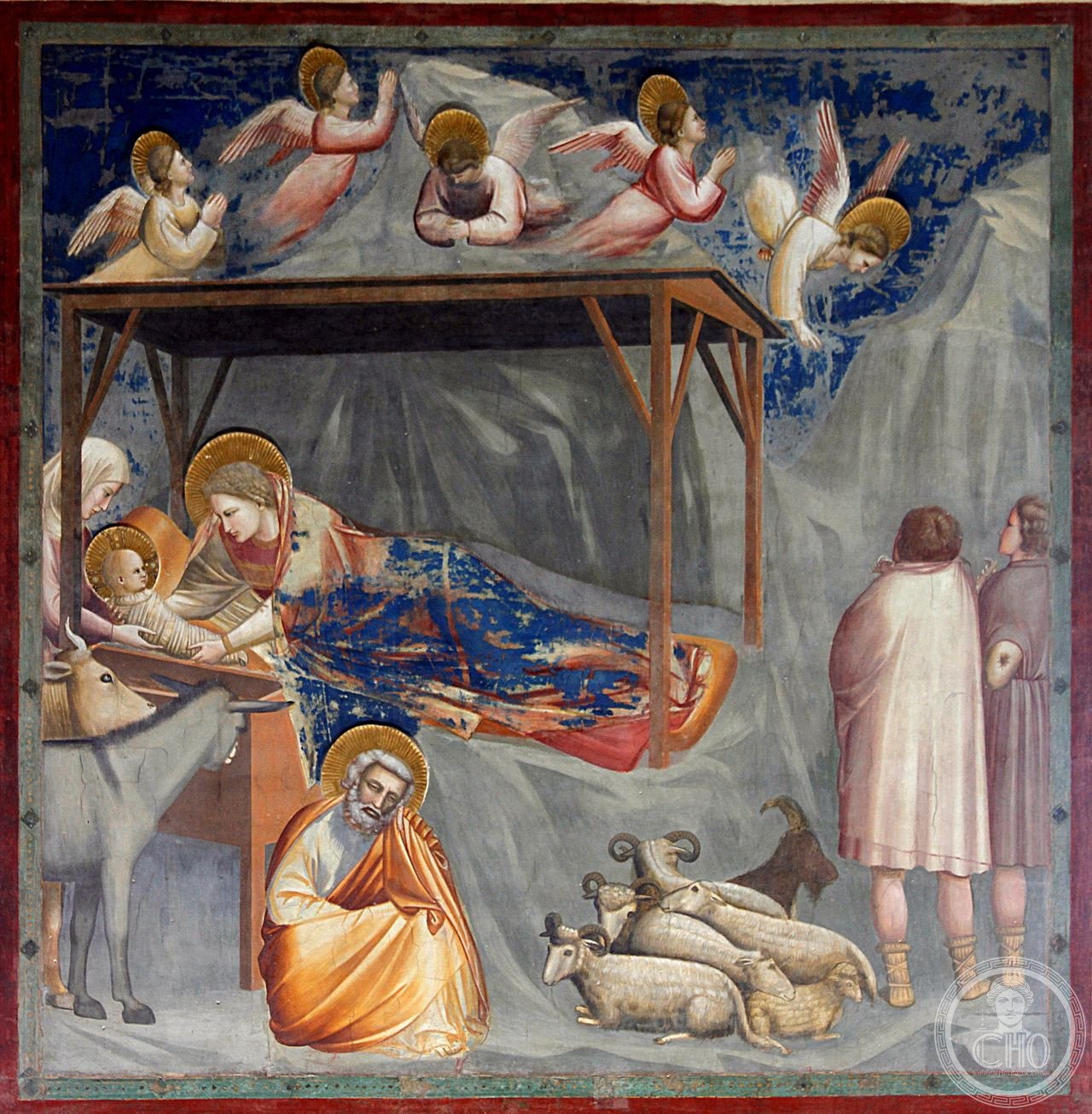
Visitors pass through a climate-controlled antechamber, where a short introductory video plays while the air equalises, before entering the chapel itself for a brief, strictly timed viewing. The narrative runs around the walls: the north wall tells the life of Mary, including the meeting of Anna and Joachim at the Golden Gate, one of the earliest tender embraces in European painting, and a Nativity scene in which the ox and ass breathe warmly over the crib. The south wall carries the Passion sequence, culminating in the Betrayal of Christ, where Judas’s yellow mantle wraps around Christ’s blue one so the two figures seem to merge, while the soldiers’ lances fan out above them in a scene often described as one of the first psychologically charged compositions in European art.
A short walk away, the Baptistery of the Cathedral holds a densely painted dome by Giusto de’ Menabuoi, completed some seventy years after Giotto’s work. The Palazzo della Ragione, Padua’s medieval civic hall, is frescoed with an astronomical cycle across what is described as the largest undivided medieval hall in Europe.
Practical information
- Booking: entry to the Scrovegni Chapel is by advance reservation only; current availability, opening times and any seasonal evening slots should be checked on the chapel’s official website.
- Visit format: visitors first spend time in a climate-controlled antechamber before entering the chapel itself for a short, closely timed viewing.
- Combining sights: the Baptistery is close by and can be visited with a combined Musei Civici ticket; the Palazzo della Ragione and the other Trecento fresco sites are within walking distance in the city centre.
Getting there
Padua is well served by train, including services from Venice via Mestre, and the Scrovegni Chapel stands in the centre of the city at Piazza Eremitani, within walking distance of the main station.
Nearby
- Battistero del Duomo — a short walk from the chapel; its dome carries a fresco cycle by Giusto de’ Menabuoi.
- Palazzo della Ragione — in the city centre; the civic hall with its frescoed astronomical calendar.
- Oratorio di San Giorgio — decorated by Altichiero da Verona a generation after Giotto’s Scrovegni cycle.
- Basilica di Sant’Antonio — further Trecento fresco decoration alongside the monument to the Gattamelata.
Sources
- Getty Conservation Institute
- Padua Musei Civici
- UNESCO World Heritage List
- Dante Alighieri, Divina Commedia (Inferno XVII)
- Cappella degli Scrovegni (official site)
Gallery
Find it on the map
See this place and what’s around it →📷 Become a Cultural Heritage Online photographer
Share your photos of places: they stay published under your name as the author. The more they're seen, the more you get noticed — and soon a contest will reward the most appreciated photos.
Log in or sign up free to add a photoIs this page about you?
This page is read by travellers and heritage enthusiasts who find it on Google. Tell us how you are connected to this place and we will take it from there.