
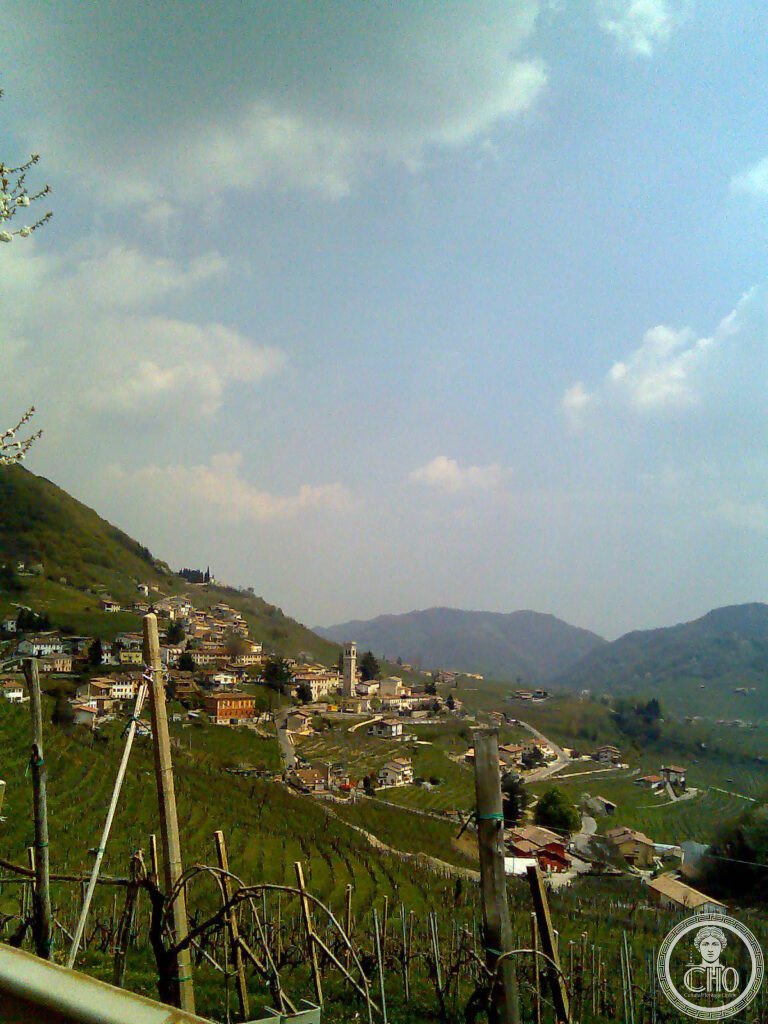
A landscape of steep, hand-tended vine terraces between Conegliano and Valdobbiadene, where the Glera grape becomes Prosecco Superiore DOCG. At its heart lies the small Cartizze sub-zone, long regarded as the finest expression of the wine.
At a glance
The hills between Conegliano and Valdobbiadene form a landscape of morainic ridges left by the last glaciation, carved into narrow terraces known locally as ciglionata. Vines and patches of woodland follow the contour lines across slopes that in many places are too steep for machinery, so grapes are still picked by hand on a significant share of the Prosecco Superiore vineyards.
The area corresponds to the Conegliano Valdobbiadene Prosecco Superiore DOCG, Italy’s highest wine classification, spread across seventeen communes. Within it lies the much smaller Cartizze sub-zone, often called the grand cru of Prosecco, prized for a microclimate that slows grape ripening compared with the surrounding valley.
Key facts
- Location: hills between Conegliano and Valdobbiadene, province of Treviso, Veneto
- Classification: Conegliano Valdobbiadene Prosecco Superiore DOCG, established 2009, building on a DOC dating to 1969
- Extent: around 8,931 hectares of vineyard across seventeen communes
- Grape variety: Glera, formerly itself known as Prosecco before the name was reserved for the wine in 2009
- Cartizze sub-zone: around 107 hectares between San Pietro di Barbozza and Santo Stefano, within the comune of Valdobbiadene
- Terracing: the ciglionata system, following the natural contours of morainic hills between roughly 100 and 500 metres
History
The earliest written reference to Prosecco wine from these hills appears in Aureliano Acanti’s 1754 description of the Agordino area. By the late eighteenth century the wine was already being traded through the port of Trieste, with customs records from 1798 noting barrels of Prosecco shipped from Valdobbiadene.
Conegliano became a centre for wine science with the founding of its enological school in 1876 under Giovanni Battista Cerletti, the oldest institution of its kind in Italy. It was here, between the 1890s and the early twentieth century, that Antonio Carpenè and Federico Martinotti developed the pressurised tank method for secondary fermentation that gives Prosecco its characteristic sparkle, a technique later patented independently in France by Eugène Charmat and still known today as the Charmat or Martinotti method.
In 1966 the area established the Strada del Prosecco, the first dedicated wine road in Italy, well before similar routes were created in South Tyrol and Tuscany. The hills were inscribed as a UNESCO World Heritage Site in 2019, reference 1571.
What you see
The Strada del Prosecco runs for around 40 kilometres between Conegliano and Valdobbiadene, passing through villages including Col San Martino, Farra di Soligo, Santo Stefano di Valdobbiadene and San Pietro di Barbozza, the last of these bordering the Cartizze sub-zone. The route gives a continuous view of terraced vineyards rising and falling with the morainic ridges.
The Cartizze sub-zone itself is a compact rectangle of vineyard reached from Valdobbiadene along the SR635. A public overlook known as the Belvedere del Cartizze gives a view down over the vineyards from around 220 metres. A handful of producers have cellars directly within the sub-zone and offer tastings, among them Silvano Follador and Bortolin Angelo, while the Enoteca Regionale in Valdobbiadene offers a wider introduction to the wines of the area.
Practical information
- Best way to explore: by car or bicycle along the Strada del Prosecco, which links the main villages and vineyard viewpoints
- Tastings: several wineries within the Cartizze sub-zone and in Valdobbiadene town offer tastings; some ask for advance booking, so check directly with individual producers
- Terrain: many vineyard paths follow steep slopes; sturdy footwear is advisable away from the main road
- Information point: the Enoteca Regionale di Valdobbiadene provides guidance on producers and routes
Getting there
Valdobbiadene lies in the province of Treviso in the Veneto region, roughly 40 kilometres from Conegliano along the SS13 and SP15 roads, which together form the Strada del Prosecco. The area is best reached by car, though check current transport options through local or regional tourism offices.
Nearby
- Conegliano — western end of the Strada del Prosecco, home to Italy’s oldest wine school
- Cartizze sub-zone — within Valdobbiadene, the smallest and most prized part of the DOCG
- Belvedere del Cartizze — a public viewpoint over the Cartizze vineyards near Santo Stefano di Valdobbiadene
- Santo Stefano di Valdobbiadene — village along the wine road adjoining the Cartizze area
Sources
- UNESCO
- Istituto Enologico di Conegliano
- Enoteca Regionale di Valdobbiadene
Find it on the map
See this place and what’s around it →📷 Become a Cultural Heritage Online photographer
Share your photos of places: they stay published under your name as the author. The more they're seen, the more you get noticed — and soon a contest will reward the most appreciated photos.
Log in or sign up free to add a photo