
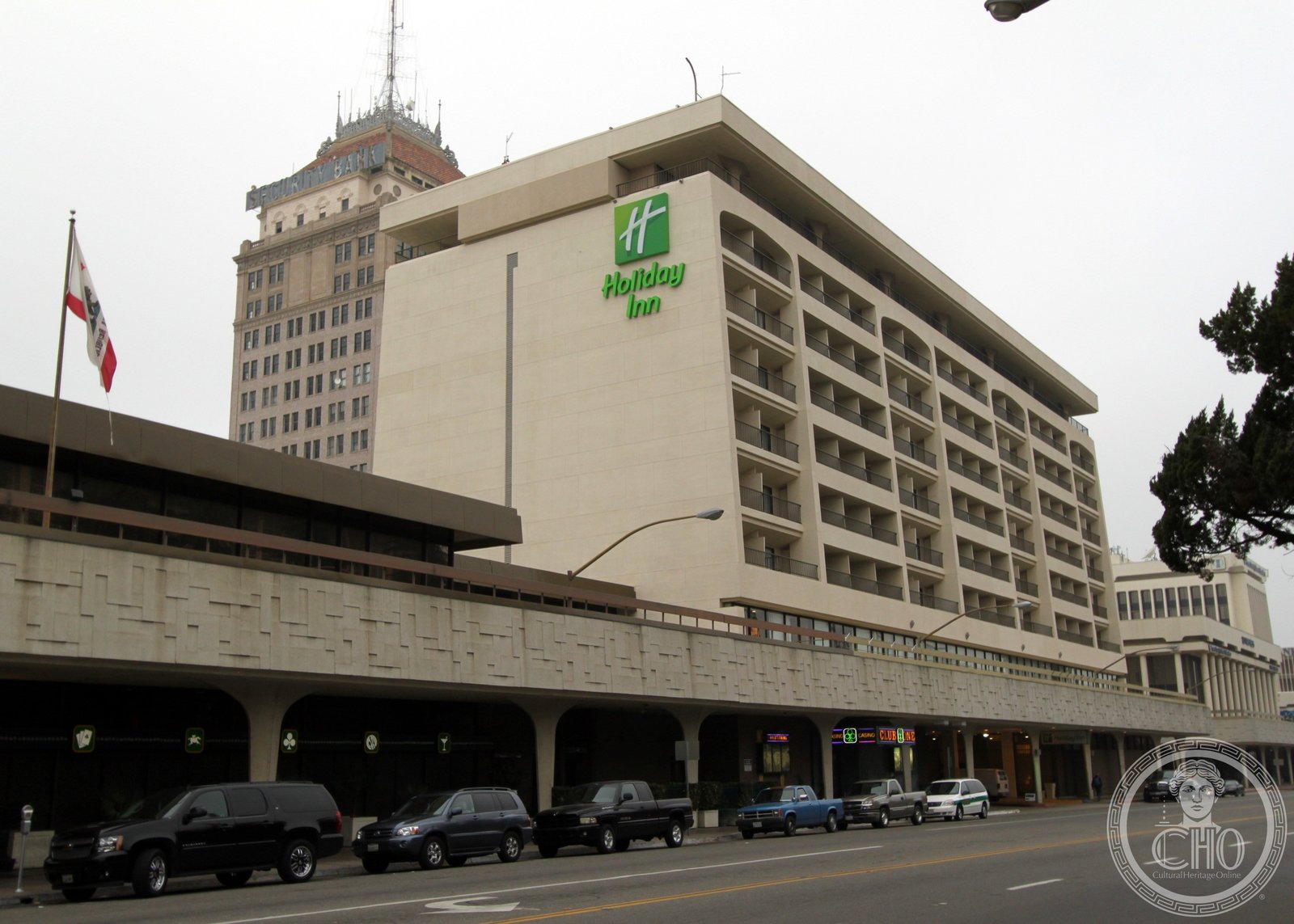
Fresno’s most prominent pre-war commercial tower, a mixed-use skyscraper in an Art Deco register that anchors the historic Fulton Mall and documents the Central Valley city’s commercial ambitions in the 1920s.
At a glance
The Pacific Southwest Building rose on the Fulton Street commercial corridor in the late 1920s as Fresno was growing from an agricultural market town into the dominant city of California’s Central Valley. Its twelve-story profile made it the tallest building in downtown Fresno upon completion and it remained a reference point in the skyline for several decades. The building combined offices with banking facilities, serving the regional economy of growers, processors, and the financial institutions that underwrote them. In 1964 the block became part of the Fulton Mall, an early pedestrianization experiment that transformed Fresno’s main retail street into a car-free promenade; the building has been a fixture of that pedestrian corridor ever since, adapting its ground-floor uses to the changing commercial character of the downtown.
Key facts
- Completed: c. 1928
- Stories: approximately 12 floors
- Style: Art Deco / late Spanish Colonial Revival
- Location: Fulton Mall, downtown Fresno, CA
- Original use: Banking and commercial offices
- Context: Part of the historic Fulton Mall corridor (1964)
History
Fresno in the 1920s was the commercial capital of the San Joaquin Valley — a city whose growth was driven by the fruit, cotton, and grape industries that made the irrigated valley one of the most productive agricultural regions in North America. The building boom of the 1920s brought a cluster of commercial structures to the Fulton Street corridor, where retailers, banks, and professional offices competed for visibility along the city’s primary shopping and business street. The Pacific Southwest Building was among the larger and more ambitious of these projects, intended to signal financial seriousness to the regional clientele that came to Fresno from across the valley.
Through the mid-century the building functioned as a mixed commercial-office address typical of the pre-war downtown type: banking on the ground floor, professional offices — attorneys, insurance agents, oil and water brokers — on the upper floors, with the name of the institution in the façade proclaiming the building’s financial character. The transformation of Fulton Street into a pedestrianized mall in 1964, one of the earliest such conversions in the American West, changed the ground-floor dynamic without displacing the building’s anchor role. Subsequent decades brought the typical downtown difficulties of the post-interstate era; efforts to revitalize the Fulton Mall corridor, including the reopening of Fulton Street to vehicular traffic in 2017, have given the building a new commercial context.
The Pacific Southwest Building remains one of the oldest standing commercial skyscrapers in Fresno and a key document of the Central Valley city’s 1920s commercial ambitions.
What you see
The building presents a vertical commercial composition organized on the principles of the American Deco skyscraper: a defined base with commercial storefronts, a uniform shaft of office floors, and an ornamented crown that distinguishes the building from its neighbors. The façade materials combine a light-colored masonry base with upper floors in a complementary plaster or stucco finish, the ornamental detail concentrated at the cornice line and at the entrance surround where the original commercial identity of the institution was most directly expressed. Surviving decorative elements at the upper stories include geometric banding and corner articulations that place the building in the Spanish Colonial Revival tradition then prevalent in California commercial architecture.
At street level, the building’s relationship to the pedestrian mall is the most immediate experience: the wide Fulton Mall promenade allows a view of the full vertical composition that would be impossible from a conventional sidewalk, and the building reads well against the California sky. The adjacent hotel structure built in later decades occupies the northern portion of the block but does not obscure the original tower’s principal elevation.
Practical information
- Location: Fulton Street / Fulton Mall, downtown Fresno, CA
- Access: The building exterior and the Fulton Street corridor are freely accessible at all hours
- Best time: Morning light from the east illuminates the main façade; the mid-day sun from the south gives the full vertical composition its strongest reading
- Note: Fulton Street was reopened to vehicular traffic in 2017; the surrounding blocks are an active urban revitalization zone
Getting there
The Pacific Southwest Building stands in the core of downtown Fresno, accessible on foot from the Fresno Amtrak station (San Joaquin line to/from Sacramento and Bakersfield/Los Angeles) which is approximately 1 mile southwest of Fulton Street. Fresno Yosemite International Airport (FAT) is roughly 4 miles northeast of downtown; FAX local bus service connects the airport to the downtown transit hub. Highway 99 bisects the valley and reaches downtown Fresno via several central exits; the Fulton Street corridor is within a five-minute walk of the downtown parking structures along Kern Street and Broadway.
Nearby
- Tower Theatre (1939), East Olive Avenue: The Streamline Moderne cinema approximately 1 mile east of the Fulton Mall, in the Tower District neighborhood that preserves Fresno’s most intact pre-war commercial streetscape
- Forestiere Underground Gardens: The remarkable subterranean garden complex excavated by Baldasare Forestiere between 1906 and 1946 — a Central Valley vernacular landmark with no parallel in American garden history
- Fresno Metropolitan Museum of Art: The regional art museum occupying the former Fresno Bee newspaper building in the downtown core, with a collection focused on American and California regional art
- Kearney Mansion Museum: The Victorian estate of wheat baron M. Theo Kearney, 7 miles west of downtown; the contrast between the agrarian wealth of 1903 and the commercial ambition of the 1928 tower documents the arc of Central Valley economic history
Sources
- Fresno City and County Historic Resources Survey — downtown commercial corridor documentation
- California Office of Historic Preservation — Central Valley commercial architecture records
- Wikimedia Commons — Pacific Southwest Building, Fresno (photographic record CC BY 2.0)
- City of Fresno Downtown Revitalization Program — Fulton Corridor planning documents
Find it on the map
See this place and what’s around it →Record researched and written by Luigi De Marchi for Cultural Heritage Online, 2026.
📷 Become a Cultural Heritage Online photographer
Share your photos of places: they stay published under your name as the author. The more they're seen, the more you get noticed — and soon a contest will reward the most appreciated photos.
Log in or sign up free to add a photoIs this page about you?
This page is read by travellers and heritage enthusiasts who find it on Google. Tell us how you are connected to this place and we will take it from there.