

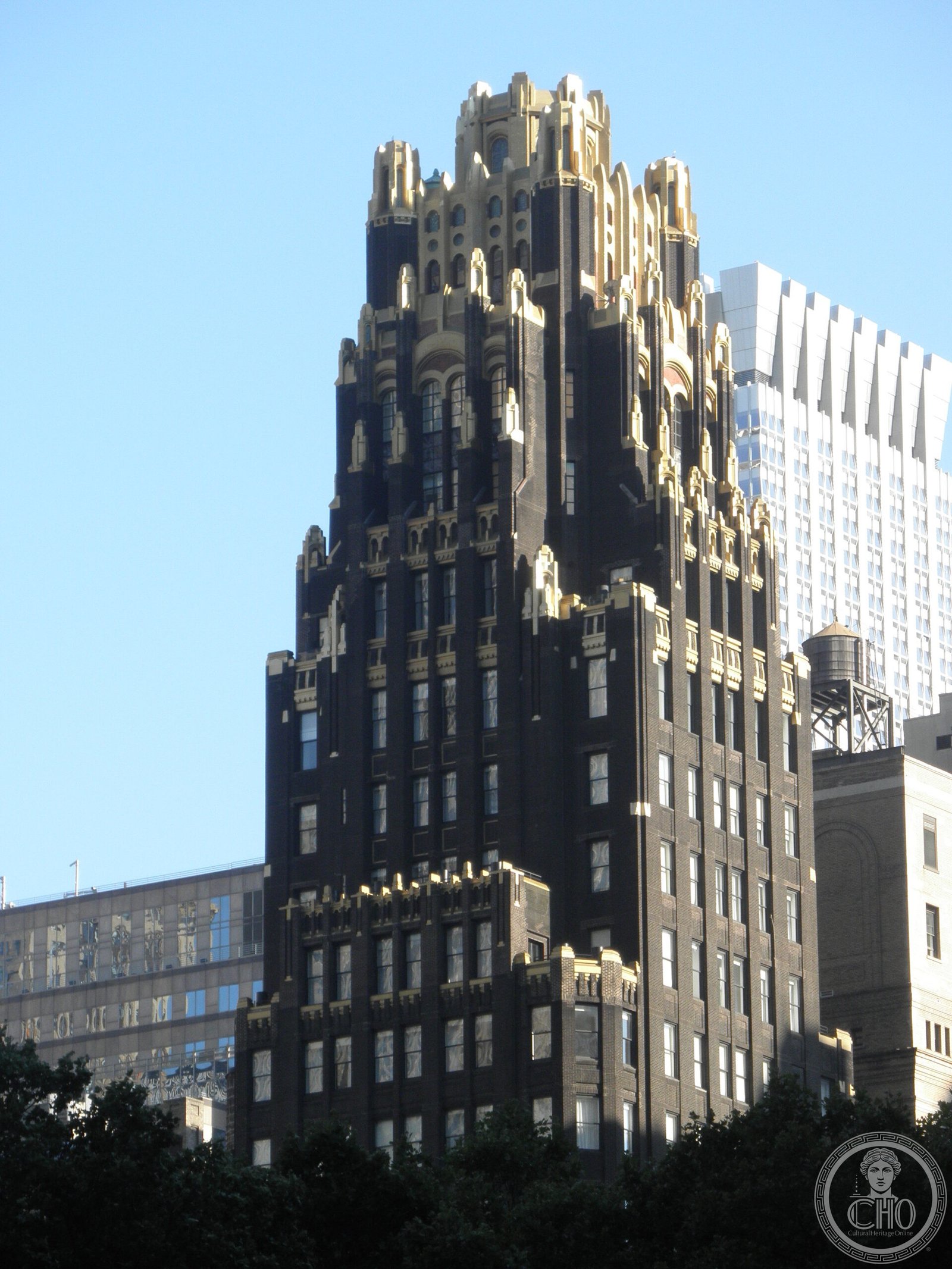
Raymond Hood’s black-and-gold tower facing Bryant Park is Art Deco theatre in miniature: 22 stories of coal-black brick crowned by gilded terracotta flames, a manifesto in masonry for the company that heated American homes.
At a glance
Standing at 40 West 40th Street on the south edge of Bryant Park, the American Radiator Building was completed in 1924 as the New York headquarters of the American Radiator Company, one of the country’s leading manufacturers of central heating equipment. Architect Raymond Hood conceived the facade as a visual metaphor: the black Roman brick body represents coal, and the gold-glazed terracotta crown represents the flame it produces. The effect — luminous against the Manhattan sky at dusk — made the building one of the most photographed in the city from its earliest years. Georgia O’Keeffe immortalised it in her 1927 canvas Radiator Building — Night, New York, depicting the tower as a glowing ember against a dark sky. Today the building operates as the Bryant Park Hotel, its exterior unchanged and listed on the National Register of Historic Places since 2003.
Key facts
- Address: 40 West 40th Street, New York, NY 10018
- Architect: Raymond Hood (1881–1934)
- Completed: 1924
- Height: 22 stories, approximately 338 feet (103 m)
- Style: Gothic-inflected Art Deco
- Current use: Bryant Park Hotel (since 2001)
- NRHP: Listed 2003
History
The American Radiator Company commissioned Hood for its New York tower at a moment when the firm dominated the U.S. central heating market. Hood, trained at the École des Beaux-Arts in Paris, was not yet the most famous architect in New York — that would come a year later with his Gothic Tribune Tower in Chicago (1925, shared with John Mead Howells) — but the Radiator Building would establish his signature: bold massing, polychrome cladding, and a willingness to treat the skyscraper as sculpture rather than engineering problem.
The choice of black brick was unprecedented for a Manhattan office tower and drew immediate comment. Hood argued that dark cladding made the building read as a unified object against the sky rather than dissolving into a patchwork of windows and spandrels, an idea he would develop further in the McGraw-Hill Building (1931) and in the collaborative design of 30 Rockefeller Plaza. The gold crown, manufactured from custom terracotta units fired with metallic glaze, reinforced the coal-and-flame allegory that the company’s marketing had long cultivated.
By the late twentieth century the building had changed tenants many times, but its fabric remained intact. The 2001 conversion to the Bryant Park Hotel preserved the lobby, reinstated the original lobby lighting, and restored the terracotta ornament. Hood’s design, once a corporate advertisement, became a canonical example of how the interwar skyscraper could carry symbolic weight beyond mere office provision.
What you see
The building’s power lies in its restraint. The base is clad in black Roman brick laid in a running bond that emphasises horizontal shadow lines and gives the tower a textile quality at street level. The windows are grouped in vertical bays framed in dark-painted metal, so the glass reads as recesses in the black field rather than as cutouts. Above the uppermost office floors, the setbacks tighten and the black brick gives way to gilded terracotta: pointed finials, carved foliage in gold relief, and a lantern-like crown that glows amber in low light.
The entrance at street level retains its original dark-marble surround and polished bronze details — elements Hood specified to maintain the unified black palette even at eye level. The Bryant Park Hotel has added a restaurant on the ground floor without altering the lobby’s proportions. From Bryant Park itself, the building reads as an isolated vertical object, its narrow frontage on 40th Street belying the depth of the floor plates behind.
Practical information
- Access: The lobby and ground-floor restaurant are accessible to the public during hotel hours; upper floors are hotel rooms.
- Best view: From Bryant Park, especially at dusk when the gold crown catches the last light. The building appears in the background of many photographs taken on the park’s south lawn.
- Time needed: 15–20 minutes to view the exterior and lobby details.
- Nearby dining: Bryant Park Grill and numerous Midtown options within two blocks.
Getting there
The American Radiator Building stands one block south of 42nd Street on the western edge of Bryant Park, between Fifth Avenue and Avenue of the Americas. The closest subway stations are 42nd Street–Bryant Park (B/D/F/M lines) on Avenue of the Americas, two blocks north, and Fifth Avenue–42nd Street (7 line), one block northeast. Grand Central Terminal is a ten-minute walk east along 42nd Street.
Nearby
- New York Public Library (1911) — Stephen A. Schwarzman Building, Beaux-Arts masterpiece on Fifth Avenue at 42nd Street, one block east.
- Chrysler Building (1930) — William Van Alen’s Art Deco spire, approximately 1.5 miles east on Lexington Avenue at 42nd Street.
- 30 Rockefeller Plaza (1933) — Hood’s largest Art Deco commission as part of the Rockefeller Center complex, 0.7 miles north.
- Chanin Building (1929) — Another Art Deco tower on Lexington Avenue at 42nd Street, one mile east.
Sources
- National Register of Historic Places, American Radiator Building nomination (2003), U.S. National Park Service.
- Carol Willis, Form Follows Finance: Skyscrapers and Skylines in New York and Chicago, Princeton Architectural Press, 1995.
- Raymond Hood, “The American Radiator Building,” Architectural Forum, 1924.
- Wikipedia contributors, “American Radiator Building,” Wikipedia, The Free Encyclopedia.
Find it on the map
See this place and what’s around it →📷 Become a Cultural Heritage Online photographer
Share your photos of places: they stay published under your name as the author. The more they're seen, the more you get noticed — and soon a contest will reward the most appreciated photos.
Log in or sign up free to add a photoIs this page about you?
This page is read by travellers and heritage enthusiasts who find it on Google. Tell us how you are connected to this place and we will take it from there.