

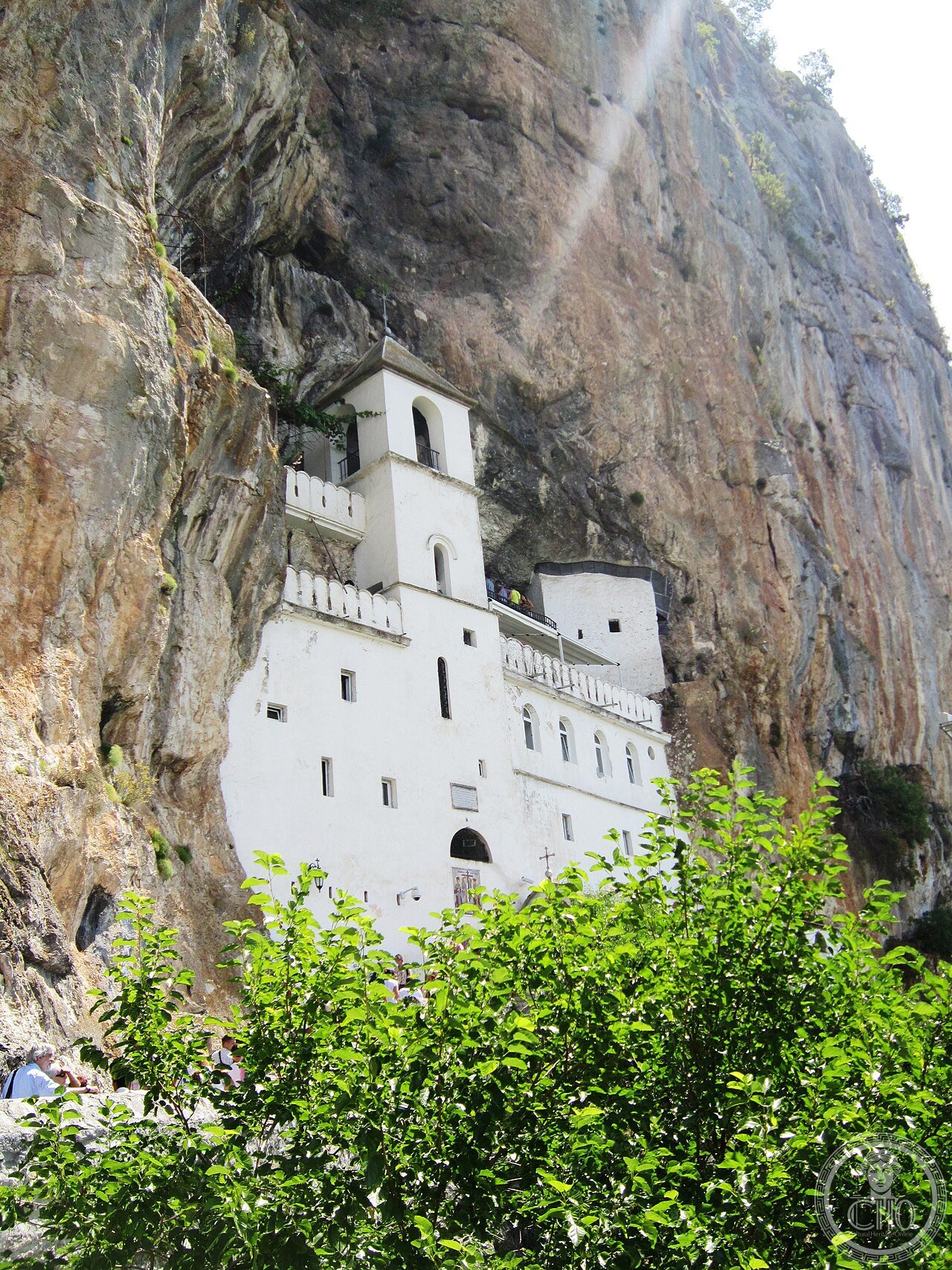
Saint Basil of Ostrog cut the monastery’s first cells directly into three natural caves in a sheer rock face, 900 metres above the plain of Bjelopavlići: in one he made the church, in the second lodgings for guests, in the third a chapel for the relics. When his tomb was opened, years after his death in 1671, the body was found incorrupt. Today up to 1.2 million pilgrims — Orthodox, Catholic and Muslim — climb to that cliff each year, often barefoot for the last three kilometres.
About Ostrog Monastery
Ostrog Monastery, a Serbian Orthodox monastery near Danilovgrad, Montenegro, is built directly into the sheer, almost vertical rock face of Ostroška Greda, at an altitude of around 900 metres above the Bjelopavlići Plain — a site widely described as a masterpiece of both nature and human construction. The monastery was founded in the early 17th century by Vasilije Jovanović, Metropolitan of Herzegovina, better known as Saint Basil of Ostrog, and is first documented on a geographical map of Montenegro dating to 1640. Saint Basil began by carving three caves directly into the rock face: in the first he established the Church of the Presentation of the Theotokos, in the second a bedroom to house guests, and in the third a chapel intended to hold religious relics. Basil died at the monastery in 1671, and when his tomb was opened some years later, his body was found completely incorrupt — a sign of sanctity recognised within Orthodox tradition — leading to his glorification as a saint; his relics remain enshrined in the cave church to this day. Ostrog has since become the single most visited pilgrimage site within the Serbian Orthodox Church, drawing between 1 and 1.2 million pilgrims annually, and is notable as a rare site of shared veneration across confessions, visited by Orthodox Christians, Catholics, and Muslims alike, many of whom report healing or relief from difficulties after praying beside Saint Basil’s relics. It is traditional for pilgrims to walk the final three kilometres from the Lower Monastery up to the cliffside Upper Monastery barefoot. Among the site’s celebrated natural features is a grapevine said to grow directly out of the bare rock face itself, regarded by pilgrims as a further sign of the monastery’s sanctity, since nothing should ordinarily be able to take root in solid stone.
Key facts
- Early 17th century: founded by Vasilije Jovanović, later Saint Basil of Ostrog
- 1640: monastery first appears on a geographical map of Montenegro
- Three caves: church, guest quarters, and relic chapel carved directly into the cliff
- 1671: Saint Basil dies; his body is later found incorrupt
- 1-1.2 million pilgrims annually: Serbian Orthodoxy’s most visited pilgrimage site
- Cross-confessional veneration: visited by Orthodox, Catholic, and Muslim pilgrims alike
- The miraculous vine: a grapevine said to grow directly from the bare cliff rock
History
Saint Basil’s original method of construction — carving living quarters, church, and reliquary chapel directly into three natural caves in a sheer cliff face — situates Ostrog within a broader Orthodox monastic tradition of cave and cliff monasteries, comparable in spirit to sites such as Meteora in Greece, but distinguished by its comparatively late 17th-century founding and by its uniquely broad, cross-confessional pilgrimage tradition. The discovery of Basil’s incorrupt body after death, and the monastery’s subsequent development into the most visited pilgrimage site of the entire Serbian Orthodox Church, reflects the enduring power of relic veneration in shaping the religious geography of the Balkans well into the modern era.
Ostrog’s status as a shared site of pilgrimage for Orthodox Christians, Catholics, and Muslims alike is unusual within the wider Balkan religious landscape, a region more often defined by confessional division than by shared sacred space — making the monastery a notable exception whose pilgrim numbers continue to grow across religious lines even today.
What you see
The Upper Monastery presents the site’s most dramatic architectural feature: a complex of church and monastic buildings built directly into and against the vertical rock face, visible from a considerable distance across the Bjelopavlići Plain below. The cave church of the Presentation of the Theotokos houses the reliquary containing Saint Basil’s incorrupt relics, while the celebrated vine, said to grow from the bare rock itself, remains a focal point for visiting pilgrims. A separate Lower Monastery, roughly three kilometres below, marks the traditional starting point for the barefoot pilgrimage ascent.
Practical information
- Opening hours: generally open daily with seasonal variation; check current hours before visiting; free admission
- Address: Ostroška Greda, Danilovgrad Municipality, Montenegro
Getting there
Ostrog Monastery’s Upper Monastery is located on a cliff face near Danilovgrad, reachable by road up to a parking area, followed by a short walk, or via the traditional barefoot pilgrimage route from the Lower Monastery. GPS: 42.6747° N, 19.0305° E.
Nearby
- Lower Monastery of Ostrog — the starting point of the traditional pilgrimage ascent
- Danilovgrad — the nearest town
- Podgorica — Montenegro’s capital, within driving distance
Sources
- Wikipedia — “Ostrog Monastery” (en.wikipedia.org)
- OrthodoxWiki — “Ostrog Monastery” (orthodoxwiki.org)
- Visit Montenegro — “The Life of Saint Basil of Ostrog” (visit-montenegro.com)
Find it on the map
See this place and what’s around it →📷 Become a Cultural Heritage Online photographer
Share your photos of places: they stay published under your name as the author. The more they're seen, the more you get noticed — and soon a contest will reward the most appreciated photos.
Log in or sign up free to add a photo