

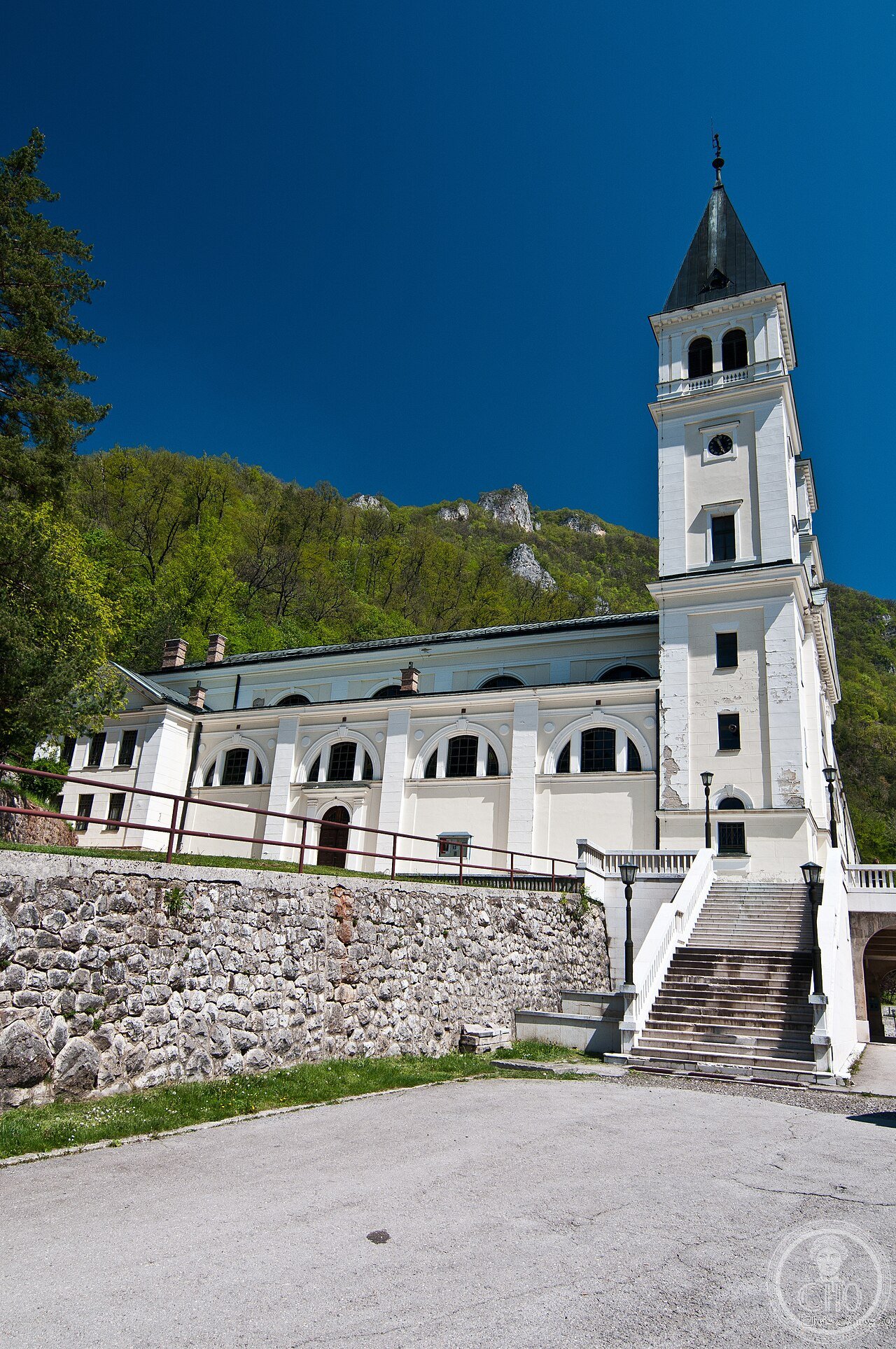
In the fourteenth century the ban of Bosnia Stephen II Kotromanić established his court at Trstivnica — today Kraljeva Sutjeska, “the king’s Sutjeska” — and beside it the Franciscans built their first monastery as early as 1340. That court vanished with the Ottoman conquest, but the monastery survived, building up over the centuries a library of some 11,000 volumes that today holds 31 of the only 53 incunabula — books printed before 1500 — surviving in all of Bosnia and Herzegovina.
About the Franciscan Monastery of Kraljeva Sutjeska
In the mid-14th century, Stjepan II Kotromanić, Ban of Bosnia, established his royal court at Trstivnica, in what is today the village of Kraljeva Sutjeska, and Franciscans built their first monastery beside that court as early as 1340; the monastery was first documented in writing in 1385, in the Franciscan writer Bartholomew of Pisa’s work “De conformitate vitae B. Francisci.” The Royal Court in Sutjeska served as the residence and administrative seat of the Bosnian kings of the Kotromanić dynasty from the mid-14th to the mid-15th century, making the monastery a direct neighbour to the political centre of the medieval Bosnian kingdom during its formative decades; nearby, at Bobovac, stood the royal castle that held Bosnia’s crown jewels and the royal chapel where several Bosnian kings and queens were buried. As Ottoman power expanded northward through the region, documentary records show the monastery was abandoned around 1626, having lost its earlier strategic and royal significance following the fall of the medieval Bosnian state. The monastery was subsequently destroyed and rebuilt several times across the following centuries; in 1888 the decision was made to demolish the old monastery building to construct a new complex, and the present church was built between 1906 and 1908 to a design by the architect Josip Vancaš, in the form of a three-nave basilica in neo-Renaissance style. Today the monastery houses a museum of historical treasures and a library of roughly 11,000 works, including Bosnian Cyrillic manuscripts and — remarkably — 31 incunabula, or books printed before 1500, out of only 53 known to survive across the whole of Bosnia and Herzegovina. In recognition of its exceptional historical and cultural significance, the architectural ensemble of the Franciscan monastery in Kraljeva Sutjeska, together with its movable heritage, was placed on the National Monuments list of Bosnia and Herzegovina by the Commission to Preserve National Monuments on 20 January 2004.
Key facts
- Mid-14th century: Stjepan II Kotromanić establishes the Bosnian royal court at Trstivnica
- 1340: Franciscans build their first monastery beside the royal court
- 1385: monastery first documented in writing by Bartholomew of Pisa
- Mid-14th to mid-15th century: seat of the medieval Bosnian royal court
- c. 1626: monastery abandoned during Ottoman expansion
- 1906-1908: present neo-Renaissance church built to designs by Josip Vancaš
- Library: around 11,000 works, including 31 of Bosnia and Herzegovina’s 53 surviving incunabula
- 2004: listed as a National Monument of Bosnia and Herzegovina
History
The monastery’s direct proximity to the medieval Bosnian royal court at Trstivnica, and its role today as custodian of nearly two-thirds of the country’s surviving incunabula, together position Kraljeva Sutjeska as one of Bosnia and Herzegovina’s most important surviving physical links to the independent medieval Bosnian kingdom, a state whose political and cultural infrastructure was largely dismantled following Ottoman conquest in the 15th century. The nearby royal castle of Bobovac, holding both the Bosnian crown jewels and the burial chapel of several Bosnian monarchs, extends this royal association across a wider surrounding landscape of medieval Bosnian statehood, of which the Franciscan monastery remains the most intact surviving religious institution.
The monastery’s cycle of destruction and rebuilding across the centuries — from its 1626 abandonment through repeated wartime damage to its complete architectural renewal in 1906-1908 — mirrors the broader turbulent history of Bosnian Franciscan communities under Ottoman and later Austro-Hungarian rule, making its continuous survival and eventual 2004 national monument listing a marker of institutional resilience across more than six and a half centuries.
What you see
The present church, built 1906-1908 to designs by Josip Vancaš, presents a three-nave basilica in neo-Renaissance style, replacing the earlier monastery buildings demolished in 1888. The monastery complex houses a museum of historical treasures alongside its extensive library, which preserves 31 incunabula and numerous Bosnian Cyrillic manuscripts among its roughly 11,000 volumes, reflecting centuries of continuous Franciscan scholarly activity at the site.
Practical information
- Opening hours: generally open daily with seasonal variation; check current hours before visiting; free or small admission fee for the museum
- Address: Kraljeva Sutjeska, Kakanj Municipality, Zenica-Doboj Canton, Bosnia and Herzegovina
Getting there
The Franciscan monastery is located in the village of Kraljeva Sutjeska, near Kakanj, in central Bosnia and Herzegovina, reachable by road. GPS: 44.1223° N, 18.2025° E.
Nearby
- Bobovac — the ruined medieval royal castle, once holding Bosnia’s crown jewels
- Kakanj — the nearest town
- Sarajevo — the Bosnian capital, roughly 60 kilometres away
Sources
- Wikipedia — “Franciscan friary, Kraljeva Sutjeska” and “Royal court in Sutjeska” (en.wikipedia.org)
- Visit B&H — “Monastery of Kraljeva Sutjeska and the royal town of Bobovac” (visitbih.ba)
- Go Bosnia — “Kraljeva Sutjeska – Seat of the Bosnian Kings” (go-bosnia.com)
Find it on the map
See this place and what’s around it →📷 Become a Cultural Heritage Online photographer
Share your photos of places: they stay published under your name as the author. The more they're seen, the more you get noticed — and soon a contest will reward the most appreciated photos.
Log in or sign up free to add a photo