

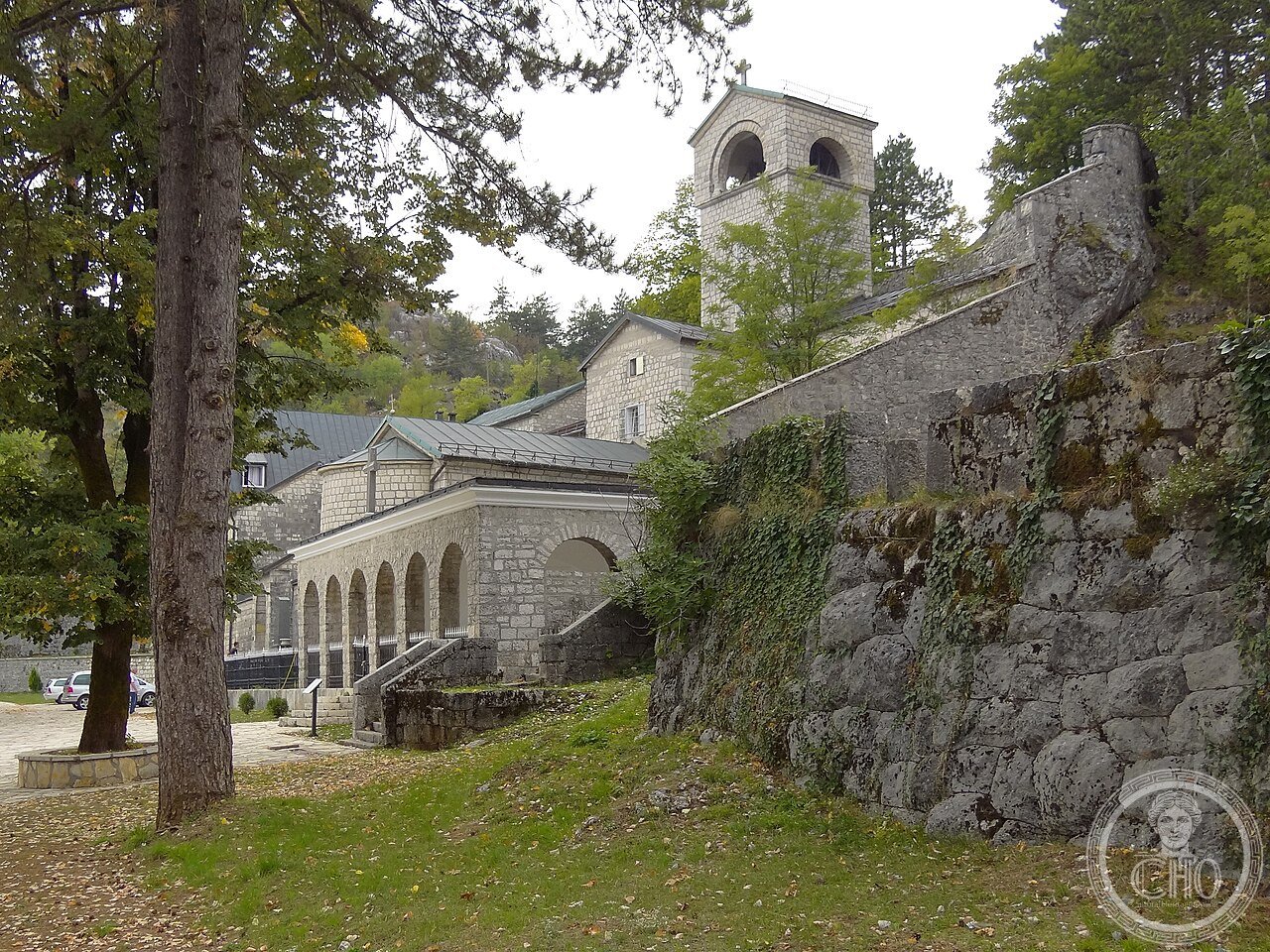
During a stay at Ancona, Prince Ivan Crnojević of Zeta visited the basilica of the Holy House of Loreto and made a vow there: to build, on his return home, a church likewise dedicated to the Mother of God. So in 1484–1485 the monastery of Cetinje was born. Destroyed during the Morean War in 1692 and rebuilt several times over the two centuries that followed, it holds today among its most venerated relics the right hand of Saint John the Baptist and a fragment of the True Cross.
About Cetinje Monastery
Cetinje Monastery was founded around 1484 by Prince Ivan Crnojević of Zeta, who designated it as the cathedral monastery of the Eparchy of Zeta; the monastery was formally established on 4 January 1485 at the site of Ćipur, and dedicated to the Nativity of the Theotokos. According to tradition, Crnojević’s decision to build the monastery followed a vow made during a stay in Ancona, Italy, where he visited the Basilica della Santa Casa in Loreto — believed by tradition to house the transported house of the Virgin Mary — and pledged to construct a church of his own dedicated to the Mother of God upon returning to Zeta. The monastery holds a number of exceptionally significant relics, including the remains of Saint Peter of Cetinje, a relic believed to be the right hand of John the Baptist, particles said to come from the True Cross, and the episcopal crown of Saint Peter of Cetinje. The monastery’s history has been marked by repeated destruction and reconstruction: it was devastated in 1692 during the Morean War, then rebuilt between 1701 and 1704 by Metropolitan Danilo Petrović-Njegoš, founder of the Petrović-Njegoš dynasty, on the site of Ivan Crnojević’s former court; the rebuilt monastery burned before 1714, and was reconstructed again around 1743 under Metropolitan Sava Petrović-Njegoš. Cetinje Monastery serves today as the seat of the Metropolitanate of Montenegro and the Littoral, making it the spiritual and administrative centre of Orthodox Christianity in Montenegro.
Key facts
- 1484-1485: founded by Prince Ivan Crnojević, dedicated to the Nativity of the Theotokos
- Founding vow: made at the Basilica della Santa Casa in Loreto, Italy
- 1692: monastery devastated during the Morean War
- 1701-1704: rebuilt by Metropolitan Danilo Petrović-Njegoš
- Before 1714: monastery burns again
- c. 1743: reconstructed once more under Metropolitan Sava Petrović-Njegoš
- Relics: the right hand of John the Baptist, a fragment of the True Cross, remains of Saint Peter of Cetinje
- Today: seat of the Metropolitanate of Montenegro and the Littoral
History
Ivan Crnojević’s founding vow, made at Loreto’s famous Marian shrine hundreds of kilometres across the Adriatic, situates Cetinje Monastery’s origins within the broader medieval and early modern tradition of pilgrimage-inspired church foundations, connecting a Balkan Orthodox monastery’s beginnings directly to one of Catholic Europe’s most celebrated Marian pilgrimage sites. The monastery’s repeated cycle of destruction and reconstruction across the 17th and 18th centuries — through the Morean War and subsequent fires — closely tracks the turbulent political history of Montenegro itself during the same period, culminating in its role under the Petrović-Njegoš dynasty as the institutional seat from which Montenegro’s prince-bishops governed both religious and secular affairs.
The presence of relics as significant as a purported hand of John the Baptist and a fragment of the True Cross gives Cetinje Monastery an unusually high concentration of major Christian relics for a monastery of its regional scale, reflecting the accumulated religious prestige gathered by the Montenegrin Metropolitanate across more than five centuries of continuous institutional history.
What you see
The present monastery buildings largely date to the 18th-century reconstructions following the fires and destruction of the 17th and early 18th centuries, presenting a relatively modest exterior in keeping with the constrained circumstances of its rebuilding under Ottoman-era pressures. Inside, the monastery’s treasury and church house its most significant relics, including the reliquary said to contain the right hand of John the Baptist, alongside vestments, manuscripts, and other objects connected to the Petrović-Njegoš dynasty’s long stewardship of the site.
Practical information
- Opening hours: generally open daily with seasonal variation; check current hours before visiting; free admission
- Address: Ul 15, Borovik, 81250 Cetinje, Montenegro
Getting there
Cetinje Monastery is located in the historic royal capital of Cetinje, at the foot of Mount Lovćen, easily reachable on foot within the town. GPS: 42.3878° N, 18.9218° E.
Nearby
- King Nikola’s Palace — the former royal residence, nearby in Cetinje
- Cetinje Old Town — the historic royal capital’s centre
- Mount Lovćen National Park — the mountain overlooking the town
Sources
- Wikipedia — “Cetinje Monastery” (en.wikipedia.org)
- Visit Cetinje — “Monastery of Ivan Crnojevic” (visitcetinje.com)
- Montenegro.org — “A look inside Cetinje Monastery” (montenegro.org)
Find it on the map
See this place and what’s around it →📷 Become a Cultural Heritage Online photographer
Share your photos of places: they stay published under your name as the author. The more they're seen, the more you get noticed — and soon a contest will reward the most appreciated photos.
Log in or sign up free to add a photo