
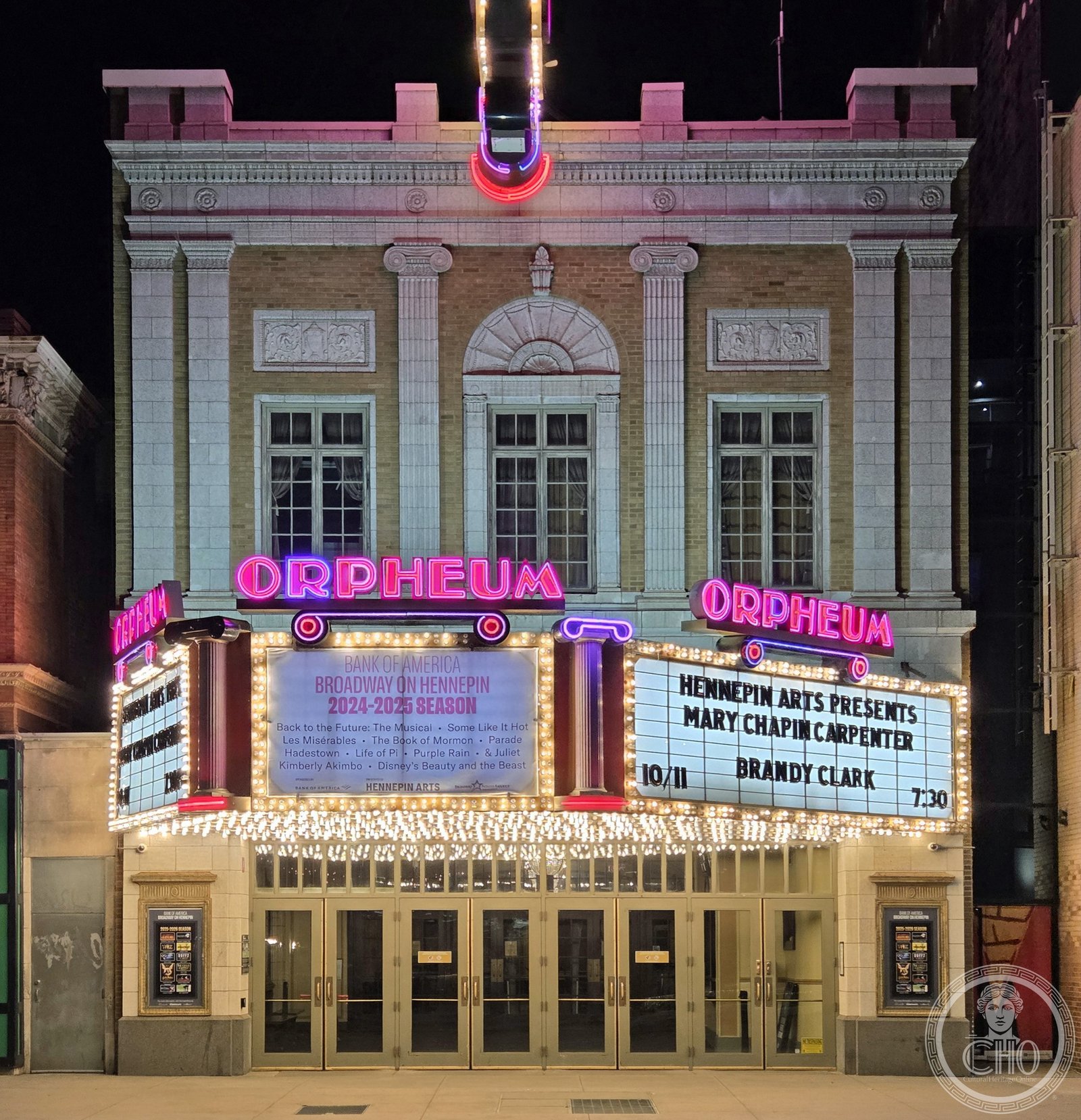
The crown of the Hennepin Avenue Theatre District, the Minneapolis Orpheum has presented touring Broadway productions, vaudeville headliners, and rock concerts from the same Baroque Revival auditorium since 1921.
At a glance
The Orpheum Theatre at 910 Hennepin Avenue is the flagship venue of the Hennepin Theatre Trust, which also manages the adjacent State Theatre (1921) and Pantages/Hennepin Theatre (1916). Opened in 1921 as part of the national Orpheum vaudeville circuit, the building seats approximately 2,600 in a richly ornamented auditorium whose design draws on Baroque Revival precedents — heavy cornices, layered balconies, gilded plasterwork, and a domed ceiling that gives the room its cathedral-like vertical drama. Listed on the National Register of Historic Places, the Orpheum has been the primary venue for national Broadway touring productions in the Twin Cities for decades.
Key facts
- Address: 910 Hennepin Avenue, Minneapolis, MN 55403
- Opened: 1921
- Original circuit: Orpheum vaudeville circuit
- Style: Baroque Revival / early atmospheric detailing
- Status: NRHP Listed; active performing arts venue, Hennepin Theatre Trust
- Capacity: approximately 2,600 seats
- Theme: Art Deco USA
History
Minneapolis in 1921 was a city of over 380,000 — the dominant commercial and cultural center of the northern Great Plains, with a downtown concentrated on Nicollet Mall and Hennepin Avenue. The Orpheum Circuit, a West Coast-headquartered vaudeville chain that would merge with the Keith-Albee interests in 1927-28 to form Keith-Albee-Orpheum (later RKO), was building flagship houses in major American cities throughout the late teens and early 1920s. The Minneapolis Orpheum, the largest and most ornate venue on the circuit’s Upper Midwest circuit, opened in 1921 to anchor the entertainment block that would become the Hennepin Avenue Theatre District.
The Orpheum Circuit’s programming model — a weekly bill of five or six acts, rotating headliners from the national circuit — brought to Minneapolis the same performers who appeared in New York, Chicago, and San Francisco: comedians, singers, dancers, novelty acts, and eventually film shorts as the movies began to displace live vaudeville. The transition from vaudeville to cinema, completed by the early 1930s, did not diminish the theatre’s role; the Orpheum simply shifted to first-run film programming as the Midwest’s largest single-screen movie house.
The theatre declined through the urban withdrawal of the 1960s and 1970s, when Hennepin Avenue’s commercial vitality eroded along with most American downtown entertainment districts. The building changed hands multiple times and threatened permanent closure before being transferred to the Hennepin Theatre Trust, the non-profit organization that continues to operate the complex today. A major restoration returned the interior plasterwork, gilding, and seating to their 1920s condition; the theatre reopened in 1993 as the primary Broadway touring venue in the Twin Cities, a role it continues to hold.
What you see
The Hennepin Avenue facade is organized around a central entrance bay with arched openings and ornamental terracotta panels, flanked by vertical piers that rise to a decorated cornice. The marquee — rebuilt in the restoration and now carrying an LED display — projects over the sidewalk at the ground floor, a characteristic feature of the American theatre street type. At night, the illuminated exterior makes the Orpheum one of the most legible landmarks on the Hennepin Avenue corridor.
Inside, the auditorium is a composition of layered balconies, deeply modeled plaster cornices, and a domed ceiling painted with a night-sky composition that echoes the atmospheric theatre style without achieving the full illusion. The Baroque ornamental vocabulary — pilasters with composite capitals, cartouches, and swag motifs — is executed in warm gold and ivory tones that give the room its characteristic evening warmth. The orchestra pit, the stage house, and the dressing room facilities were all upgraded in the 1993 restoration to accommodate modern touring Broadway productions.
Practical information
- Access: 910 Hennepin Avenue, downtown Minneapolis; light rail and bus stops on Hennepin Avenue; paid parking in ramps within two blocks
- Programming: Broadway touring productions, concerts, special events; check Hennepin Theatre Trust calendar
- Time needed: 2–3 hours for a full production; walk the Hennepin Avenue Theatre District (Orpheum + State + Pantages/Hennepin) before the performance
- Best season: year-round; Minneapolis winters are severe, but the theatre is fully enclosed and accessible via the downtown Skyway System
Getting there
Minneapolis–Saint Paul International Airport (MSP) is approximately 10 miles south of downtown Minneapolis, served by the METRO Blue Line light rail that connects directly to downtown in about 25 minutes. The Orpheum Theatre is on Hennepin Avenue a short walk from the METRO Green Line’s stops along 5th Street in downtown Minneapolis. Amtrak’s Empire Builder route (Chicago–Seattle/Portland) stops at Target Field Station, approximately 0.5 miles northwest of the Orpheum — a walkable distance along the entertainment corridor.
Nearby
- State Theatre (1921) — the Orpheum’s companion Hennepin Theatre Trust venue, a second 2,100-seat movie palace of the same vintage on the same block, approximately 0.1 miles south at 805 Hennepin Avenue
- Foshay Tower (1929) — the Art Deco skyscraper that served as Minneapolis’s tallest building until 1972; Washington Monument in form, now a hotel; approximately 0.4 miles southeast on 9th Street
- Walker Art Center — major contemporary art museum adjacent to the Minneapolis Sculpture Garden, approximately 1 mile northwest via Hennepin Avenue
Sources
- National Register of Historic Places — Orpheum Theatre listing, Minnesota Historical Society
- Hennepin Theatre Trust — institutional history and restoration documentation
- Theatre Historical Society of America — Orpheum Circuit records
- Wikimedia Commons — Orpheum Theatre night.jpg, CC BY-SA 4.0, McGhiever
Find it on the map
See this place and what’s around it →📷 Become a Cultural Heritage Online photographer
Share your photos of places: they stay published under your name as the author. The more they're seen, the more you get noticed — and soon a contest will reward the most appreciated photos.
Log in or sign up free to add a photoDo you manage this place?
This page is read by travellers and heritage enthusiasts who find it on Google. Keep it accurate — and make it work for you. Free for non-profit heritage institutions.