

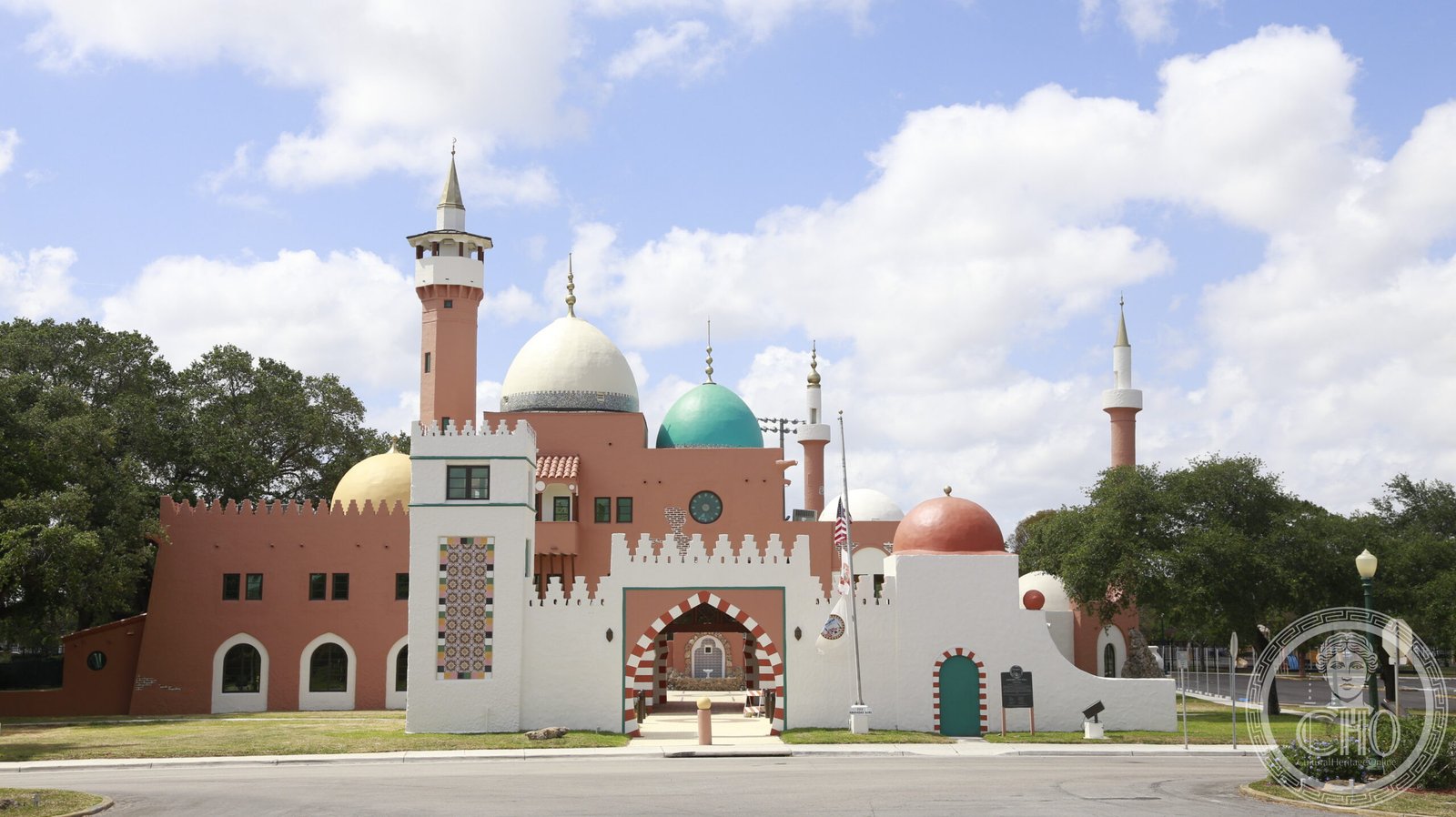
Opa-locka City Hall is the centrepiece of the most concentrated collection of Moorish Revival architecture in the Western Hemisphere, a fantasy city conjured from the Florida flatlands in 1926 by developer Glenn Curtiss and architect Bernhardt E. Muller. Inspired by the tales of the Arabian Nights, Curtiss platted an entire municipality around a unifying exotic aesthetic: onion domes, horseshoe arches, crenelated parapets, minarets, and mosaic tile applied to municipal buildings, commercial blocks, and residences alike. City Hall — with its multiple domes and arched arcade — served as the civic anchor of this improbable vision. Twenty structures in Opa-locka are listed on the National Register of Historic Places as the Opa-locka Thematic Resource Area, one of the most unusual historic districts in the United States. The city is widely dubbed “the City of the Seven Domes,” and its skyline remains unmistakable decades after the original boom subsided.
At a glance
- Type
- Municipal civic building
- Period
- 1925–1926
- Style
- Moorish Revival / Art Deco Exotic
- Location
- 777 Sharazad Boulevard, Opa-locka, Florida, USA
- Coordinates
- 25.9017° N, 80.2453° W
- Architect(s)
- Bernhardt E. Muller
Overview
City Hall was built as part of Glenn Curtiss’s vision for a complete “Arabian Nights” city north of Miami. Curtiss, an aviation pioneer turned Florida land developer, partnered with architect Bernhardt Muller to apply a consistent Moorish vocabulary to every building in the new town. The result was unprecedented in American urbanism: a unified exotic streetscape built at speed during the Florida land boom. City Hall, completed when the town was officially incorporated on 14 May 1926, functions today as the seat of municipal government and as a symbol of one of American history’s most audacious real-estate fantasies.
History
Glenn Curtiss platted Opa-locka in 1925, naming streets after Arabian Nights characters — Sharazad, Sinbad, Ali Baba. The Florida land boom funded rapid construction; Muller designed dozens of buildings in quick succession. The town was incorporated in May 1926, but the boom collapsed later that year following a catastrophic hurricane and a nationwide credit contraction. Many planned structures were never built. The district survived decades of neglect and was recognised through the Opa-locka Thematic Resource Area listing on the National Register of Historic Places. Restoration efforts in the late twentieth and early twenty-first centuries have stabilised the most significant surviving buildings, including City Hall.
Architecture & Design
Muller drew on North African and Middle Eastern sources — particularly Spanish Moorish and Ottoman — to create a vernacular exotic style suited to Florida’s climate and construction methods. City Hall features the defining elements of the Opa-locka vocabulary: bulbous onion domes, horseshoe (Saracenic) arches at the arcade level, crenelated parapets suggesting a mediaeval Islamic fortification, and smooth stucco walls painted in warm ochres and whites. Minarets punctuate the roofline. The overall composition is theatrical rather than archaeologically precise, a deliberate romantic fantasy appropriate to a city conceived as a leisure destination and speculative real-estate proposition.
Cultural significance
Opa-locka represents the most ambitious example of themed urbanism in early twentieth-century America. Unlike individual exotic-revival buildings — common throughout the 1920s — Opa-locka applied a single non-Western vocabulary to an entire city plan. Its existence challenges conventional narratives of American architecture by demonstrating how far developers and clients were willing to stray from European models during the boom years. The district also documents the aspirations and rapid collapse of Florida’s 1920s land speculation era, making it a site of economic as well as architectural history.
Visiting today
City Hall is an active municipal building; the exterior and surrounding streetscape can be visited freely. The historic district is best explored on foot or by car — street names retain their Arabian Nights theme. Several other listed buildings remain visible on Sharazad Boulevard and Ali Baba Avenue. The area is in an urban neighbourhood; visitors should take standard city precautions. Local preservation organisations periodically offer guided tours of the historic district.
Getting there
Opa-locka is approximately 15 miles north of downtown Miami. The nearest Metrorail station is Opa-locka (Orange line), a short walk or ride from City Hall on Sharazad Boulevard. By car, take I-95 north to the NW 135th Street exit, then head west. Miami International Airport is approximately 20 minutes by car. Rideshare services operate throughout the area.
Sources & resources
Find it on the map
See this place and what’s around it →Record researched and written by Luigi De Marchi for Cultural Heritage Online, 2026.
📷 Become a Cultural Heritage Online photographer
Share your photos of places: they stay published under your name as the author. The more they're seen, the more you get noticed — and soon a contest will reward the most appreciated photos.
Log in or sign up free to add a photoIs this page about you?
This page is read by travellers and heritage enthusiasts who find it on Google. Tell us how you are connected to this place and we will take it from there.