

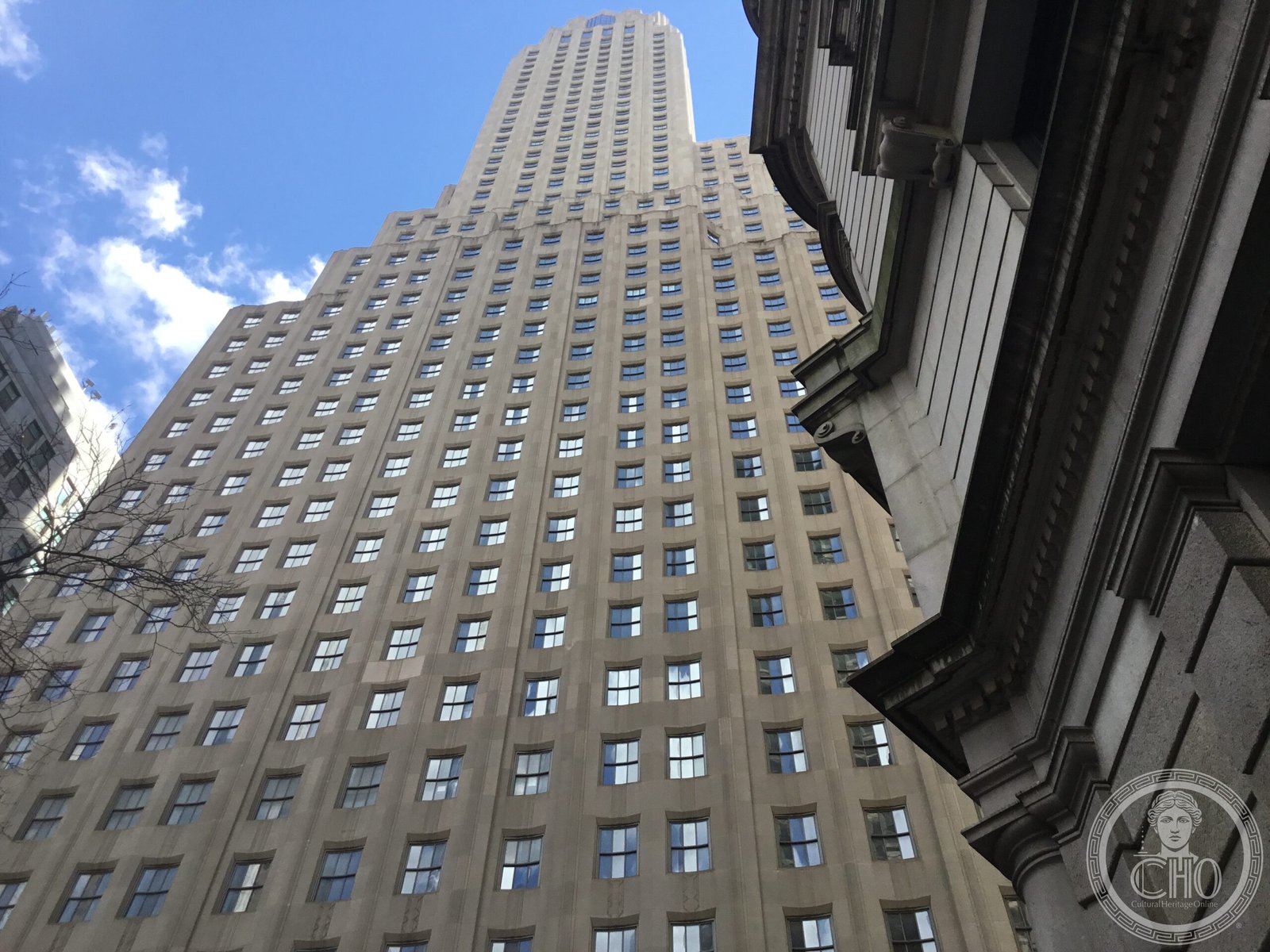
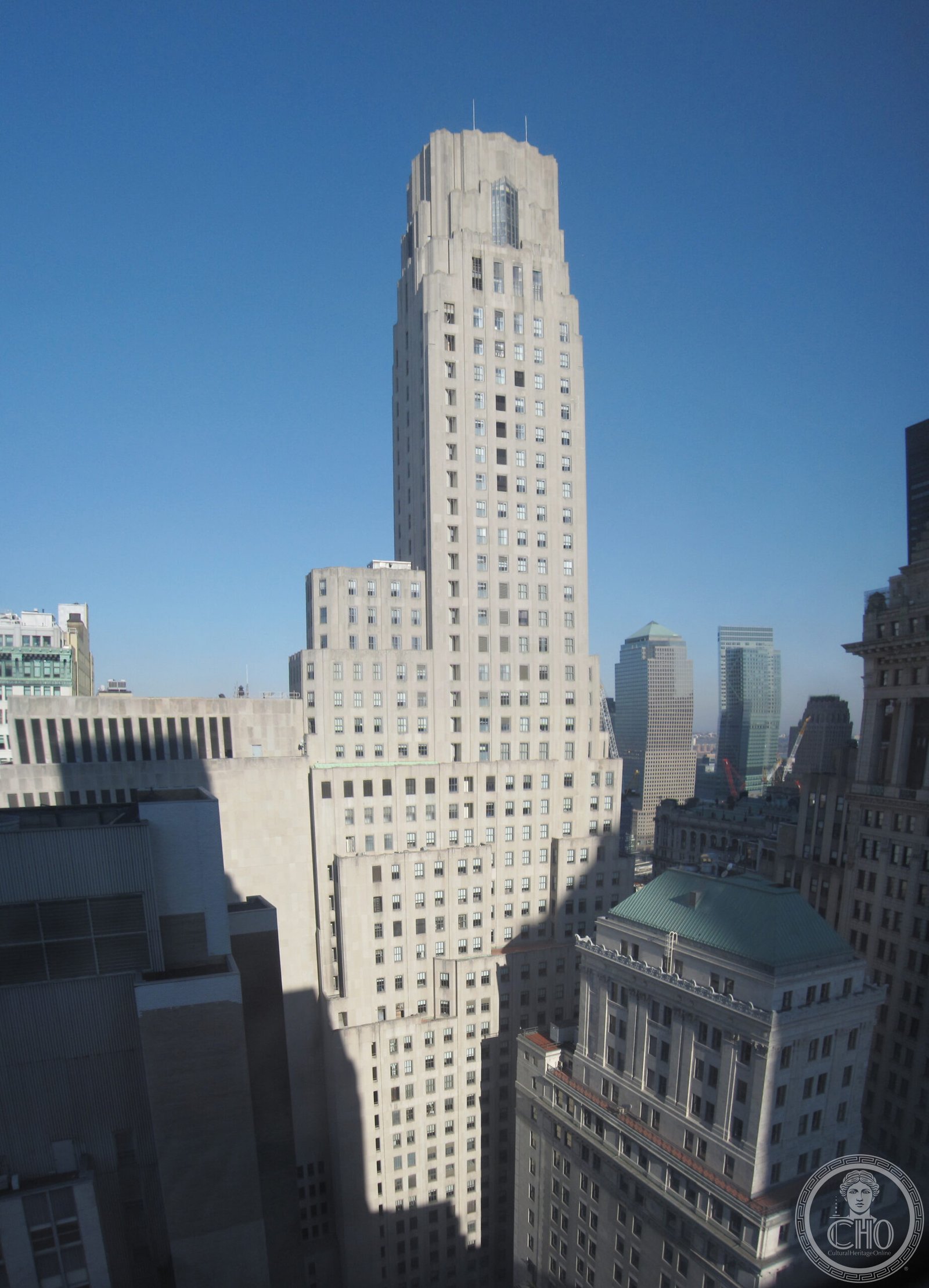
Rising fifty floors above the intersection of Broadway and Wall Street, One Wall Street is among the most refined Art Deco towers ever built in New York City. Completed in 1931 to designs by Ralph Thomas Walker of Voorhees, Gmelin and Walker, the limestone-clad skyscraper tapers elegantly skyward through a series of setbacks mandated by the 1916 zoning law, its crown dissolving into abstract geometric relief that recalls the hand-cut patterns of ancient stonework. Inside, the legendary Red Room banking hall stuns visitors with 13,000 square feet of polychromatic mosaic — red-and-gold tessellated walls rising to a gold-on-black celestial ceiling — one of the most extraordinary interiors the Art Deco era produced anywhere in the world. After decades as the headquarters of the Bank of New York, the building was converted between 2018 and 2023 into 566 condominiums, bringing new life to one of Lower Manhattan’s most architecturally significant addresses while preserving its peerless public spaces.
At a glance
- Type
- Office skyscraper / residential conversion
- Period
- Completed 1931; annex 1965; residential conversion 2018–2023
- Style
- Art Deco
- Location
- 1 Wall Street, Financial District, Manhattan, New York City, USA
- Coordinates
- 40.7072° N, 74.0117° W
- Architect(s)
- Ralph Thomas Walker (Voorhees, Gmelin and Walker)
Overview
One Wall Street commands the corner of Broadway and Wall Street at the symbolic heart of American finance. At 50 storeys and 654 feet, it dominated the Lower Manhattan skyline when it opened in March 1931 and remains one of the finest examples of Art Deco applied to commercial architecture at monumental scale. Its exterior is clad entirely in Indiana limestone, carved with abstract geometric ornament that grows denser and more intricate as the eye travels upward. The building was designated a New York City exterior landmark in 2001 and its Red Room interior received landmark status in June 2024, ensuring that its extraordinary mosaics remain permanently protected.
History
The Irving Trust Company commissioned the tower in the late 1920s, at the peak of Wall Street prosperity, as a statement of corporate confidence. Construction began in 1929 — the same year the stock market crashed — and the building was completed in 1931 amid the deepening Depression, a monument to ambition built against the current. For decades it served as the headquarters of Irving Trust and later the Bank of New York. A 28-storey annex clad in contrasting granite was added in 1965. By the early 2000s much of the financial industry had migrated to Midtown, and the building stood partially vacant. The conversion to residential use ran from 2018 to 2023. A Whole Foods market opened in the base in January 2023, and in March 2025 the Paris department store Printemps opened its New York store here, with its shoe salon in the Red Room.
Architecture & Design
Ralph Walker conceived the tower as a vertical sculpture, its limestone mass ascending through staggered setbacks toward a faceted crown. The facade ornament — abstract flutes, chevrons, and low-relief carvings — was designed to catch raking light and cast deep shadows that shift through the day. The Red Room is Walker’s masterpiece: a hall 100 feet long by 40 feet wide, every surface encrusted with Byzantine-influenced mosaic in deep crimson and warm gold. The ceiling pattern references medieval cosmological maps; the floor is laid in red terrazzo. When the Red Room received interior landmark designation in 2024 it became one of the most recently protected Art Deco interiors in the city, decades after the exterior had already been recognised.
Cultural significance
One Wall Street represents the high-water mark of the Art Deco skyscraper in New York, a building that synthesises European decorative modernism with American engineering ambition. The Red Room stands as one of the finest surviving examples of monumental Art Deco interior decoration in the world.
Visiting today
The Red Room is now part of Printemps New York, which opened in March 2025 and uses it as its shoe salon; it can be seen during store hours. The Whole Foods Market occupying a lower level also provides public access to parts of the building’s base. The exterior is best appreciated from the corner of Broadway and Exchange Place, where the full setback profile and crown are visible. Lower Manhattan is dense with Art Deco architecture; a self-guided walk linking One Wall Street with 70 Pine Street, 20 Exchange Place, and 40 Wall Street takes approximately two hours.
Getting there
The nearest subway stations are Wall Street (2, 3 trains) on Broadway and Rector Street (1 train) two blocks south. The R and W trains stop at Cortlandt Street nearby. The Staten Island Ferry terminal at Whitehall Street is a ten-minute walk along Broadway. Citi Bike docks are located on Wall Street and on Broad Street. The building entrance is at 1 Wall Street on the Broadway frontage.
Sources & resources
Gallery
Find it on the map
See this place and what’s around it →
Record researched and written by Luigi De Marchi for Cultural Heritage Online, 2026.
📷 Become a Cultural Heritage Online photographer
Share your photos of places: they stay published under your name as the author. The more they're seen, the more you get noticed — and soon a contest will reward the most appreciated photos.
Log in or sign up free to add a photoIs this page about you?
This page is read by travellers and heritage enthusiasts who find it on Google. Tell us how you are connected to this place and we will take it from there.