
Old City of Jerusalem

Jerusalem Old City Dome of the Rock Western Wall Church Holy Sepulchre UNESCO World Heritage
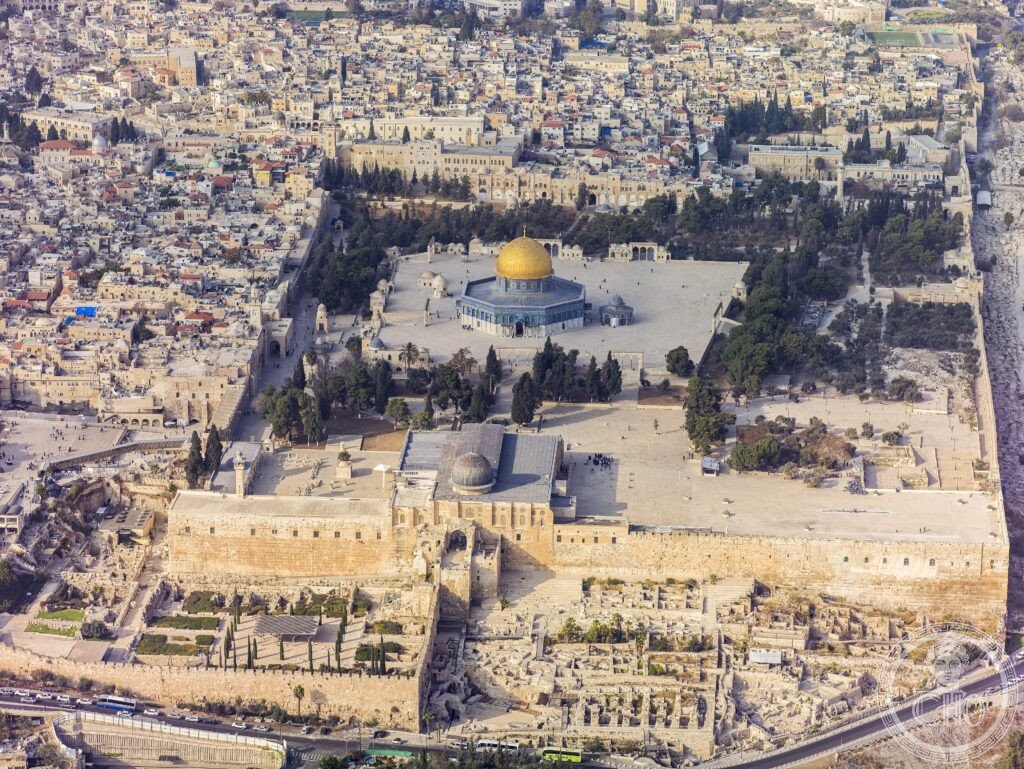
The Old City of Jerusalem (the aerial view of the Temple Mount / Haram al-Sharif (the most contested 35 acres of land in the world; a 500×300 m elevated limestone platform on the south-east corner of the Old City): the Dome of the Rock (Qubbat al-Sakhra; built 691–692 CE by Umayyad Caliph Abd al-Malik; the 24-karat gold-plated aluminium dome (re-gilded most recently with gold donated by Jordan’s King Hussein in 1993; the most politically significant dome restoration in modern Islamic architecture); the octagonal blue-tiled exterior; the rock (the Foundation Stone; the most sacred single rock in Judaism (the stone on which Abraham prepared to sacrifice Isaac; the holiest spot in Judaism from which God created the world; the location of the Holy of Holies of the First and Second Temples of Jerusalem; the most theologically dense single rock in the world); in Islam, the rock from which the Prophet Muhammad ascended to heaven on the Night Journey (the Isra and Mi’raj)); the Al-Aqsa Mosque (the silver dome to the south; the 3rd most sacred mosque in Islam after the Kaaba in Mecca and the Prophet’s Mosque in Medina); the Western Wall (below and to the left of the Temple Mount; the most sacred prayer site in Judaism; the surviving retaining wall of the Herodian Temple Mount expansion; the site of the most sustained Jewish lamentation in history)), Old City of Jerusalem, Israel — UNESCO World Heritage Site (in Danger list) 1981. Photo via Wikimedia Commons.
Jerusalem, Israel / Palestinian Territory · founded ~3500 BCE; continuously inhabited 5,000+ years; most contested city in world history; sacred to Judaism (Temple Mount; Western Wall; David’s Tomb), Christianity (Church of Holy Sepulchre; Via Dolorosa; Garden of Gethsemane), and Islam (Dome of the Rock 691 CE; Al-Aqsa Mosque; Night Journey); Old City 1 km² walled (Ottomans 1535); 4 quarters (Jewish/Christian/Muslim/Armenian); 220 historical monuments · UNESCO World Heritage (Danger List since 1982) 1981

Old City of Jerusalem

The most contested square kilometre of land in the world and the spiritual nucleus of three of humanity’s great religions — the Old City of Jerusalem, enclosed within Ottoman walls and layering 5,000 years of continuous human settlement, holds the Western Wall, the Dome of the Rock, and the Church of the Holy Sepulchre within a few hundred metres of one another — a density of sacred space unmatched anywhere on Earth.

At a glance

The Old City of Jerusalem (UNESCO WHS 1981; on the List of World Heritage in Danger since 1982 — the only World Heritage site in the world to have been placed on the Danger List within one year of inscription; the most politically contentious UNESCO listing in the history of the organisation; inscribed at the request of Jordan (the former administering power of the West Bank and the Old City from 1948 to 1967) over Israeli objections — the most diplomatically fraught World Heritage inscription in history); the Old City (approximately 1 km² within the walls; the 11 gates (the most important: the Jaffa Gate (main western entry), the Damascus Gate (the finest Ottoman gate; the most impressive single stone gateway in any walled city in the Levant), the Lions’ Gate (the gate through which Israeli paratroopers entered the Old City on 7 June 1967 — the most symbolically loaded single entry through any city gate in 20th-century history)); the 4 quarters (the Jewish Quarter; the Christian Quarter; the Muslim Quarter; the Armenian Quarter — the oldest and smallest; the most ancient national-religious enclave in the Old City; the Armenian community has been continuously present in Jerusalem since at least the 4th century CE — the longest unbroken diaspora presence of any Christian community outside Armenia)); 220 historical monuments within 1 km² — the most concentrated single density of sacred and historical monuments in any urban area on Earth.

Key facts

  • The Temple Mount / Haram al-Sharif: the most contested 35 acres on Earth — the Temple Mount (the 500×300 m limestone platform on the south-east corner of the Old City; the platform was built up by Herod the Great (r. 37–4 BCE) as the base for his expanded Second Temple (the most ambitious construction project of any Herodian king: the quarrying and laying of the limestone ashlars — some weighing up to 600 tonnes; the most massive single stone blocks in any ancient building in the Levant)); the Dome of the Rock (Qubbat al-Sakhra; completed 691–692 CE by Umayyad Caliph Abd al-Malik; the oldest surviving Islamic building in the world (older than any mosque or palace in the Umayyad, Abbasid, or Fatimid caliphates); the dome (the gold-plated aluminium dome is a replacement (1959–1961) for the original lead dome; the gold leaf covering was donated by King Hussein of Jordan in 1993 — 80 kg of gold; the most expensive single architectural donation in 20th-century Islamic history in monetary terms); the interior (the finest Byzantine and Umayyad mosaic programme in any building in the Levant: 240 m of Quranic inscriptions (the oldest surviving monumental Quranic inscription in the world; the most important epigraphic evidence for the early formation of the Quranic text in architecture)); the Al-Aqsa Mosque (the silver-domed mosque at the southern end of the Haram; originally built c. 705 CE by Umayyad Caliph al-Walid I; capacity 5,000 worshippers; the 3rd holiest mosque in Islam; the site of the assassination of King Abdullah I of Jordan (17 July 1951 — in the presence of his 15-year-old grandson who would become King Hussein))
  • The Western Wall (Kotel): the most sacred Jewish prayer site in the world — the Western Wall (the 488-m long retaining wall of the Temple Mount expansion built by Herod the Great; the most important single surviving structure of Herodian Jerusalem; the Wall is 5 m wide; the blocks are up to 12 m long and 3 m high; the joints between the ashlars are the most precisely fitted in any Herodian construction); the prayer (the most intensely used public prayer space in the world per square metre of floor area: the Wall is divided between a men’s section (the larger, northern section) and a women’s section; the notes (millions of small slips of paper inserted into the cracks of the Wall bearing written prayers; collected twice per year and buried in the Mount of Olives — the most unusual prayer recycling tradition in any religion); the Western Wall Tunnel (the most important archaeological discovery adjacent to the Wall: the tunnel running north along the entire length of the retaining wall, revealing 488 m of Herodian ashlars underground — the most complete surviving Herodian construction in Jerusalem; the largest stone: the “Western Stone” (570 tonnes — the largest single block in any ancient construction in the world (larger than any single stone in the Great Pyramid or Stonehenge)))
  • The Church of the Holy Sepulchre: the most sacred site in Christianity — the Church of the Holy Sepulchre (in the Christian Quarter; the church (or basilica) that encloses both the site of the Crucifixion of Jesus (Golgotha/Calvary) and the site of his burial (the tomb — the Holy Sepulchre itself); the most important single building in the Christian world; the current structure (the most layered church in Christendom: the Constantinian basilica (326 CE); the Crusader church (1149 CE); the Ottoman period restorations; the British mandate and the 1994 restoration); the 6 Christian denominations (the most complex multi-denomination ownership arrangement in the world: 6 denominations — Roman Catholic, Greek Orthodox, Armenian Apostolic, Coptic Orthodox, Ethiopian Orthodox, and Syriac Orthodox — share the church under a Status Quo agreement that has not changed since the Ottoman period (the most diplomatically frozen property arrangement in any religious building in the world; a broken ladder on the façade has stood unmoved since the 18th century because no denomination will agree to remove it — the most absurd consequence of religious property law in any monument in the world)); the Via Dolorosa (the 14-station walk through the Muslim and Christian Quarters marking the traditional route of the Passion; the most walked devotional route in Christianity; the Stations include sites within both the Muslim Quarter (Stations 1–9) and the Church of the Holy Sepulchre itself (Stations 10–14)))
  • Heritage: UNESCO World Heritage Site (Danger List), Old City of Jerusalem and its Walls, inscribed 1981
  • GPS: 31.7767° N, 35.2345° E

History

The ancient city (the Bronze Age settlement on the southeastern hill (the City of David) dates to approximately 3500 BCE — the oldest continuously occupied urban site in the Levant and one of the oldest in the world; the Jebusite city (pre-Israelite; conquered by David c. 1000 BCE — the most politically consequential urban conquest in biblical history); the First Temple (Solomon’s Temple; built c. 960 BCE; destroyed by Nebuchadnezzar II of Babylon in 586 BCE; the most traumatic single event in the history of Judaism); the Second Temple (built c. 516 BCE after the return from Babylon; expanded by Herod the Great to enormous proportions (c. 20 BCE–64 CE); the most architecturally ambitious single building project in the ancient Levant; destroyed by the Roman general Titus in 70 CE during the Siege of Jerusalem — the most consequential single military event in the history of Christianity (the destruction scattered the early Christian community throughout the Mediterranean) and Judaism (the beginning of the Diaspora)); the Crusader period (1099–1187 CE; the Kingdom of Jerusalem; the Crusader churches (the Church of the Holy Sepulchre rebuilt 1149; the most important Crusader construction in the Holy Land)); the Ottoman period (1517–1917 CE; Suleiman the Magnificent rebuilt the city walls in 1535–1541 — the walls that still enclose the Old City today; the most extensively surviving Ottoman urban fortification in the Levant); UNESCO WHS 1981.

What you see

The Jerusalem Old City visit (the single most important logistical fact about visiting Jerusalem: the Old City is compact (1 km²) but the density of monuments makes time management essential; the most efficient full-day route: enter via the Jaffa Gate; walk the ramparts (the walkable rampart tour runs the full perimeter and gives the most comprehensive overview of the 4 quarters from above); descend to the Jewish Quarter (the Cardo: the excavated Roman main street of Byzantine Aelia Capitolina — the widest single Roman paved street visible in situ in the Levant; the Hurva Synagogue — the finest restored Ottoman-era synagogue in Jerusalem); the Western Wall (the most emotionally intense single visit: the Plaza fills with prayer every day; Friday sunset Shabbat at the Wall is the most spiritually charged public event in Judaism); the Via Dolorosa (from the Lion’s Gate through the Muslim Quarter); the Church of the Holy Sepulchre (the Edicule — the small chapel encasing the tomb of Christ — is typically crowded; arrive before 9am for a short queue); the bazaars (the Muslim Quarter souk: the most intense and most traditional market street in the Levant; the bittersweet smell of cardamom, roasting coffee, and fresh bread overlaid with tourist gold and ceramic kitsch).

Practical information

  • Getting there: Ben Gurion International Airport (TLV; Tel Aviv; 55 km west of Jerusalem (Israel Railways Shuttle to Tel Aviv + light rail; 1h 30min; or direct sherut (shared taxi): 1h; the most common airport-to-Jerusalem transfer for independent travellers; the train terminal at Ben Gurion is the most architecturally impressive airport railway station in the Middle East: the underground station in the rock, 100 m below the surface — the deepest railway station in Israel)); the security (the most rigorously checked border crossing in the world: all passengers pass through full security screening at both TLV and Jerusalem’s Old City gates; the Old City gates are controlled by Israeli border police and the Temple Mount compound has additional access restrictions (non-Muslim visitors may enter the Temple Mount compound from the Mughrabi Gate (by the Western Wall Plaza) only during restricted morning hours (Sunday–Thursday 7:30–11am and 1:30–2:30pm, approximately); the most frequently changed access schedule at any UNESCO site in the world; verify current hours on arrival))
  • Yad Vashem and West Jerusalem: the most important Holocaust memorial in the world — Yad Vashem (the Israeli Holocaust memorial and museum; located on the western slopes of Mount Herzl, 6 km west of the Old City; the Hall of Names (the most extensive Holocaust commemoration database: 4.8 million individual victims documented; the repository of Pages of Testimony; the most important single archival effort in Holocaust studies); the New Museum wing (2005; Moshe Safdie architect; the prism-like building cut through the hillside; the most cinematically designed Holocaust museum in the world: the 180-m-long triangular prism terminates in a balcony opening over the Judean Hills — the most emotionally powerful architectural ending of any museum); free admission (the only major memorial museum of this calibre with no entry fee in the world))
  • Petra (Jordan) and Wadi Rum: the essential Arab World heritage circuit — the border crossing (the most convenient border crossing between Israel and Jordan for day-trippers: the Yitzhak Rabin/Wadi Araba crossing at Eilat/Aqaba (300 km south of Jerusalem; 3h 30min by bus; the most southern Israeli border crossing; the most frequently used by Eilat-based tourists)); Petra (the Nabataean rose-red city carved into rose sandstone in the Jordan desert; described in its own place card at culturalheritageonline.com/places/petra-jordan); the Siq (the narrow 1.2-km gorge leading to the Treasury (Al-Khazneh) — the single most dramatic approach to any ancient monument in the world: 80-m high rock walls tapering to 2–5 m wide, then the sudden revelation of the Treasury facade in a frame of sunlit rock)); Wadi Rum (the Martian landscape of rose-red sandstone mountains and sand dunes; the most atmospherically extraterrestrial landscape in the Arab world; Lawrence of Arabia country)

Getting there

Ben Gurion Airport (TLV) 55 km. Train to Tel Aviv + sherut (shared taxi) to Jerusalem (1h 30min total). Temple Mount access non-Muslim visitors restricted (Mughrabi Gate only; morning hours; verify on arrival). No entry fee for Old City itself; sites have individual admission. GPS: 31.7767, 35.2345.

Nearby

  • Masada (UNESCO WHS 2001) and the Dead Sea — 90 km south-east of Jerusalem (1h 30min by bus or car); the most dramatic siege site in ancient history and the most extraordinary natural experience in the Middle East — Masada (the 1st-century CE Herodian fortress-palace on an isolated table mountain above the Dead Sea (450 m high; vertical cliff faces on all sides); the siege (73 CE; the Roman general Lucius Flavius Silva besieged the last 960 Jewish Zealots (Sicarii) who had held out for 3 years after the fall of Jerusalem in 70 CE; the ramp (the Roman siege ramp: the most extensive surviving Roman siege engineering in the world; the ramp took 6 months to build; when the Romans breached the walls, the 960 Zealots drew lots and killed each other rather than surrender — the most dramatic mass suicide in ancient history; the most controversial single event in Jewish cultural memory (the “Masada Complex” — a term coined to describe the Israeli psychological determination to resist to the last rather than surrender; the most psychologically consequential ancient battle for a modern state))); the Dead Sea (the lowest point on Earth: -430 m; the saltiest large lake in the world (34% salinity; the most buoyant natural body of water on Earth; a person cannot sink; reading a newspaper while floating is the most clichéd tourist photograph in the Dead Sea canon))
  • Bethlehem and the Church of the Nativity (UNESCO WHS 2012) — 10 km south of Jerusalem’s Old City (20 min by sherut); the birthplace of Jesus and the oldest continuously operational church in the Christian world — the Church of the Nativity (originally built by Constantine the Great (c. 330 CE) over the grotto traditionally identified as the birthplace of Jesus; the current structure (the most complex mosaic of architectural periods in any Christian church: the 4th-century Constantinian floor mosaics (the oldest Christian mosaics in the Holy Land); the 12th-century Crusader mosaics on the nave walls (the finest surviving Crusader mosaics in the Levant); the 14th-century iconostasis); the Nativity Grotto (the star marking the exact site of the birth (the most venerated single floor marking in Christianity); the most visited spot in Bethlehem; 3 denominations — Greek Orthodox, Armenian, Roman Catholic — have overlapping custody of the Grotto under the same Status Quo agreement as the Church of the Holy Sepulchre))
  • The Sea of Galilee and Nazareth: the landscape of the Gospels — Nazareth (160 km north of Jerusalem; 2h by bus; the largest Arab city in Israel; the Basilica of the Annunciation (the largest church in the Middle East; built 1969 over the traditional site of the angel Gabriel’s announcement to Mary; the most significant Marian site in Galilee); the Sea of Galilee (Hebrew: Kinneret; 180 km north of Jerusalem; 2h 30min drive; a freshwater lake 21 km long at 215 m below sea level; the Galilee region of Jesus’s ministry: Capernaum (the town where Jesus lived and preached; the most complete first-century synagogue in Israel visible in situ); the Mount of Beatitudes (the hillside where Jesus is said to have delivered the Sermon on the Mount; the most perfectly framed evangelical landscape in the New Testament))

Sources

  • Wikipedia, Old City of Jerusalem; Temple Mount; Dome of the Rock; Western Wall; Church of the Holy Sepulchre, accessed June 2026
  • UNESCO, Old City of Jerusalem and its Walls, WHS reference 148, inscribed 1981; Danger List since 1982
  • Simon Sebag Montefiore, Jerusalem: The Biography, Weidenfeld & Nicolson, 2011

Hero image: Temple Mount / Dome of the Rock, Jerusalem, Wikimedia Commons. Editorial text © Cultural Heritage Online, 2026.

📷 Diventa un fotografo di Cultural Heritage Online

Condividi le tue foto dei luoghi: restano pubblicate con la tua firma come autore. Più vengono viste, più ti fai conoscere — e presto un concorso premierà le foto più apprezzate.

Accedi o registrati gratis per aggiungere una foto
📋 Copy & share on social
Scroll to Top