
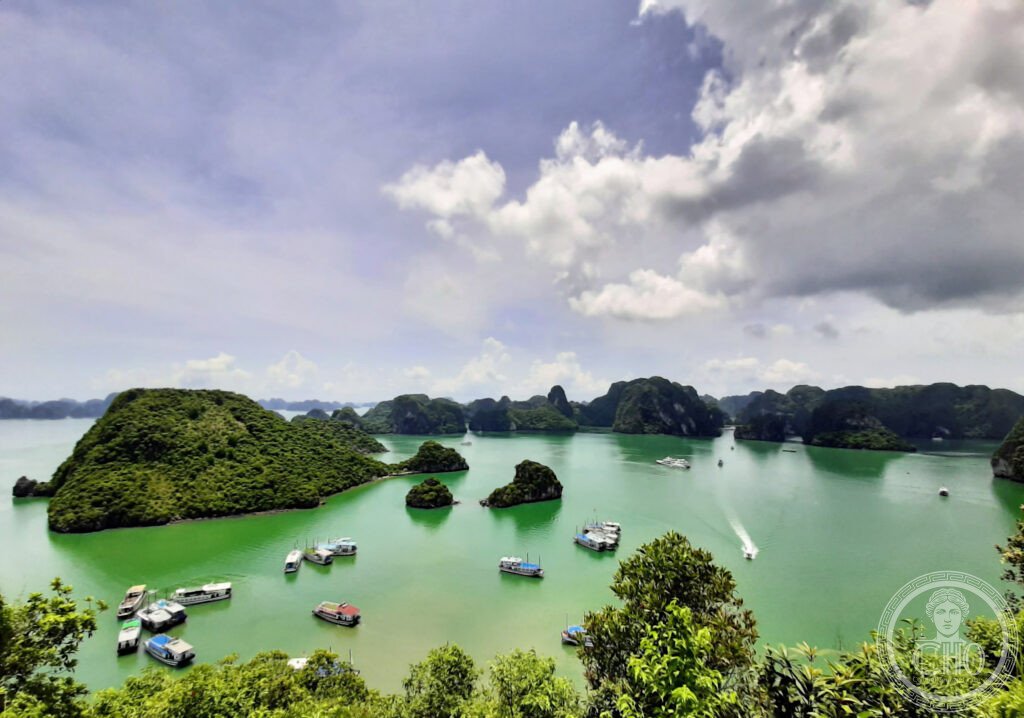
The most mythologically rich seascape in Asia and the finest example of karst limestone topography in the marine environment anywhere on Earth. Ha Long Bay, in the Gulf of Tonkin in north-eastern Vietnam, scatters 1,969 forested limestone pillars across 1,553 km² of emerald water in a landscape that the Vietnamese call the place where the Dragon descended to the sea.
At a glance
Ha Long Bay (UNESCO WHS 1994) was extended in 2000 to include the adjacent Bai Tu Long Bay and in 2011 to include the Cat Ba Archipelago: the most frequently extended single UNESCO natural heritage boundary in South-East Asia. The mythology: the name “Ha Long” means “Descending Dragon” in Vietnamese — the most evocative place name in Vietnamese geography. In the origin myth of Ha Long Bay the Jade Emperor sent a family of dragons to defend Vietnam from foreign invaders; the dragons descended and spat out jewels that became the islands and islets — the most complete mythology of a geological landscape in Vietnamese culture. The islands have secondary names from their shapes: the Fighting Cocks (Ga Choi), the Incense Burner, Sail Island, Toad Island; the most recognisable shape is the silhouette that appears on the Vietnamese 200,000 dong banknote — the most widely distributed image of Ha Long Bay. The geology is the karst limestone: the islands are the remnants of a massive shallow-sea limestone platform from the Carboniferous period, approximately 350 million years ago, uplifted and dissolved over millennia by tropical rainfall — the most complex karst dissolution landform visible from a boat anywhere in South-East Asia. There are 200+ caves within the bay. The most impressive is the Thiên Cung (Heavenly Palace Cave): 10,000 m² of stalactite and stalagmite formations in 7 chambers, the most dramatic cave interior in the bay, where the formations take the shapes of animals and deities in Vietnamese folk belief — the most anthropomorphised natural cave formations in Vietnam. The Đầu Gỗ Cave is the largest cave in Ha Long Bay by volume, with 3 enormous chambers, used by the Trần dynasty admiral Trần Hưng Đạo to store wooden stakes: the famous stakes used to sink Kublai Khan’s Mongol fleet in 1288 in the Battle of Bạch Đằng River — the most consequential military use of a cave in Vietnamese history.
Key facts
- The karst geology: the most complex marine limestone landscape in the world. The islands of Ha Long Bay are fengcong karst (a cluster of connected karst towers) and fenglin karst (isolated karst towers rising from an alluvial plain or water surface) — the most productive geological classification debate in the Vietnamese heritage literature, since UNESCO scholars have debated which Chinese-derived classification is most appropriate for Ha Long Bay ever since the 1994 inscription. The most important single fact about the Ha Long Bay karst is that the islands were once part of the same limestone platform as the interior of Quảng Ninh province: when sea levels rose after the last Ice Age, approximately 10,000–6,000 years ago, the plain was flooded and the limestone peaks became islands — the most dramatic sea-level-rise landscape-transformation in South-East Asian geography. Then the erosion. The tropical rainfall (2,000 mm per year), the seawater chemistry (carbonic acid from dissolved CO₂ dissolves the limestone at the sea surface level — the most active limestone dissolution process in any marine environment in South-East Asia), and the wind produce the mushroom-shaped undercut bases of many islands: the most visually striking erosion feature, where the islands appear to float because the base is narrower than the crown due to wave erosion at the tidal line.
- The cave systems: the most spectacular stalactite architecture in northern Vietnam. The Surprise Cave (Sửng Sốt) is the most visited cave in Ha Long Bay, with 3 chambers. The third chamber is the most impressive: 10,000 m² of floor area, a cathedral volume, where the stalactites and stalagmites have been illuminated in coloured lights since 2006 — the most frequently criticised lighting decision in Vietnamese heritage tourism. The coloured lights (pink, purple, orange, green) are considered by conservation purists to be the worst aesthetic intervention at any Vietnamese UNESCO site: popular with Vietnamese domestic tourists, deplored by most international visitors. The Thiên Cung Cave (Heavenly Palace) is the 10,000 m² cave described above, 4 km from the bay centre. The Kong Island is in Bái Tử Long Bay, the adjacent bay northeast of Ha Long: it was the film location for the 2017 film Kong: Skull Island (Peter Jackson was unavailable so Jordan Vogt-Roberts directed), the most significant Hollywood use of a Vietnamese UNESCO landscape as a film set. The bay received a measurable increase in visitor numbers in the 18 months following the film’s release — the most directly documentable tourism impact of a blockbuster film on any Vietnamese heritage site.
- The Cat Ba Langur: the most endangered primate in the world. The Cat Ba Langur (Trachypithecus poliocephalus; the white-headed langur endemic to Cat Ba Island; population in 2026: approximately 50–60 individuals — the most critically endangered primate in Asia and one of the 5 most critically endangered primates in the world; the decline (from approximately 2,500 individuals in the 1960s to the current 50 due to hunting and habitat loss — the most rapid large-mammal population collapse in Vietnamese history); the Cat Ba Langur Conservation Project (a German-funded initiative operating since 2000; the most effective single-species primate conservation project in Vietnam: the population has stabilised after reaching a low of approximately 35 individuals c. 2000; the most important conservation success story in the Cat Ba Archipelago); the cat ba langur can be seen from chartered boat tours around the southern sea stacks of Cat Ba Island (the only reliable wild-primate viewing location in northern Vietnam accessible by day trip from Ha Long City)).
- Heritage: UNESCO World Heritage Site, Ha Long Bay, inscribed 1994 (extended 2000, 2011).
- GPS: 20.9101° N, 107.1839° E.
History
Human history: Ha Long Bay has been inhabited by humans for at least 7,000 years. The Hòa Bình culture sites are the most important prehistoric culture in northern Vietnam, dated c. 10,000–2,000 BCE, and the Ha Long Bay shell middens from approximately 7,000 years ago are the most ancient evidence of human settlement in the bay area. Then the fishing culture: the Việt Muong and later Vietnamese fishing communities lived in floating villages in the bay for millennia — the most continuous marine-residential culture in northern Vietnam. The floating villages (làng chài) of Ha Long Bay have existed in approximately the same form for at least 500 years. The largest floating village, Cửa Vạn, had approximately 700 residents and was the most ancient continuously inhabited floating village in Ha Long Bay; it was recently relocated to shore as part of the government’s programme to move floating villages to land settlements — the most culturally consequential heritage management decision in Ha Long Bay in the 21st century. The last floating village residents left in 2019. Then the Mongol wars. At the Battle of Bạch Đằng River (1288) the Vietnamese general Trần Hưng Đạo, the most celebrated military commander in Vietnamese history, defeated the third Mongol invasion of Vietnam by driving the Mongol fleet into the Bạch Đằng estuary at low tide, where iron-tipped wooden stakes previously planted at low water impaled the fleet’s wooden hulls — the most ingeniously tidal military tactic in medieval South-East Asian history. The stakes were stored, according to legend, in the Đầu Gỗ cave in Ha Long Bay. UNESCO WHS 1994.
What you see
The most important single decision for a Ha Long Bay visit is the cruise. The overnight junk boat cruise is the standard and the most rewarding experience, and 2-night/3-day cruises are the optimal length for the central bay area plus Cat Ba Island. The best-value boats are mid-range Vietnamese-owned operators, the most frequently recommended in the independent travel community: Indochina Junk and Bhaya Cruises are historically the most reliable, while the luxury tier (Heritage Line vessels) is the finest but 4–5× the price. On timing, the best months are October–December and March–April, the most comfortable season: low humidity, calm seas, best visibility. The summer monsoon (June–August) brings rain and rough seas, but the mist on the water is the most atmospheric weather for photography. And the sunrise from the sun deck of a junk boat anchored in a cove surrounded by limestone pillars is the most celebrated sunrise moment in Vietnamese tourism.
Practical information
- Getting there: Hanoi Noi Bai Airport (HAN) is 55 km west of Hanoi city centre, and it is a 3h 30min drive from Hanoi to Ha Long City by tourist bus — the most common Ha Long approach for independent travellers, with coaches running from the Old Quarter. From Hanoi to Ha Long by Hai Phong hydrofoil is the fastest surface option: 2h 30min Hanoi port → Ha Long, operated by Cat Ba Express. Ha Long Airport (VDO; Vân Đồn International Airport) is 50 km north-east of Ha Long City, opened in 2018, with direct flights from Ho Chi Minh City (2h) and international charters: the most convenient airport for Ha Long Bay direct access. On the Ha Long Bay tour every visitor enters the bay by boat from Tuan Chau Marina or Ha Long International Cruise Port. The most confusing geographic fact about Ha Long Bay is that “Ha Long City” is on the mainland and the bay’s islands are all uninhabited, except Cat Ba: no visitor “stays” on a Ha Long Bay island in the conventional sense, and the overnight experience is on the boat.
- Hanoi and the Old Quarter: the finest Asian colonial city of the 19th century. Hanoi, the capital of Vietnam, lies 160 km south-west of Ha Long City and is the most compact and walkable historic city in South-East Asia. The Old Quarter (Hoan Kiem district) has 36 traditional guild streets (36 phố phường), the most completely surviving guild-street layout in any Asian city, each street named for the craft sold there: Hang Bac (silver), Hang Gai (silk and embroidery), Hang Ma (paper) — the most atmospheric single street market in Vietnam. The Hoan Kiem Lake has the Turtle Tower in its centre and is the most symbolically important urban lake in Vietnam, with the legend of the restored sword of Emperor Ly Thai To returned to the Golden Turtle god; the Temple of the Jade Mountain (Ngoc Son), on an island in the lake, is the most visited traditional temple in Hanoi. The Ho Chi Minh Mausoleum is the most strictly supervised monument in Vietnam: Ho Chi Minh’s embalmed body is displayed in a granite mausoleum, the most politically significant single body in Vietnamese public space, and the body is sent to Russia every autumn for maintenance — the most internationally mobile embalmed leader in the world. The Old Quarter egg coffee (cà phê trứng) is the most Hanoi-specific beverage in Vietnamese food culture: espresso with a whipped egg yolk and sugar foam, invented in the 1940s by Nguyen Giang at the Giang Café, which is still operating — the most frequently Instagrammed hot drink in northern Vietnam.
- Hội An Ancient Town (UNESCO WHS 1999) and Central Vietnam: the finest preserved trading port in South-East Asia. Hội An is 600 km south of Hanoi by train (the Reunification Express; 14h overnight; the most scenically dramatic section is Da Nang to Hue, passing over the Hai Van Pass, the most photographed mountain road in Vietnam). The Ancient Town is the most completely preserved example of a South-East Asian trading port of the 15th–19th centuries. The Japanese Covered Bridge, built in 1593, is the symbol of Hội An and the most frequently photographed colonial bridge in Vietnam. Of the merchant houses the best preserved is the Tan Ky Old House (1741), the most complete example of a Vietnamese-Chinese merchant residence with Japanese architectural elements — the most syncretic domestic architecture in any historic town in Vietnam. Every full moon the Old Town extinguishes its electric lights and fills the streets with silk lanterns: the most romantic urban lighting event in Vietnam. Hội An also has the highest density of bespoke tailoring shops per block of any city in Asia, and a competent tailor can produce a suit in 24–48 hours — the most frequently cited practical purchase on the Vietnamese tourist trail.
Getting there
Hanoi Noi Bai Airport (HAN). Bus from Hanoi Old Quarter to Ha Long City 3h 30min. All bay visits by boat from Tuan Chau Marina or Ha Long International Cruise Port. 2-night/3-day overnight junk cruise recommended. GPS: 20.9101, 107.1839.
Nearby
- Cat Ba Island and Archipelago. Adjacent to Ha Long Bay (2h by speedboat from Ha Long City). The largest island in the Ha Long-Cat Ba UNESCO complex and the only inhabited island in the bay. Cat Ba (Cat Ba National Park (2 km from Cat Ba town; 17,000 ha of primary rainforest, mangrove, and coral reef — the most biodiverse single island in northern Vietnam; the Cat Ba Langur conservation area (described in Key Facts; the most critically endangered primate in Asia; the Southern trail to the langur viewing area (3h round trip) is the finest wildlife hike in Cat Ba National Park); the Cat Ba town (the most convenient overnight base for Ha Long Bay independent travellers; the harbour-front guesthouses with the limestone karst backdrop — the finest budget accommodation scenery in Vietnam))).
- Phong Nha-Kẻ Bàng National Park (UNESCO WHS 2003). 500 km south of Hanoi (9h drive or overnight train to Đồng Hới + 45min car). The finest cave system in the world and the largest cave in the world. At Phong Nha, the Hang Sơn Đoòng is the largest cave in the world by volume: 5.5 km long, 200 m high, 150 m wide. It contains its own weather system, since clouds form in the cave interior — the most extraordinary single cave phenomenon in the world, an internal weather system. A separate jungle ecosystem has developed inside the cave on the floor, the most isolated jungle ecosystem in the world: the underground jungle is invisible from the cave entrance and is accessible only by a 2-day guided expedition through the cave. The tour is the most exclusive heritage tour in Vietnam: only 1,000 permits per year for Hang Sơn Đoòng, the tour is 6 days, and the permit costs USD 3,000 — the most expensive legal single-site adventure tourism experience in Vietnam.
- The Hue Imperial City (UNESCO WHS 1993). 700 km south of Hanoi (12h by Reunification Express overnight train from Hanoi; 3h from Da Nang which is 1h 30min flight from Hanoi). The best-preserved dynastic imperial complex in South-East Asia. The Hue Citadel is the Imperial City of the Nguyen dynasty (1802–1945), the last Vietnamese imperial dynasty, modelled on the Forbidden City in Beijing but adapted to Vietnamese aesthetic and climatic needs. The Purple Forbidden City is the innermost enclosure, with the residences of the emperor and the imperial family: the most restricted enclosure in Vietnamese royal history. The Royal Tombs are 7 Nguyen emperor tombs in the surrounding hills, the most architecturally varied funerary landscape in Vietnam; the finest is the Tomb of Minh Mạng, a perfect Chinese-Vietnamese synthesis with granite-roofed audience halls and a crescent lake — the most harmoniously designed imperial tomb garden in Vietnam. The Thien Mu Pagoda is the 7-storey pagoda on the Perfume River bank, the most recognisable temple silhouette in central Vietnam; it preserves the car (an Austin Westminster) of the monk Thich Quang Duc, who drove from Hue to Saigon and burned himself in protest against the Diem government in 1963 — the most politically consequential act of self-immolation in the 20th century.
Sources
- Wikipedia, Ha Long Bay. Cat Ba Langur. Battle of Bạch Đằng (1288), accessed June 2026.
- UNESCO, Ha Long Bay, WHS reference 672, inscribed 1994 (extended 2000, 2011).
- Fiona Terry and Brian O’Brien (eds), Place-Based Conservation: Ha Long Bay and Cat Ba Archipelago, IUCN, 2011.
Find it on the map
See this place and what’s around it →📷 Become a Cultural Heritage Online photographer
Share your photos of places: they stay published under your name as the author. The more they're seen, the more you get noticed — and soon a contest will reward the most appreciated photos.
Log in or sign up free to add a photo