
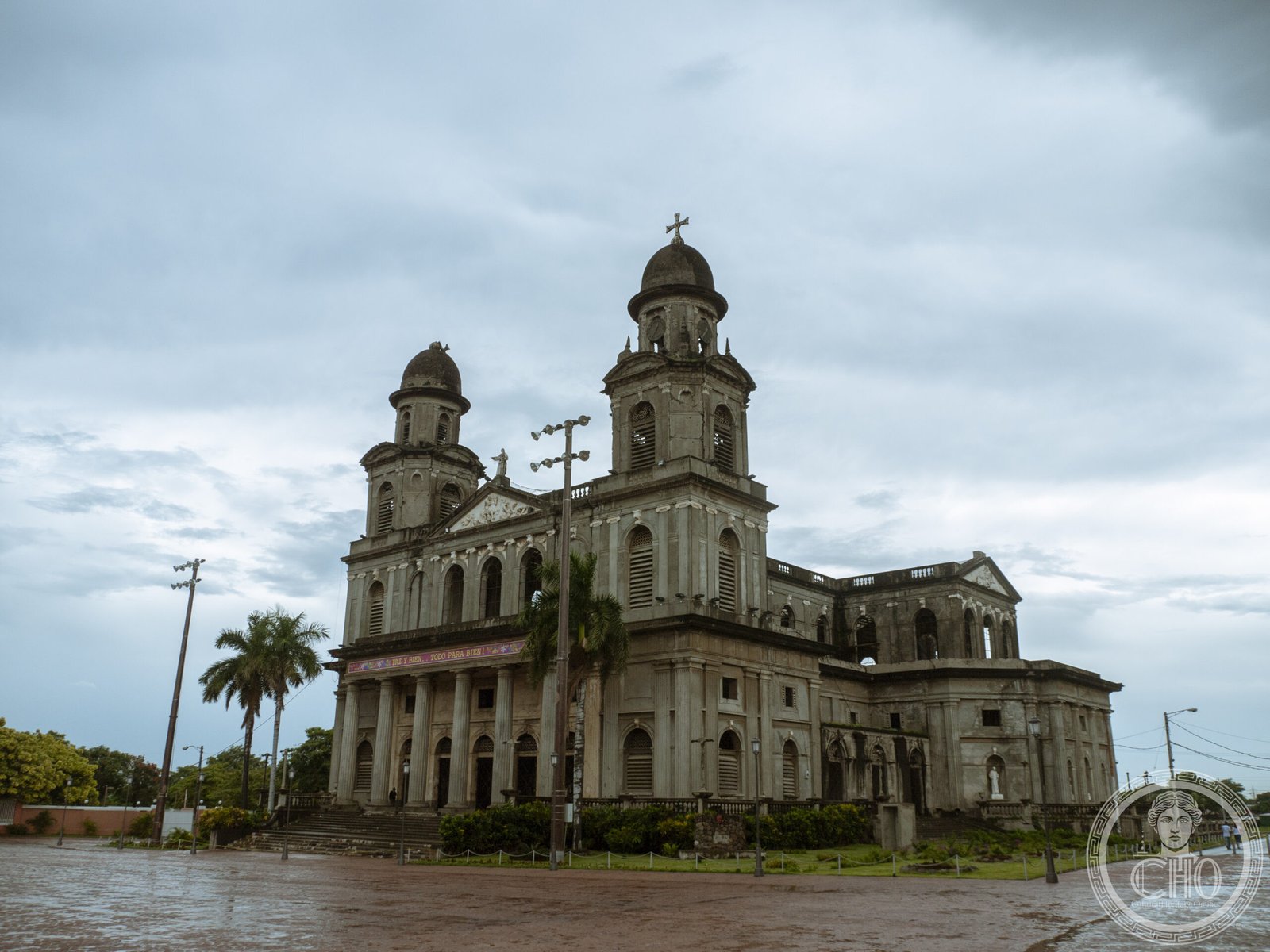
In Managua, in Nicaragua, the present ruin of the old cathedral stands on the site of a colonial parish church completed in 1783. Work on the building that later became the cathedral began with the laying of the first stone on 5 April 1925, with the inauguration on 1 December 1938 and the consecration as a cathedral, according to most sources, on 24 July 1946 (one source instead gives 1945). The structure, in Neoclassical style with Victorian and Renaissance elements according to some sources, echoes in its facade the church of Saint-Sulpice in Paris, at the wish of the first bishop of Managua, Monsignor Jose Antonio Lezcano y Ortega, who had studied in the French capital. The load-bearing prefabricated iron skeleton was shipped from Belgium and assembled on site under the direction of the engineer Pablo Dambach, whose nationality sources describe inconsistently as either Belgian or Swiss. On 31 March 1931, Holy Tuesday, an earthquake of estimated magnitude around 6 struck Managua, causing about 1,200-1,500 deaths: at that point only the metal skeleton of the cathedral had been erected, and it held while many other buildings in the city collapsed. On 23 December 1972, at 00:35, a new earthquake of magnitude around 6.2 devastated the city, with a death toll estimated between 10,000 and 20,000 people according to different sources: the cathedral building, by then completed, did not collapse but became structurally unstable and was closed, with the south tower clock left stopped, according to several sources, at the exact hour of the quake. A decree of the National Governing Junta of 1973 confiscated the city’s historic center and banned its reconstruction, passing the building from the ownership of the archdiocese to that of the Nicaraguan State, where it remains to this day; for about twenty years, from 1972 to 1993, Managua was left without an active cathedral. On 20 July 1979, about 200,000 people gathered, according to sources not fully independently verified, at the cathedral and the square in front of it, renamed that day Plaza de la Revolucion, to celebrate the fall of the Somoza regime and the triumph of the Sandinista revolution, with the bells rung and celebratory gunfire that reportedly struck the upper part of the bell tower of San Paolo. In the following decades several restoration attempts followed, none ever completed: presidential decree 127-2000 declared the building a historic and cultural heritage of the nation, promising funding mechanisms never substantially implemented; an offer of restoration from the Mexican president Vicente Fox in 2004 went nowhere; in March 2018 the architect Jose Francisco Teran Callejas called the restoration project “inviable”; a commission of experts was set up in February 2019 to evaluate Italian and Mexican technical diagnoses; a press headline from July 2024 still reported no signs of restoration, seven years after the last plan presented. Subsequent earthquakes, in 2014 and in 2022, caused further damage to the towers, and a structural diagnosis concluded that decades of neglect and damp caused more damage than the 1972 earthquake itself. The interior remains closed today and cordoned off for safety reasons, while the exterior and the surrounding area are open to visitors and lit at night. The new Metropolitan Cathedral of the Immaculate Conception, designed by the Mexican architect Ricardo Legorreta and inaugurated in 1993 with the financial contribution of the American businessman Tom Monaghan, founder of Domino’s Pizza, stands elsewhere in the city with its distinctive concrete domes, often nicknamed “the eggs”; an arson attack in July 2020 against the venerated image of the “Sangre de Cristo” took place in a chapel of this new cathedral, not in the old ruin, a distinction not to be confused.
About the Old Cathedral
In Managua, Nicaragua, the ruin of the old cathedral stands on the site of a colonial parish church completed in 1783. Construction of the building that later became the cathedral began with the laying of the first stone on 5 April 1925, was inaugurated on 1 December 1938, and consecrated as a cathedral, per most sources, on 24 July 1946. Built in a neoclassical style with, per some sources, Victorian and Renaissance elements, its facade echoed the church of Saint-Sulpice in Paris at the request of Managua’s first bishop, Monsignor José Antonio Lezcano y Ortega, who had studied in the French capital; its load-bearing iron skeleton was prefabricated and shipped from Belgium, assembled on site under engineer Pablo Dambach, whose nationality sources describe inconsistently as either Belgian or Swiss.
Key facts
- 31 March 1931: only the bare iron skeleton stands when an earthquake devastates Managua — and survives it.
- 1 December 1938: the completed cathedral is inaugurated.
- 23 December 1972: a devastating earthquake leaves the finished cathedral structurally unsafe, its tower clock frozen at the moment of impact.
- 1973: a government decree confiscates the historic center and bans reconstruction, transferring ownership from the Archdiocese to the State.
- 1972-1993: Managua has no active cathedral, until the new Metropolitan Cathedral opens elsewhere in the city.
- Multiple restoration attempts, from 2000 to 2019, have gone unexecuted; the ruin still stands today.
History
Built as a bare iron frame that outlasted the 1931 earthquake, then completed and consecrated by 1946, this cathedral was gutted by the catastrophic 1972 Managua earthquake and has stood as an unrepaired ruin ever since — confiscated by the state in 1973, symbolically present at the 1979 celebration of the Sandinista revolution’s triumph, and the subject of repeatedly announced but never-executed restoration plans across successive Nicaraguan governments.
What you see
A neoclassical facade modeled on Paris’s Saint-Sulpice frames a roofless, structurally unsound shell, its twin bell towers scarred by decades of subsequent earthquakes and, reportedly, celebratory gunfire in 1979. The south tower’s clock remains frozen at the moment of the 1972 earthquake, one of the ruin’s most photographed details.
Practical information
- Opening hours: exterior and grounds generally accessible; interior closed to the public for safety.
- Address: Distrito I, central Managua, near Plaza de la República and the Rubén Darío National Theater, Nicaragua.
Getting there
The ruin stands in Managua’s abandoned former city center, in Distrito I, near the Rubén Darío National Theater. GPS: 12°09′23″N, 86°16′17″W.
Nearby
- Rubén Darío National Theater — a short walk away in Managua’s historic center.
Sources
- Wikipedia (English and Spanish) — “Old Cathedral of Managua” and “Antigua catedral de Managua”
- ArchDaily — feature on the Old Cathedral and the new Metropolitan Cathedral of Managua.
- Presidential Decree No. 127-2000, La Gaceta No. 236, 13 December 2000 (Nicaraguan official gazette, via secondary reporting).
Find it on the map
See this place and what’s around it →📷 Become a Cultural Heritage Online photographer
Share your photos of places: they stay published under your name as the author. The more they're seen, the more you get noticed — and soon a contest will reward the most appreciated photos.
Log in or sign up free to add a photo