
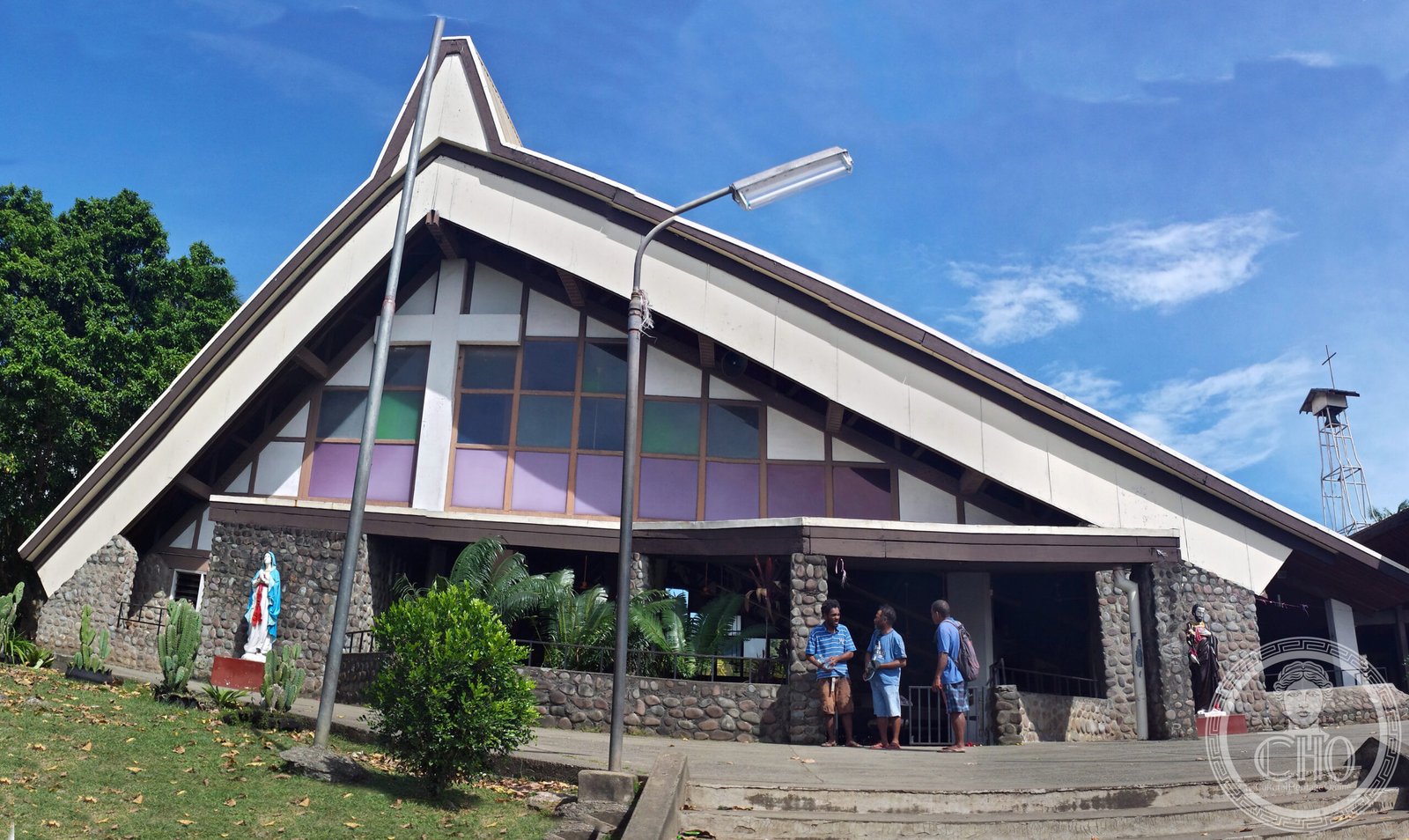
In Honiara, the capital of the Solomon Islands, on the island of Guadalcanal, the first pro-cathedral of the Holy Cross was made from a disused military Quonset hut, a leftover from the Second World War, and was blessed on 21 May 1957 by Bishop J. M. Aubin before, according to the sources, about 2,500 people. A brick recovered from the first Catholic mission station of the Solomons, founded in 1845, was set into the facade. The present building, on the same hill, had its foundation stone laid on 14 September 1976, to a design by the Melbourne architect Noel McKernan, who deliberately kept the “tent” shape of the Quonset hut it replaced. Built in a style inspired by Pacific architecture, without fixed side walls but with adjustable shutters for the tropical climate, and with an altar and lectern carved from local palm wood, it was completed in 1977 and consecrated on 17 September 1978 by the then bishop Daniel Stuyvenberg, a Marist. A marble statue of the Virgin, on display in the pro-cathedral, is said to have survived the wartime destruction of the mission at Visale, the historic Marist seat on the northwest coast of Guadalcanal since 1904, and it bears visible machine-gun bullet marks. That is a physical link, through transfer, to the older mission — not proof that the current cathedral site itself was bombed, since neither the pro-cathedral nor the present building yet existed during the war. The most dramatic link to the Second World War concerns the Marist order that leads the archdiocese today. In August 1942, in the massacre at the Ruavatu mission on the north coast of Guadalcanal, the Marist priests Arthur Duhamel and Henry OudeEngberink and two sisters, after days of torture, were killed with bayonets by Japanese forces for refusing to cooperate militarily. A third sister, Sister Edmee, escaped and was the only witness. Catholic missionary activity in the Solomons began with the French Marist fathers, sent to the South Pacific from 1837. The first bishop for Melanesia, Jean-Baptiste Epalle, was mortally wounded a few days after arriving at San Cristobal in 1845. The apostolic prefecture of the British Solomon Islands was erected on 27 July 1897 by Pope Leo XIII, raised to an apostolic vicariate in 1912, to a diocese in 1966 and to a metropolitan archdiocese in 1978 by Pope John Paul II, with the bull “Laetentur insulae multae”, the first ecclesiastical province created by that same pope. The first archbishop was Daniel Stuyvenberg (1978-1984); the present archbishop is Monsignor Christopher Michael Cardone, a Dominican, in office since 2016. John Paul II is said to have visited Honiara on 9 May 1984, though this date comes from secondary sources not fully verified against a primary Vatican itinerary. According to local tradition, reported by Wikipedia but not confirmed by primary academic sources, the cathedral hill is said to coincide with the place where the expedition of Alvaro de Mendana planted the first Christian cross of the Solomons in 1568 and celebrated the first mass in the archipelago — a claim to be treated as tradition, not as established fact.
About Holy Cross Cathedral
In Honiara, the capital of the Solomon Islands, on Guadalcanal, the first Holy Cross pro-cathedral was made from a disused wartime military Quonset hut and blessed on 21 May 1957 by Bishop J. M. Aubin before, per sources, roughly 2,500 people; a brick salvaged from the Solomons’ first Catholic mission station, founded in 1845, was set into its façade. The current building, on the same hill, had its foundation stone laid on 14 September 1976, designed by Melbourne architect Noel McKernan, who deliberately echoed the “tent-like” shape of the Quonset hut it replaced.
Key facts
- 21 May 1957: a pro-cathedral built from a surplus WWII Quonset hut is blessed.
- 14 September 1976 – 17 September 1978: the current cathedral built and consecrated.
- August 1942: Marist priests and sisters are killed by Japanese forces in the Ruavatu mission massacre nearby.
- 1978: elevated to Metropolitan Archdiocese by Pope John Paul II’s first ecclesiastical-province bull.
- 9 May 1984: Pope John Paul II reportedly visits Honiara, though the date rests on secondary sources.
- 2016: Archbishop Christopher Michael Cardone, O.P., takes office.
History
Built first from a leftover American military Quonset hut in 1957, then rebuilt in 1978 with a design deliberately echoing that hut’s tent-like shape, this cathedral embodies Honiara’s own postwar origins as a city built on the ruins of the Guadalcanal campaign. Its bullet-marked Virgin statue, carried from the Marist mission of Visale, and its order’s own documented wartime martyrs at Ruavatu tie the cathedral to a Catholic mission history that suffered real, violent loss during the Pacific War before the current building ever existed.
What you see
A tent-shaped structure with no fixed side walls but adjustable shutters for the tropical climate reflects both Pacific architectural tradition and the Quonset-hut pro-cathedral it replaced, its altar and lectern carved from local palm wood.
Practical information
- Opening hours: generally open daily outside services; check current hours before visiting.
- Address: Mendana Avenue, Honiara, Guadalcanal, Solomon Islands.
Getting there
The cathedral stands on Cathedral Hill above Mendana Avenue, Honiara’s main waterfront road. GPS: 9°26′11″S, 159°57′48″E.
Nearby
- Point Cruz — the waterfront point associated with Álvaro de Mendaña’s 16th-century landing, a short distance away.
Sources
- Solomon Islands Encyclopaedia — “Holy Cross Catholic Cathedral” and “Honiara” entries (solomonencyclopaedia.net).
- Wikipedia — “Holy Cross Cathedral, Honiara” and “Roman Catholic Archdiocese of Honiara”
- Warfare History Network and Find a Grave — Ruavatu mission massacre, August 1942.
Find it on the map
See this place and what’s around it →📷 Become a Cultural Heritage Online photographer
Share your photos of places: they stay published under your name as the author. The more they're seen, the more you get noticed — and soon a contest will reward the most appreciated photos.
Log in or sign up free to add a photo