

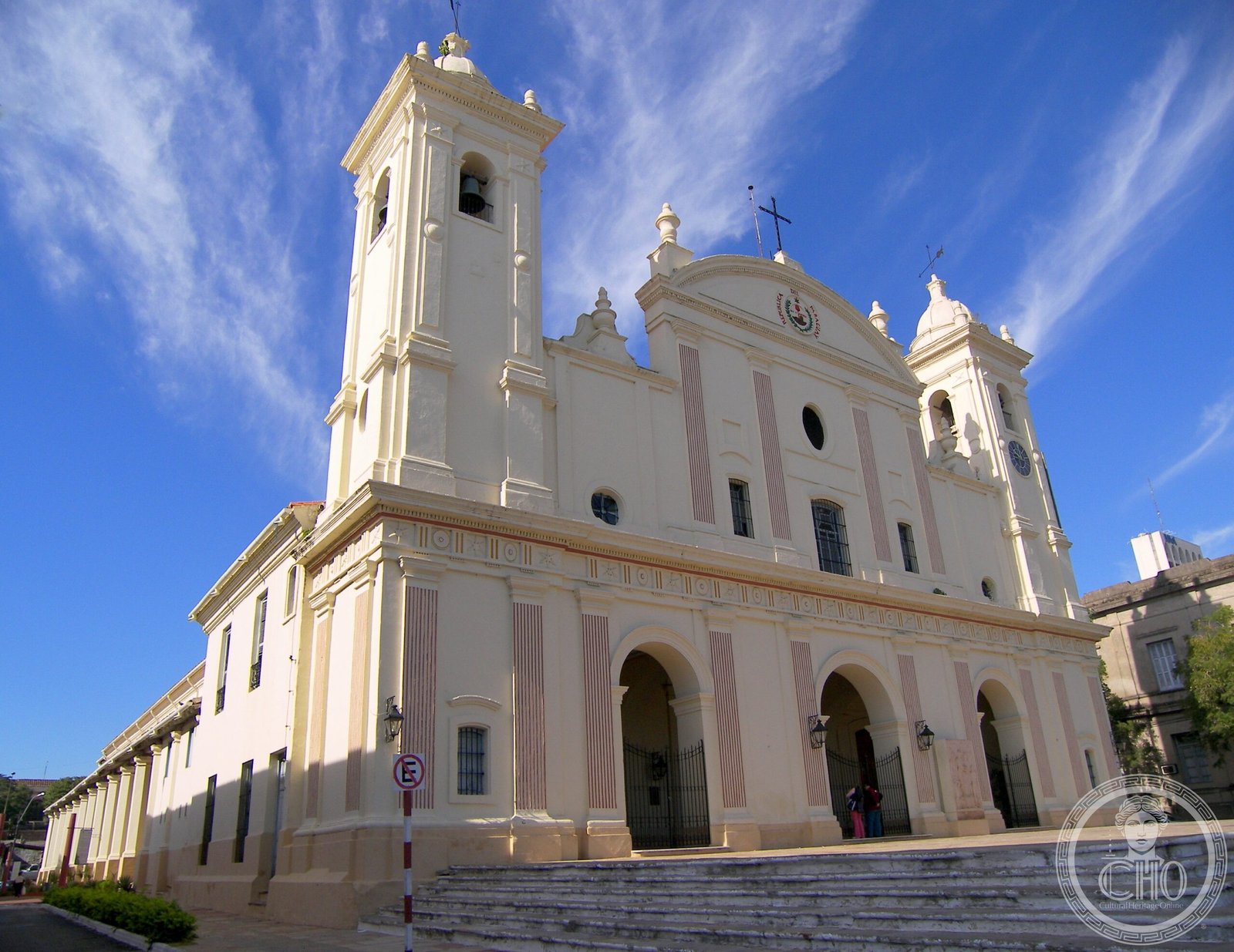
In Asunción, Paraguay, the present cathedral seat is at least the fourth, and by some accounts the fifth, to stand on this site since 1539. In that year a first church of wood and mud, «La Encarnación», was built, and it was destroyed by the fire that struck the city on 4 February 1543. The rebuildings that followed, formally made the cathedral seat on 10 January 1548, decayed again and again from rotting wood and adobe and from the floods of the river, until a building raised after 1687 which took in, during a renovation of 1791, material from the disused Jesuit church of Asunción. That building was demolished in February 1842 to make room for the present cathedral. Work on the building of today began on 10 May 1842 under the government of President Carlos Antonio Lopez, to a design by the Basque architect Pascual de Urdapilleta, chosen by competition, with the assistants Carlos Zucchi, Patricio Aquino and Tomas Berges. The cathedral was blessed, still unfinished, on 27 October 1845 by the vicar general Monsignor Pedro Jose Moreno, since Bishop Basilio Lopez was ill. Neoclassical in style, with the high altar clad in silver, the building keeps in its tower the largest and oldest bell, brought according to academic sources from the Jesuit-Guaraní village of San Cosme y Damian in 1760. A painting of the Virgin and Child, from San Ignacio, arrived instead much later, during the presidency of Benigno Ferreira (1906-1908), and not in the dispersal that followed the expulsion of the Jesuits in 1767-68, as is sometimes assumed. The largest transfer of works, four altarpieces, ten images of saints and a gilded tabernacle, with the images of Saint Ignatius and Saint Francis recut as Saint Peter and Saint Paul, came instead from the urban Jesuit church in Asunción itself, a city institution distinct from the rural Guaraní missions: a distinction worth keeping, so as not to overstate the link with the reducciones properly so called. The diocese of Paraguay was erected on 1 July 1547 by Pope Paul III and raised to metropolitan archdiocese on 1 May 1929 by Pope Pius XI, under Archbishop Sinforiano Bogarin. The present archbishop is Cardinal Adalberto Martinez Flores, appointed on 17 February 2022 and made cardinal on 27 August 2022, the first cardinal in the history of Paraguay. No specific damage to the building is documented during the War of the Triple Alliance (1864-1870) or the Chaco War (1932-1935). A single press source, explicitly as a hypothesis, reports that the underground crypts were walled up by the Lopez government shortly before the Triple Alliance for fear of looting, a detail to be treated with caution. Pope Francis visited the cathedral on 11 July 2015, celebrating vespers there with bishops, priests, religious and Catholic movements during his apostolic journey to Paraguay, an event distinct from the Mass of the same day at the Marian sanctuary of Caacupé. John Paul II is also said to have met priests and religious there on 17 May 1988, although this second fact comes with only medium reliability from secondary sources.
About the Metropolitan Cathedral
In Asunción, Paraguay, the current cathedral is at least the fourth, and by some reconstructions the fifth, building to stand on this site since 1539, when a first wood-and-mud church, “La Encarnación,” was destroyed by the fire that struck the city on 4 February 1543. Successive rebuilds, formally designated the cathedral seat on 10 January 1548, repeatedly decayed from rotting timber, adobe, and river flooding, until a post-1687 building — which incorporated material from Asunción’s disused Jesuit church in an 1791 renovation — was demolished in February 1842 to make way for today’s cathedral.
Key facts
- 10 May 1842: construction begins on the current, Neoclassical cathedral.
- 27 October 1845: blessed while still unfinished, the bishop too ill to attend.
- 1760: the cathedral’s oldest and largest bell arrives from the Jesuit-Guaraní mission town of San Cosme y Damián.
- 1 May 1929: elevated to a metropolitan archdiocese by Pope Pius XI.
- 11 July 2015: Pope Francis celebrates Vespers here during his apostolic journey to Paraguay.
- 27 August 2022: Archbishop Adalberto Martínez Flores becomes Paraguay’s first-ever cardinal.
History
Rebuilt repeatedly since 1539 after fire, flood, and structural decay, this cathedral’s current Neoclassical form dates only to 1842, though its tower still rings a bell carried from a Jesuit-Guaraní mission town in 1760 — a rare, well-documented thread connecting an urban cathedral to Paraguay’s vanished rural reducciones, distinct from the larger cache of altarpieces and sculptures that actually came from the Jesuits’ own city church in Asunción. No documented damage ties the building to Paraguay’s two catastrophic modern wars, the War of the Triple Alliance or the Chaco War, though Pope Francis’s 2015 visit and Cardinal Adalberto Martínez Flores’s 2022 elevation as Paraguay’s first cardinal mark its more recent chapters.
What you see
A Neoclassical facade by Basque architect Pascual de Urdapilleta fronts an interior with a silver-plated high altar, its tower bell salvaged from the Jesuit-Guaraní mission of San Cosme y Damián in 1760, decades before the missions themselves were dissolved.
Practical information
- Opening hours: generally open daily outside services; check current hours before visiting.
- Address: Independencia Nacional, between Avenida Mariscal López and Comuneros, Barrio Catedral, Asunción, Paraguay.
Getting there
The cathedral stands in Asunción’s historic Barrio Catedral, on Independencia Nacional. GPS: 25°16′54″S, 57°37′57″W.
Nearby
- Barrio Catedral — Asunción’s historic district surrounding the cathedral.
Sources
- Durán Estragó, Margarita — La Iglesia Catedral de Asunción 1537-1987, Universidad Católica, 1987 (via portalguarani.com).
- Wikipedia (Spanish and English) — “Catedral metropolitana de Asunción” and “Asunción Cathedral”
- Vatican.va — official itinerary, Apostolic Journey of Pope Francis to Ecuador, Bolivia and Paraguay, 5-13 July 2015.
- Catholic-Hierarchy.org and GCatholic.org — Archdiocese of Asunción listings.
Find it on the map
See this place and what’s around it →📷 Become a Cultural Heritage Online photographer
Share your photos of places: they stay published under your name as the author. The more they're seen, the more you get noticed — and soon a contest will reward the most appreciated photos.
Log in or sign up free to add a photo