

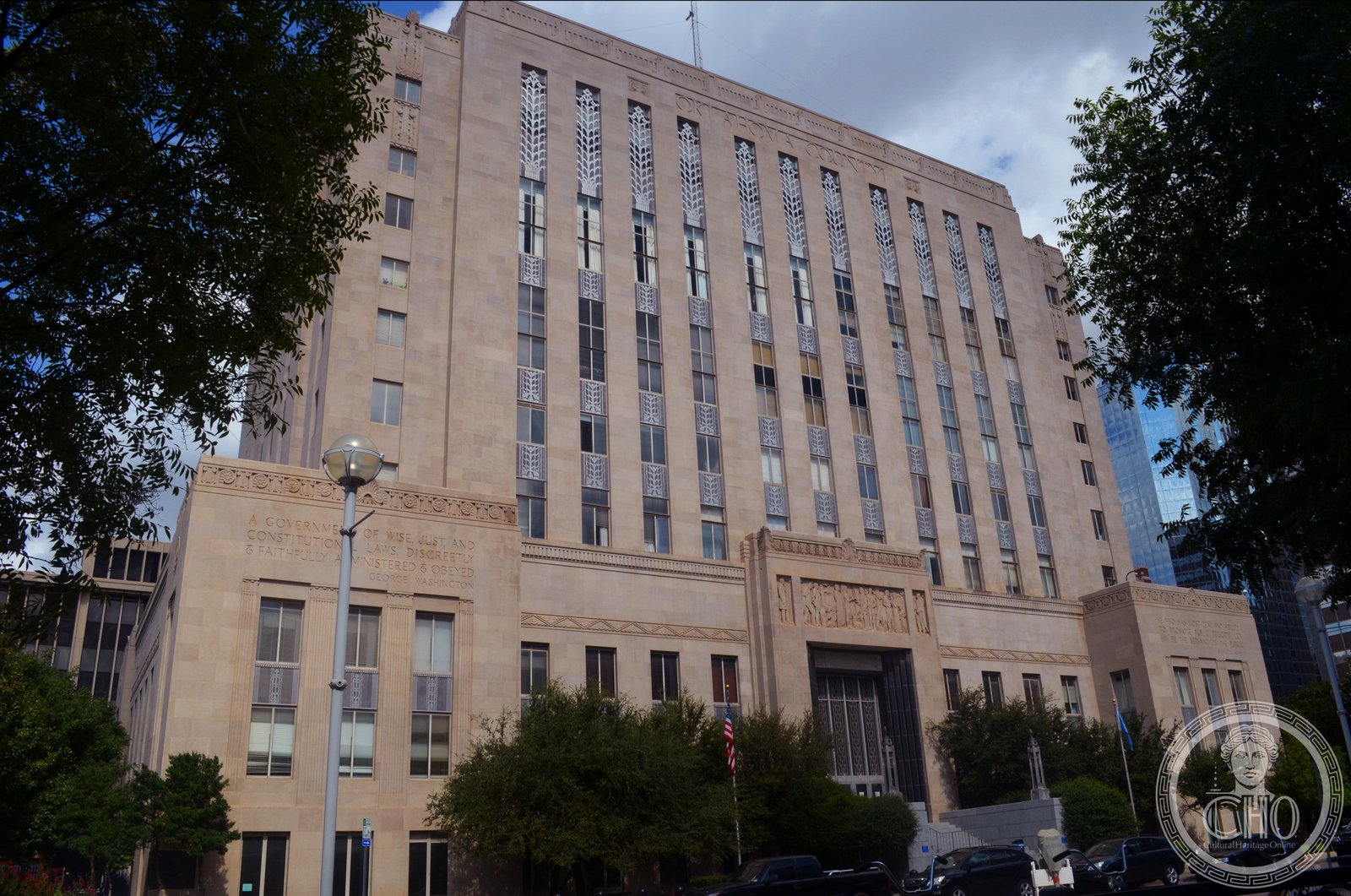
Built with New Deal money at the height of the Depression and loosely modeled on the stepped profiles of Mayan temples, the Oklahoma County Courthouse brings an earthbound gravity to downtown Oklahoma City that its Indiana limestone has only deepened over eighty years.
At a glance
Completed in 1937 at 321 Park Avenue in downtown Oklahoma City, the Oklahoma County Courthouse is an eleven-story Art Deco and Art Moderne civic structure designed by the prominent Oklahoma architectural firm Layton & Forsyth—Solomon Layton, George Forsyth, and Jewel Hicks. The $1.5 million building, funded jointly by county bonds and a grant from the federal Public Works Administration, replaced a nineteenth-century courthouse that had long outgrown county government. Listed on the National Register of Historic Places in 1992, the courthouse remains in active use as Oklahomacounty’s primary judicial and administrative facility.
Key facts
- Completed: 1937
- Architect: Solomon Layton, George Forsyth, Jewel Hicks (Layton & Forsyth)
- Contractor: Manhattan Construction Co.
- Style: Art Deco / Art Moderne (PWA Moderne)
- Cost: $1.5 million (bond issue + PWA grant)
- Floors: 11
- Address: 321 Park Ave., Oklahoma City, OK 73102
- NRHP: March 5, 1992 (ref. 92000126); County Courthouses of Oklahoma TR
- GPS: 35.46889°N, 97.52056°W
History
By the 1930s, Oklahoma County’s original courthouse—a two-story brick building completed in the 1900s—was visibly inadequate for a county whose population had grown with the oil economy. In 1937, county officials secured both a local bond issue and a Public Works Administration grant to fund a replacement. The PWA, the New Deal agency responsible for hundreds of public buildings across the country during the Depression, brought federal scrutiny to the design process: buildings receiving its funds were expected to project civic dignity and, implicitly, economic confidence.
The commission went to Layton & Forsyth, the firm founded by Solomon Layton, the most prolific architect in Oklahoma state history. Layton had already designed the Oklahoma State Capitol and numerous other public buildings across the state. His partners George Forsyth and Jewel Hicks executed the courthouse design, which was completed and occupied in 1937. A modern annex building was added in 1967 immediately adjacent to the courthouse and connected to it by a covered walkway, leaving the original Art Deco tower intact.
What you see
Architectural historians have described the courthouse as “loosely abstracted from stepped-back Mayan temples”—a reference to the building’s profile of receding setbacks and its flat, almost hieratic exterior ornament. The entire structure is sheathed in sandy-brown Indiana limestone, a material that absorbs the intense Oklahoma light rather than reflecting it, giving the courthouse a heaviness and permanence that sets it apart from lighter neoclassical contemporaries. Inscribed quotations run at several levels across the facade, adding a textual layer to the formal geometry.
Inside, the two-story lobby is the building’s most dramatic space: the floor is laid in terrazzo with a large compass rose at its center, the chandeliers are abstracted wagon-wheel forms in cast metal, and third-floor balcony overlooks give the space its double-height volume. A carved mural panel depicts an allegorical “scene of Oklahoma friendship” between a Native American figure and a Mountain Man—a regional narrative embedded in stone at the heart of the building.
Practical information
- Current use: Active county courthouse; lobby accessible during court hours (weekdays)
- Hours: Monday–Friday, standard business hours; courthouse security at entry
- Photography: Exterior freely photographable; interior photography at security discretion
- Note: The 1967 annex building is immediately adjacent; the original tower is clearly identifiable by its limestone cladding and Deco setbacks
Getting there
The Oklahoma County Courthouse stands at 321 Park Avenue in the civic core of downtown Oklahoma City. It is two blocks north of the Myriad Botanical Gardens and within easy walking distance of the Oklahoma City National Memorial and Museum. Will Rogers World Airport is approximately 9 miles southwest. Metered street parking is available along Park Avenue and Robinson Avenue; several municipal parking garages serve the downtown courthouse district.
Nearby
- Oklahoma City National Memorial & Museum — three blocks southeast; commemorating the 1995 federal building bombing
- First National Center Oklahoma City — one block west; 1931 Art Deco skyscraper with restored lobby
- Myriad Botanical Gardens — four blocks south; 17-acre downtown park
Sources
- National Register of Historic Places listing #92000126, March 5, 1992; County Courthouses of Oklahoma TR
- Parker, John. “The Oklahoma County Courthouse.” Oklahoma City Downtown Monthly, June 2004 (via Oklahoma County website)
- Breeze, Carla. American Art Deco: Architecture and Regionalism. W. W. Norton, 2003, pp. 19, 113
- Oklahoma County government records, oklahomacounty.org
Find it on the map
See this place and what’s around it →Record researched and written by Luigi De Marchi for Cultural Heritage Online, 2026.
📷 Become a Cultural Heritage Online photographer
Share your photos of places: they stay published under your name as the author. The more they're seen, the more you get noticed — and soon a contest will reward the most appreciated photos.
Log in or sign up free to add a photoIs this page about you?
This page is read by travellers and heritage enthusiasts who find it on Google. Tell us how you are connected to this place and we will take it from there.