
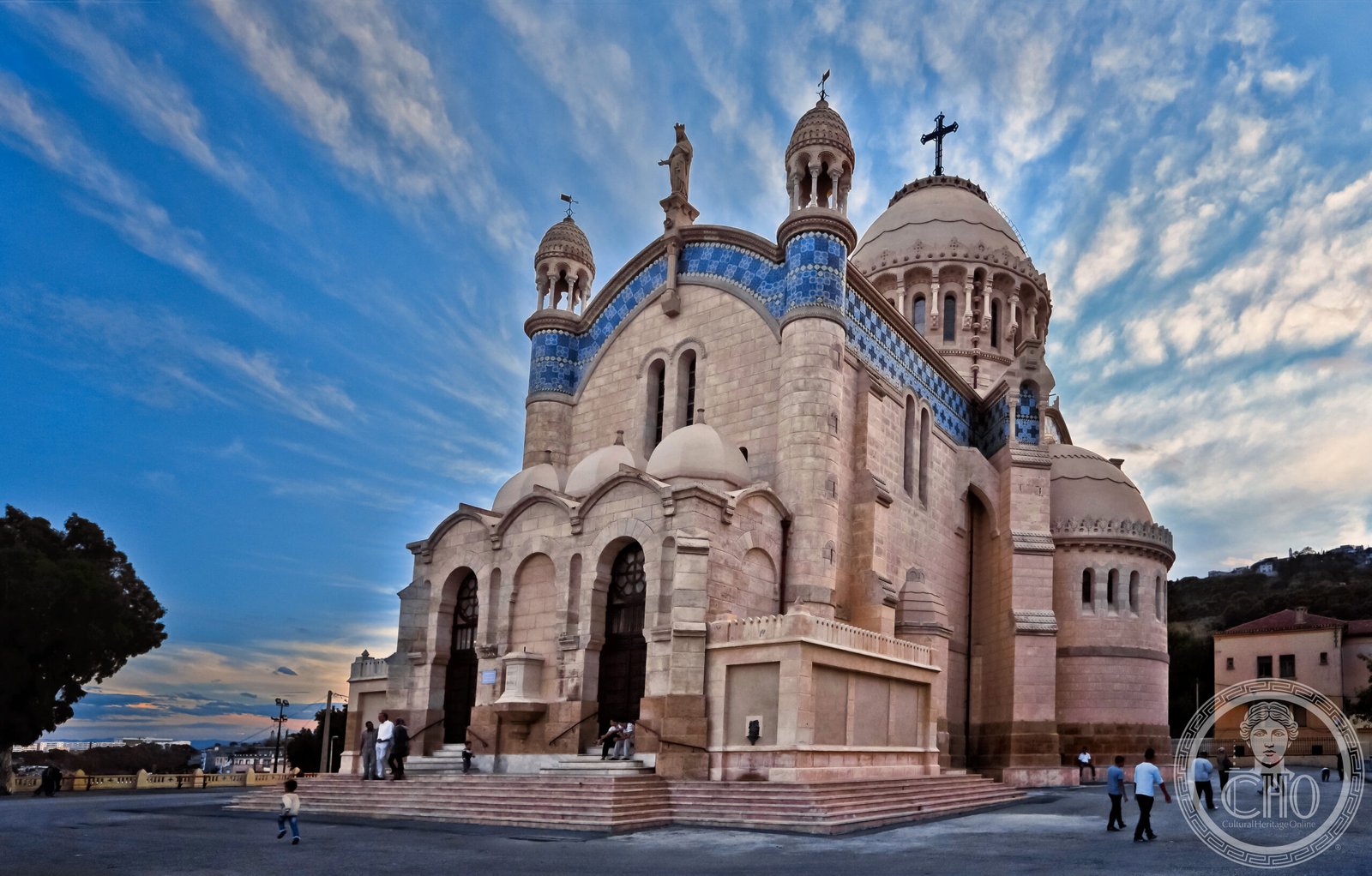
Overlooking the bay of Algiers, on a rocky spur in the district of Bologhine, the basilica of Notre-Dame d’Afrique was built between 1858 and 1872 to a Neo-Byzantine design by the architect Jean-Eugène Fromageau. A temporary chapel had already stood on the same site in 1857. The works began under Bishop Louis-Antoine-Augustin Pavy and were completed by Archbishop Charles Lavigerie, who consecrated the building on 2 July 1872. Pope Pius IX raised it to the rank of minor basilica in 1876, and the statue of the Virgin was canonically crowned on 30 April of the same year by Cardinal Lavigerie himself. On the wall of the apse an inscription reads «Notre-Dame d’Afrique, priez pour nous et pour les musulmans», Our Lady of Africa, pray for us and for the Muslims. According to the official website of the shrine the text was there from the beginning, although the exact date of its composition and the name of whoever wanted it are not documented in any source found. The shrine was entrusted to the White Fathers, the Missionaries of Africa, in 1868, and to the Missionary Sisters of Notre-Dame d’Afrique in 1869. It survived the Algerian war of independence, from 1954 to 1962, and the decades that followed, though it fell into disrepair towards the end of the twentieth century. The available sources report this only in passing, and give no detailed account of how the building went on working after the almost complete emigration of the European Catholic population of independent Algeria. A bombardment on 16 April 1943 damaged it and destroyed part of the original stained glass installed between 1868 and 1873, and the Boumerdès earthquake of May 2003 struck it again. The basilica was restored between 2007 and 2010 and reopened on 13 December 2010, in a project worth 5.1 million euros promoted by Archbishop Henri Teissier and funded by the European Union, the French state, the Provence-Alpes-Côte d’Azur region, the Bouches-du-Rhône department, the city of Marseille and the wilaya of Algiers. Today the basilica is both an active parish, with daily mass at 18 and Friday mass at 10:30, and one of the most visited sights in Algiers, in a country now overwhelmingly Muslim. On 13 April 2026 Pope Leo XIV came here on a visit, meeting the Algerian Christian community and listening to the testimony of lay faithful who serve in the church. In the official text published by the Holy See he called the basilica a sign of our desire for peace and unity, a Church of living stones, where communion between Christians and Muslims comes about.
About the Basilica
The Basilica of Notre-Dame d’Afrique, on a rocky outcrop above the Bay of Algiers, is a Neo-Byzantine Catholic church built 1858–1872 by architect Jean-Eugène Fromageau and consecrated by Archbishop Charles Lavigerie. Elevated to minor basilica status in 1876, it remains an active parish and one of Algiers’s most-visited landmarks.
Key facts
- 1858–1872: built under Bishop Louis-Antoine-Augustin Pavy, completed and consecrated by Archbishop Charles Lavigerie on 2 July 1872.
- 1876: elevated to minor basilica by Pope Pius IX; Marian statue canonically crowned 30 April 1876.
- Apse inscription: “Notre-Dame d’Afrique, priez pour nous et pour les musulmans” (“pray for us and for the Muslims”).
- 16 April 1943: damaged by wartime bombing, destroying part of its original stained glass.
- 2007–2010: €5.1 million restoration after damage from the 2003 Boumerdès earthquake; reopened 13 December 2010.
- 13 April 2026: visited by Pope Leo XIV, who met the local Christian community there.
History
Built during French colonial rule and consecrated in 1872, Notre-Dame d’Afrique has functioned for over 150 years in a city and country that were overwhelmingly Catholic under colonization and are now overwhelmingly Muslim after independence in 1962 — its own apse inscription explicitly praying for Muslims alongside Christians. Damaged by wartime bombing in 1943 and by earthquake in 2003, it was extensively restored with international funding by 2010, and continues as a functioning parish and major tourist site, recently visited by Pope Leo XIV in April 2026 as a symbol of Christian-Muslim coexistence in Algeria.
What you see
A Neo-Byzantine domed exterior in banded stone overlooking the sea, with a monumental statue of the Virgin Mary and cross visible from the bay; the interior, restored after earthquake and wartime damage, retains 19th-century stained glass and the apse inscription dedicating the sanctuary to both Christians and Muslims.
Practical information
- Opening hours: daily Mass at 18:00, Friday Mass at 10:30; check current visiting hours before travel.
- Address: Bologhine district, Algiers, Algeria, overlooking the Bay of Algiers.
Getting there
The basilica stands on a hilltop above the Bologhine district, overlooking the Bay of Algiers. GPS: approximately 36.8011°N, 3.0425°E (sources vary by roughly 150–200 metres; treat as indicative).
Nearby
- Bay of Algiers — the basilica’s hilltop site offers sweeping views over the harbor and the city below.
Sources
- Wikipedia (English and French) — “Notre-Dame d’Afrique,” “Basilique Notre-Dame-d’Afrique”
- notre-dame-afrique.org — official basilica history page.
- Vatican.va — official text of Pope Leo XIV’s 13 April 2026 address at the basilica.
- eglise-catholique-algerie.org — Catholic Church in Algeria, parish information.
- peresblancs.org — Missionaries of Africa (White Fathers) historical records.
Find it on the map
See this place and what’s around it →📷 Become a Cultural Heritage Online photographer
Share your photos of places: they stay published under your name as the author. The more they're seen, the more you get noticed — and soon a contest will reward the most appreciated photos.
Log in or sign up free to add a photo