
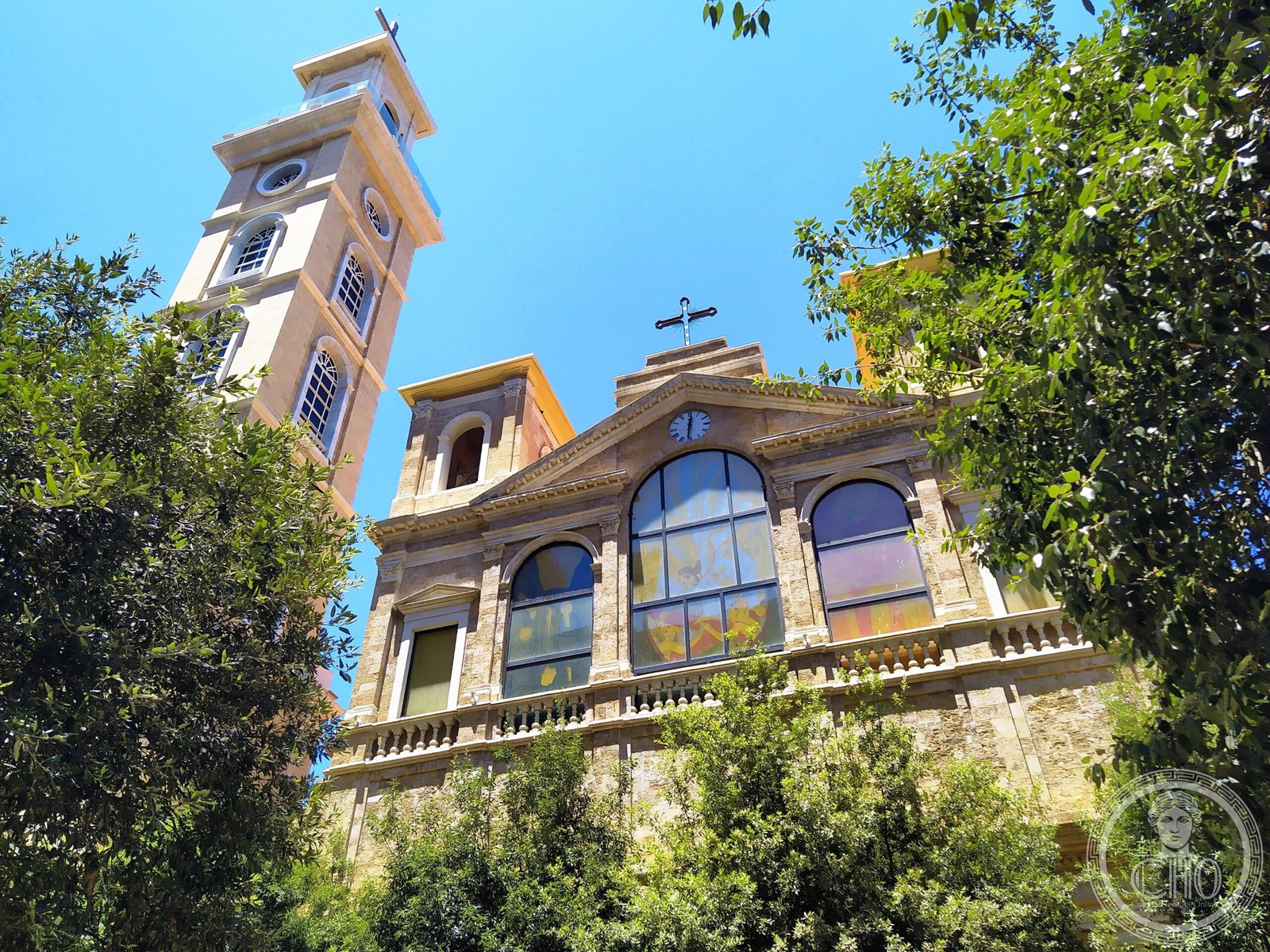
On Nejmeh Square, in the heart of the old centre of Beirut, the Maronite Catholic cathedral of Saint George stands beside the Mohammad al-Amin mosque. A few metres away is the separate Greek Orthodox cathedral of Saint George, an older building (1767-1772) with which it is sometimes confused, although they are two distinct churches of two different Christian denominations. A first Maronite building stood on the same site as early as 1753-1755. The present cathedral was begun in 1884 under Archbishop Youssef Debs and consecrated on Palm Sunday of 1894, to a neoclassical design by the Italian architect Giuseppe Maggiore, inspired by the Roman basilica of Santa Maria Maggiore, with reused columns taken from the ruins of the Roman temple of Deir el-Qalaa, at Beit Mery. During the Lebanese civil war (1975-1990), whose dividing line, the so-called «Green Line», ran right by the old centre, the cathedral was badly damaged, looted and defaced, and lost, according to some sources, a painting of Saint George attributed to Delacroix. The rebuilding was completed in 1997 and the building was reconsecrated on 24 April 2000 by the Maronite patriarch Nasrallah Boutros Sfeir. The present bell tower, 72 metres high and crowned by a cross of 7 metres, was inaugurated on 19 November 2016 by the archbishop of Beirut, Paul Matar. Its height was deliberately reduced from an initial design of 75 metres, so as not to rise above the minarets of the neighbouring Mohammad al-Amin mosque: an explicit gesture of interfaith harmony in a city that still carries the scars of the civil war. On 4 August 2020 the explosion at the port of Beirut damaged the cathedral’s stained glass, frescoes, plaster and fittings, restored only a few years before. A recovery project funded by a grant of 184,830 dollars from the international ALIPH foundation, carried out between 2020 and 2022 by the French Catholic organisation Œuvre d’Orient, is now reported as finished. The cathedral is the seat of the Maronite archeparchy (archdiocese) of Beirut, a district distinct from the patriarchal see proper, which is at Bkerke, north-east of the city, where the present Patriarch of Antioch of the Maronites, Cardinal Beshara Boutros Rai, has resided since 2011. The Maronite Church is the largest Christian denomination in Lebanon: on the estimates of the United States State Department, based on Statistics Lebanon data, about 16% of the country’s total population and more than half of its Christian component, though Lebanon has held no official census since 1932, precisely because of the political sensitivity of the confessional power-sharing system. By convention, since the National Pact of 1943, later rebalanced by the Ta’if accords of 1989, the presidency of the Lebanese Republic belongs to a Maronite.
About the Cathedral
The Maronite Catholic Cathedral of Saint George, on Nejmeh Square in downtown Beirut, is the seat of the Maronite Archeparchy of Beirut, built 1884–1894 in neoclassical style by Italian architect Giuseppe Maggiore. It stands beside the Mohammad Al-Amin Mosque and near, but distinct from, the older Greek Orthodox Cathedral of Saint George.
Key facts
- 1884–1894: current cathedral built under Archbishop Youssef Debs, consecrated Palm Sunday 1894.
- Architect Giuseppe Maggiore modeled the design on Rome’s Santa Maria Maggiore basilica.
- 1975–1990: severely damaged, looted and defaced during the Lebanese Civil War.
- 24 April 2000: reconsecrated by Maronite Patriarch Nasrallah Boutros Sfeir after 1997 rehabilitation.
- 19 November 2016: 72-metre bell tower inaugurated, deliberately kept below the height of the neighboring mosque’s minarets.
- 4 August 2020: damaged by the Beirut port explosion; restored 2020–2022 with an ALIPH Foundation grant.
History
A Maronite church has stood on this site since the mid-18th century, but the current cathedral dates to 1884–1894, replacing the earlier building as Beirut’s Maronite community grew. Severely damaged during Lebanon’s 1975–1990 civil war, when the fighting’s demarcation line ran near the historic center, the cathedral was rebuilt and reconsecrated in 2000, gained its landmark bell tower in 2016, and was damaged again — along with much of downtown Beirut — by the catastrophic port explosion of 4 August 2020, before a further international-funded restoration was completed by 2022.
What you see
A neoclassical facade modeled on a Roman basilica, fronted by a clock and flanked by a 72-metre bell tower topped with a 7-metre cross — a height capped by design so as not to exceed the minarets of the adjacent Mohammad Al-Amin Mosque, a rare architectural gesture of interfaith coexistence in a city still marked by sectarian conflict.
Practical information
- Opening hours: generally open daily outside services; check current hours before visiting.
- Address: Nejmeh Square (Place de l’Étoile), downtown Beirut, Lebanon.
Getting there
The cathedral stands on Nejmeh Square in downtown Beirut, beside the Mohammad Al-Amin Mosque. GPS: 33°53′43″N, 35°30′19″E.
Nearby
- Mohammad Al-Amin Mosque — Beirut’s largest mosque, built immediately adjacent to the cathedral.
- Greek Orthodox Cathedral of Saint George — a separate, older (1767–1772) cathedral of a different Christian denomination, roughly 120 metres away, with its own archaeological crypt museum.
Sources
- Wikipedia (English and French) — “Maronite Cathedral of Saint George, Beirut,” “Saint George Greek Orthodox Cathedral,” “Green Line (Lebanon),” “National Pact”
- Archnet — St. George Maronite Cathedral, Beirut.
- ALIPH Foundation — “Rehabilitation of the Maronite Cathedral of Saint George” project page.
- GCatholic.org — Maronite Archeparchy of Beirut and Patriarchate of Antioch records.
- U.S. State Department — 2022 Report on International Religious Freedom, Lebanon.
- Encyclopaedia Britannica — “Lebanese National Pact”
- ICSR/XCEPT — “Rebuilding Downtown Beirut,” on the Green Line and downtown war damage.
Find it on the map
See this place and what’s around it →📷 Become a Cultural Heritage Online photographer
Share your photos of places: they stay published under your name as the author. The more they're seen, the more you get noticed — and soon a contest will reward the most appreciated photos.
Log in or sign up free to add a photo