
Noto

Noto Sicily late Baroque limestone cathedral Gagliardi 1703 earthquake rebuild Val di Noto UNESCO 2002
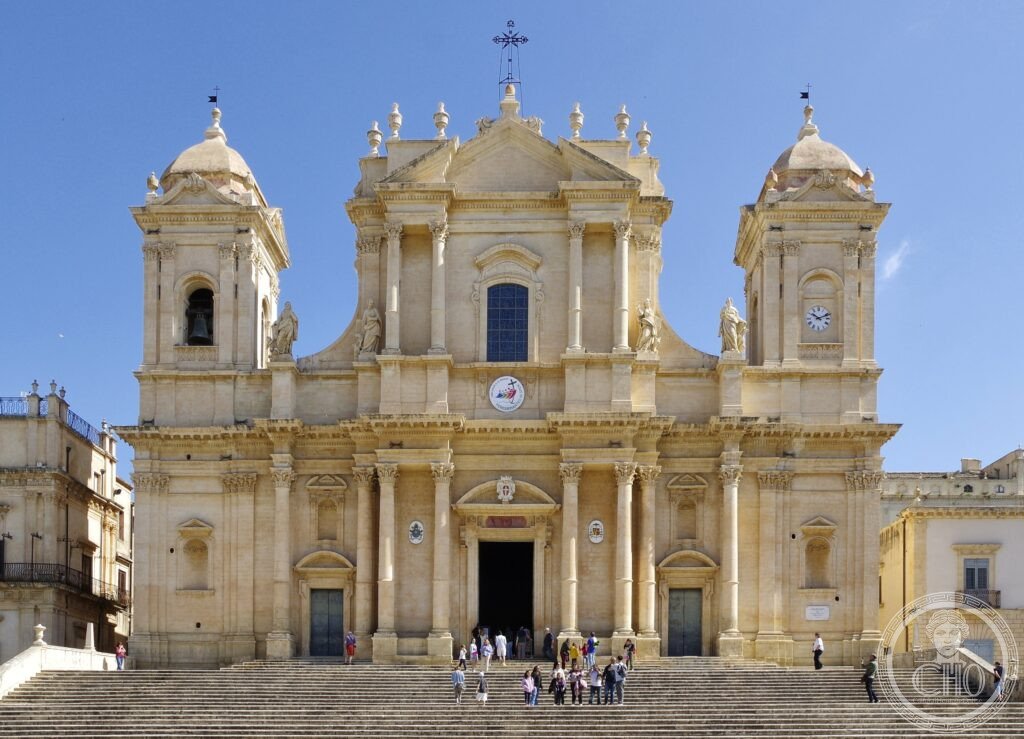
Noto Cathedral (Cattedrale di San Nicolò) and the Piazza Municipio, Noto, Province of Syracuse, Sicily, Italy. The Cathedral facade (completed 1770 CE; partially collapsed 1996 CE; restored 2007 CE): the three-level facade in honey-colored Sicilian limestone (Pietra di Noto; the local sedimentary limestone that gives all Val di Noto buildings their warm golden colour; the stone is soft when first cut and hardens on exposure to air — the 18th-century builders worked it like wood, producing the most elaborate carved decoration of the Italian Baroque outside Rome); the Via Corrado Nicolaci (visible at left) with the balcony monsters (the wrought-iron balconies of Palazzo Villadorata with carved grotesque figures — the most photographed street-level detail in the Val di Noto). Part of the UNESCO World Heritage serial inscription “Late Baroque Towns of the Val di Noto (South-Eastern Sicily)” (reference 1024, inscribed 2002). Photo via Wikimedia Commons.
Noto, Province of Syracuse, Sicily, Italy · 1703 earthquake → rebuilt 1703–1780; Rosario Gagliardi architect; Pietra di Noto limestone; UNESCO WHS 2002 (ref 1024, serial 8 towns)

Noto

Noto (UNESCO 2002) is the most complete surviving example of 18th-century Baroque urban design — an entire city rebuilt from scratch after the 1693 earthquake in honey-coloured local limestone by architect Rosario Gagliardi, with a master plan of such deliberate magnificence that it became the standard reference for the aesthetic coherence of a Baroque city, and whose Cathedral balconies, Via Corrado Nicolaci grotesque carvings, and sunset light on the stone have made it one of the most photographed cities in southern Italy.

At a glance

Noto (the most precisely Noto single Syracuse Sicily Italy 36.8907 N 15.0689 E UNESCO WHS 2002 reference 1024 serial 8 towns Val di Noto: the 1693 earthquake (magnitude 7.4 estimated; epicentre near Sortino, 40 km north of Noto; the most destructive earthquake in Italian history (60,000–70,000 dead; 49 towns in southeastern Sicily either destroyed or severely damaged); the old Noto Antica was on a hilltop 10 km northwest of the current city; it was completely destroyed; the decision to rebuild on a new site in the valley below was taken by Don Giuseppe Lanza di Assaro (the Spanish viceroy’s representative for the rebuilt province) in 1693 CE; the new site was chosen for three reasons: (1) the valley position offered better protection from earthquakes than the exposed hilltop; (2) the new grid plan could incorporate the full Baroque planning programme from scratch (the old city had accumulated centuries of irregular medieval street patterns that could not be rationalized); (3) the valley had abundant water from the Asinaro river); the master planner (the architect responsible for the new city plan was not, contrary to popular belief, a single named architect: the planning was managed by a committee involving the Spanish military engineer Carlos de Grunenbergh who drew the initial grid street plan in 1693–1695 CE; the individual building designs (the Cathedral, the Palazzo Ducezio, the churches of Montevergine, S. Chiara, the Convento del Crocifisso) were designed by Rosario Gagliardi (1698–1762 CE; the dominant figure in the Val di Noto Baroque; his training is unknown (no surviving documentation before 1726 CE) but his technical mastery of facades, convex-concave movement, and tower design suggests Borromini influence (possibly transmitted via the Neapolitan school)); the Pietra di Noto (the local limestone: a sedimentary calcarenite quarried from the hills 5–10 km south of Noto; the technical properties that made it the primary building material: it can be cut with hand tools (no blasting required) and carved with the precision of wood when freshly quarried; on exposure to air it hardens through carbonation of the calcium carbonate matrix; the color range from pale cream when fresh to the characteristic deep honey-gold after 50+ years of weathering; the current honey color of most Noto buildings is primarily the result of 300 years of weathering, not the original construction appearance)).

Key facts

  • The Via Corrado Nicolaci balconies and why the Palazzo Villadorata grotesques are the most discussed architectural detail in the Val di Noto: Via Corrado Nicolaci (the street running north from the Piazza Municipio perpendicular to the main Corso Vittorio Emanuele; width 10m; length 150m; lined on both sides by 18th-century palace facades with elaborate wrought-iron balconies; the most famous balconies are those of Palazzo Villadorata (Palazzo Nicolaci di Villadorata; Via Corrado Nicolaci 18; built 1737–1763 CE for the Nicolaci family, the most powerful local noble family of the 18th century; the balconies (18 on the piano nobile; the most elaborate on the second-floor level; the wrought-iron screens of the balconies are standard Baroque wrought-iron; the specific detail that makes the balconies famous is the carved stone corbels supporting each balcony from below: the corbels are carved as grotesque hybrid figures — half-human, half-animal combinations including a winged horse-centaur (the most recognizable), a mermaid, a leonine man, a winged lion, and various hybrid bird-beasts; the 18 corbels on the piano nobile are all different (no two the same); the carving technique: the corbels were carved in Pietra di Noto when it was still freshly quarried and therefore relatively soft, allowing the level of anatomical detail visible in the hooves, feathers, and facial expressions; the iconographic source for the grotesques is disputed — the winged horse-centaur is almost certainly derived from an engraving of a similar motif in the German grotesque print tradition (Wenzel Hollar, c.1640s CE) that circulated widely in 18th-century European craft workshops via illustrated books))
  • GPS: 36.8907° N, 15.0689° E

History

From the 1693 earthquake to the 1996 Cathedral collapse to 2002 UNESCO (the most precisely Noto single 1693 CE earthquake: the historical account of the 1693 earthquake and the Noto rebuild is preserved in the “Relazione del terremoto del 1693” by Francisco Marullo (published Catania 1695 CE; the most important primary source for the earthquake and its immediate aftermath); the rebuild decision (the choice between repairing Noto Antica on its hilltop or building a new city on the valley site was debated for approximately 2 years (1693–1695 CE); the pro-hilltop faction (led by the bishop and the remnant of the old nobility) argued that the historic site had religious significance and could not be abandoned; the pro-valley faction (led by the Spanish colonial administrator Don Giuseppe Lanza) argued that the hilltop site was structurally unsound and the valley offered a clean slate for the Baroque planning programme; the valley faction won; Noto Antica was formally abandoned in 1695 CE (the ruins of Noto Antica are visible 10 km northwest of the current city and are a popular hiking destination; the most intact surviving structure is the Porta della Montagna (15th century) and the ruins of the Norman castle)); the construction (1695–1780 CE): Gagliardi’s Cathedral (1693 CE design by Agostino Cassone; completed by Gagliardi in a modified form; the original facade design went through 3 major revisions before the current version (which Gagliardi executed 1740–1770 CE)); the Via Corrado Nicolaci Palazzo Villadorata (1737–1763 CE); the Palazzo Ducezio (1746 CE; the civic palace; the neoclassical colonnaded facade is unusual in the Val di Noto context — it is closer to the Roman Palladian tradition than to the Sicilian Baroque; the architect was Vincenzo Sinatra); 1996 CE Cathedral dome collapse (the dome of the Noto Cathedral collapsed on 13 March 1996 CE (the collapse was the result of 300 years of structural deterioration combined with the 1990 earthquake damage; the collapse destroyed the dome, the right transept, and part of the nave roof); the Cathedral was rebuilt with international funding (the Italian government + private donations); the restoration was controversial because it used reinforced concrete frames within the Pietra di Noto exterior shell (the pragmatic solution; it would not have been accepted by the Noto city authorities in any other city, but the symbolic importance of the Cathedral and the pressure to reopen for the 2002 UNESCO inscription drove the timeline); 2002 CE UNESCO inscription reference 1024 (serial of 8 towns: Caltagirone, Militello in Val di Catania, Catania, Modica, Noto, Palazzolo Acreide, Ragusa, Scicli)).

What you see

The Corso Vittorio Emanuele, the Cathedral, Palazzo Villadorata, and the Mercato (the most precisely Noto single visit (2–3 hours for the main circuit; half day for Noto + Noto Antica ruins): 1) arrival (the bus from Syracuse arrives at the Piazza Marconi at the east end of the Corso; the first view is the Porta Reale (the triumphal arch at the east entrance to the Corso; 1838 CE; neoclassical; the entrance to the triumphal arch is marked by three columns topped with a dog, an eagle, and a tower (the heraldic symbols of the city)); 2) the Corso Vittorio Emanuele (the main east-west axis; length 600m; width 12m; the street rises gently from east to west; the three piazzas on the Corso: Piazza Immacolata (east end; the church of San Francesco d’Assisi by Gagliardi), Piazza Municipio (center; the Cathedral + Palazzo Ducezio), Piazza XVI Maggio (west end; the Villabermuda garden + the Teatro Tina di Lorenzo)); 3) the Cathedral (Cattedrale di San Nicolò; Piazza Municipio; the three-level facade with the two bell towers (the left tower is a reconstruction (collapsed 1996 CE); the right tower original 18th century); the interior: the 1996 collapse destroyed most of the original interior decoration; the current interior is a restoration (1996–2007 CE) with some original 18th-century elements preserved (the main altar, 3 of the 6 original side chapels)); 4) Via Corrado Nicolaci (north of Piazza Municipio; the Palazzo Villadorata facade (the balcony corbels; best viewing from the street level, looking up at an approximately 30-degree angle; the corbels on the piano nobile are at 7–8m height; binoculars optional but helpful for the carving detail)); 5) the Mercato (the daily covered market at the Via Cavour / Via Piave intersection; 8AM–1PM; the best place in Noto for the local citrus (Noto grows the Arancia di Ribera (DOP) and the Limone di Siracusa (IGP) + the seasonal products (the Noto almond (Mandorla di Noto, IGP; one of the most aromatic almond varieties in Italy; used in the Granita di Mandorla (the local granita (crushed ice flavored drink) made with almond milk)))).

Practical information

  • Getting to Noto from Syracuse and combining with Modica and Ragusa Ibla in a 3-day Val di Noto circuit: transport from Syracuse: Interbus (the main regional bus operator; runs Siracusa–Noto 7 times/day; 55 min; €3.50; departs from Siracusa bus station (Via Malta, adjacent to the Porta Aretusa sea front)); Trenitalia train (Siracusa–Noto; 35 min; €3; 6 trains/day; the Noto station is 1.5 km from the city center (15 min walk downhill)); from Catania airport: Interbus from Fontanarossa airport to Noto (2h; €12; 3 times/day; the most convenient connection from Catania for Val di Noto visitors)); by car: SS115 from Siracusa south to Noto (30 km; 40 min); the 3-day circuit: Day 1 Noto (arrive afternoon; evening passeggiata on the Corso (the Corso is traffic-free from 5 PM; the evening light on the Cathedral at 6–7 PM in summer is the best light of the day)); Day 2 Modica (35 km south of Noto; the chocolate city (Cioccolato di Modica (the historic cold-worked chocolate; the Aztec-style process without emulsification, producing a grainy, crumbly bar with flavor inclusions); the Duomo di San Giorgio (Gagliardi 1702 CE; the most dramatic single church in the Val di Noto; the 250-step staircase leading up to the entrance is the visual centerpiece of the city)); Day 3 Ragusa Ibla (the historic lower town; the Giardini Iblei (the public garden at the eastern tip of the Ibla peninsula; the view of the entire ragusa landscape from the terrace); the Duomo di San Giorgio Ibla (another Gagliardi church; not to be confused with Modica; same architect, different city))

Getting there

Interbus from Syracuse 7x/day (55 min, €3.50) or Trenitalia train (35 min, €3, 1.5 km walk from station). From Catania airport: Interbus 3x/day (2h, €12). Car: SS115 Siracusa→Noto 30 km. GPS: 36.8907, 15.0689.

Nearby

  • Modica — 35 km southwest (UNESCO WHS 2002 same serial; Duomo di San Giorgio by Gagliardi (1702 CE; 250-step staircase) + Cioccolato di Modica (IGP; cold-worked Aztec-style chocolate without emulsification))
  • Syracuse — 32 km northeast (UNESCO WHS 2005 (reference 1200); the Greek Theatre (5th century BCE) + the Ear of Dionysius quarry + the Piazza del Duomo (the Cathedral built inside the Doric Temple of Athena (480 BCE) — the original columns are visible inside the Cathedral nave))

Sources

  • Wikipedia, Noto, Sicily; Rosario Gagliardi; Palazzo Nicolaci di Villadorata; Pietra di Noto, accessed June 2026
  • UNESCO, Late Baroque Towns of the Val di Noto (South-Eastern Sicily), WHS reference 1024, inscribed 2002
  • Blunt, Anthony. Sicilian Baroque. London: Weidenfeld and Nicolson, 1968

Hero image: Noto, Province of Syracuse, Sicily, Italy, Wikimedia Commons. Editorial text © Cultural Heritage Online, 2026.

📷 Diventa un fotografo di Cultural Heritage Online

Condividi le tue foto dei luoghi: restano pubblicate con la tua firma come autore. Più vengono viste, più ti fai conoscere — e presto un concorso premierà le foto più apprezzate.

Accedi o registrati gratis per aggiungere una foto
📋 Copy & share on social
Scroll to Top