
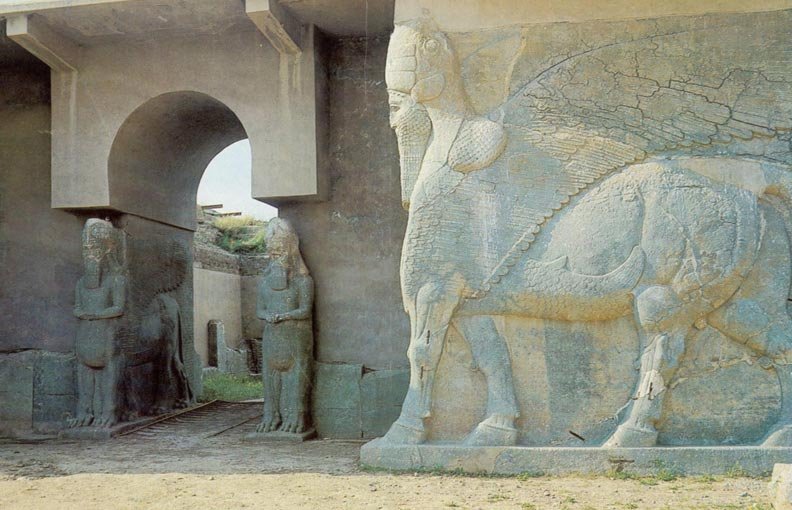
On the east bank of the Tigris 30km south of Mosul, Nimrud (ancient Kalhu) served as the capital of the Assyrian Empire for 150 years, yielding discoveries that transformed Victorian understanding of the Bible — and was systematically dynamited by ISIS in 2015.
At a glance
Nimrud is among the most historically consequential archaeological sites in the world. Founded as a major city by Shalmaneser I around 1250 BC and developed into the imperial capital by Ashurnasirpal II around 879 BC, it was the seat of the Neo-Assyrian Empire at its height under Ashurnasirpal II, Shalmaneser III, Tiglath-Pileser III, and Sargon II. Its colossal lamassus — human-headed, eagle-winged bull and lion colossi guarding palace gates — became icons of Mesopotamian civilisation after their discovery by Austen Henry Layard in 1845–1851. In 1988 Iraqi archaeologists found the Nimrud Treasures, 57 kilograms of exquisite Assyrian gold jewellery in four royal tombs beneath the Northwest Palace throne room. In 2015 the Islamic State filmed the deliberate demolition of the site’s remaining monuments before dynamiting the entire complex — an act of cultural destruction unprecedented in its systematic documentation.
Key facts
- Ancient name: Kalhu (Assyrian); Calah (biblical, Genesis 10:11–12)
- Capital period: c. 879–706 BC (Ashurnasirpal II to Sargon II)
- Location: East bank of the Tigris, 30km south of Mosul, Nineveh Governorate, Iraq
- Primary excavators: Austen Henry Layard (1845–51); Max Mallowan (1949–58)
- Nimrud Treasures: Discovered 1988 — 57kg gold, ~1,000 precious stones; now in the Iraq Museum, Baghdad
- 2015 destruction: ISIS demolished and dynamited the site February–March 2015; reconstruction began 2017
- Status: Partially accessible; extensively damaged but under ongoing restoration
History
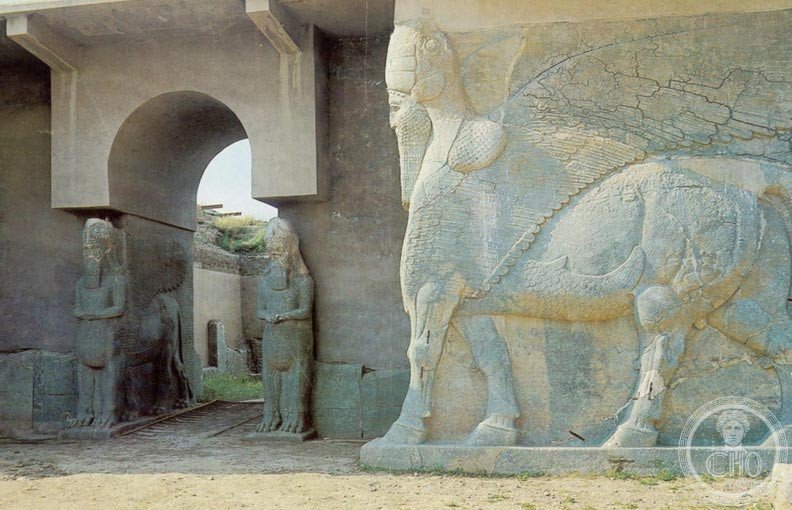
Nimrud entered the historical record as a settlement of Shalmaneser I (c. 1274–1245 BC), who built a citadel here during the Middle Assyrian period. It was Ashurnasirpal II (r. 883–859 BC) who transformed it into an imperial capital, constructing the Northwest Palace — a sprawling complex of stone-lined throne rooms, reception halls, and residential quarters whose walls were entirely sheathed in carved alabaster relief panels depicting royal hunts, military campaigns against Aramaean and Syrian kingdoms, and elaborate ceremonial processions. The palace entrance was guarded by lamassus: human-headed, eagle-winged colossal bulls and lions carved from single blocks of alabaster, approximately 4 metres tall and weighing up to 30 tonnes, their bodies shown in five-legged perspective (four legs in profile, two in frontal view) so that they appeared correctly proportioned from any angle. Ashurnasirpal’s inaugural banquet inscription records feeding 69,574 guests for ten days at the palace’s completion.
The city’s biblical resonance was enormous. Layard’s 1845–1851 excavations arrived at Nimrud knowing it might be Nineveh or Calah from Genesis 10:11–12, and his discoveries — the winged bulls, the carved reliefs, the cuneiform tablets — confirmed that these were the very Assyrian capitals mentioned in the books of Kings and Isaiah as the instruments of God’s punishment on Israel. The reliefs provided the first visual evidence for the siege of Lachish described in 2 Kings 18, showing Assyrian soldiers attacking a walled city that matched the archaeological evidence from Lachish itself. Max Mallowan’s post-war excavations (1949–1958) — accompanied periodically by his wife Agatha Christie, who helped clean and photograph small finds — uncovered the Fort Shalmaneser arsenal, the Black Obelisk of Shalmaneser III (now in the British Museum), and extensive ivory carvings of Syrian and Phoenician manufacture that had been deposited as tribute from vassal states.
In 1988, during construction work near the throne room of the Northwest Palace, Iraqi archaeologists Muzahim Mahmoud Hussein and his colleagues discovered four intact royal tombs dating to the 9th–8th centuries BC, containing the burials of Assyrian queens — Yaba, Banitu, Atalia — and a male burial. The tombs yielded 57 kilograms of gold jewellery of extraordinary craftsmanship: crowns, earrings, necklaces, bracelets, and vessels of goldsmith technique not previously known from Assyria, together with approximately 1,000 precious and semi-precious stones. Removed for safekeeping during the Gulf Wars to a central bank vault in Baghdad, the treasures survived the post-2003 looting of the Iraq Museum and were rediscovered in a flooded vault in 2003.
What you see
The site covers approximately 360 hectares and was surrounded by a massive mud-brick wall approximately 8km in circuit. At its northwest corner stands the citadel mound (Tell Nimrud), rising about 12 metres above the plain, site of the Northwest Palace of Ashurnasirpal II and later Esarhaddon, the ziggurat of Nimrud (partially reconstructed), and the Nabu temple. The Northwest Palace’s throne room suite — once lined with carved alabaster reliefs now distributed among the British Museum, the Metropolitan Museum of Art, the Oriental Institute in Chicago, and the Iraq Museum — retained fragments in situ until 2015. To the southeast of the citadel, the Fort Shalmaneser arsenal built by Shalmaneser III covers approximately 25 hectares, its magazines and ceremonial chambers still showing traces of the ivories and tribute objects stored there.
After 2015 the site presents a landscape of rubble and blast craters where the main monuments stood. Reconstruction work funded by the Italian government and the Iraqi State Board of Antiquities and Heritage has partially restored the ziggurat and sections of palace walls, with a site museum established adjacent to the citadel mound. Visitors can walk the outline of the Northwest Palace’s throne-room suite, see reconstructed sections of the citadel wall, and view in situ fragments of carved stonework that survived or have been recovered from the debris of the ISIS demolition.
Practical information
- Location: 30km south-southeast of Mosul on the east bank of the Tigris; accessible via the road to Al-Hamdaniya (Qaragosh)
- Access: The site is in northern Iraq and requires coordination with local authorities; security conditions should be verified before visiting
- Site museum: Small on-site museum with recovered fragments; Nimrud ivories and Treasures replicas on display; originals in the Iraq Museum, Baghdad
- Photography: Permitted throughout the accessible areas
- Best time to visit: March–May or October–November; summers are extremely hot (over 45°C)
Getting there
From Mosul, take the main road south toward Al-Hamdaniya; Nimrud is signposted approximately 30km from Mosul city centre. The site is not served by public transport; private vehicle or organised tour from Mosul is required. Erbil (Irbil), the Kurdish Regional Government capital approximately 90km to the east, has an international airport with connections to Istanbul, Dubai, and several European cities and may serve as a more practical base for visitors.
Nearby
- Nineveh — the other great Assyrian capital, opposite modern Mosul on the Tigris (c. 25km north), with Sennacherib’s Southwest Palace and the Nergal Gate lamassus
- Hatra — Parthian city and UNESCO World Heritage Site, approximately 110km southwest; partially destroyed by ISIS in 2015, now under restoration
- Assur (Qal’at Sherqat) — the original religious capital of Assyria, UNESCO World Heritage Site, approximately 100km south on the Tigris
- Mosul Museum — the museum whose lamassu casts were smashed in the 2015 ISIS video; being rebuilt with replicas and original fragments
Sources
- Layard, A.H. — Nineveh and Its Remains (1849); Discoveries in the Ruins of Nineveh and Babylon (1853)
- Mallowan, M.E.L. — Nimrud and Its Remains, 2 vols. (1966)
- Hussein, M.M. & Suleiman, A. — Nimrud: A City of Golden Treasures (2000)
- Emberling, G. & Teeter, E. — Nimrud: Jewels of the Assyrian Empire, Oriental Institute Museum (2010)
- UNESCO Emergency Safeguarding of the Heritage of Iraq — Wikipedia: Nimrud
Find it on the map
See this place and what’s around it →📷 Become a Cultural Heritage Online photographer
Share your photos of places: they stay published under your name as the author. The more they're seen, the more you get noticed — and soon a contest will reward the most appreciated photos.
Log in or sign up free to add a photo