
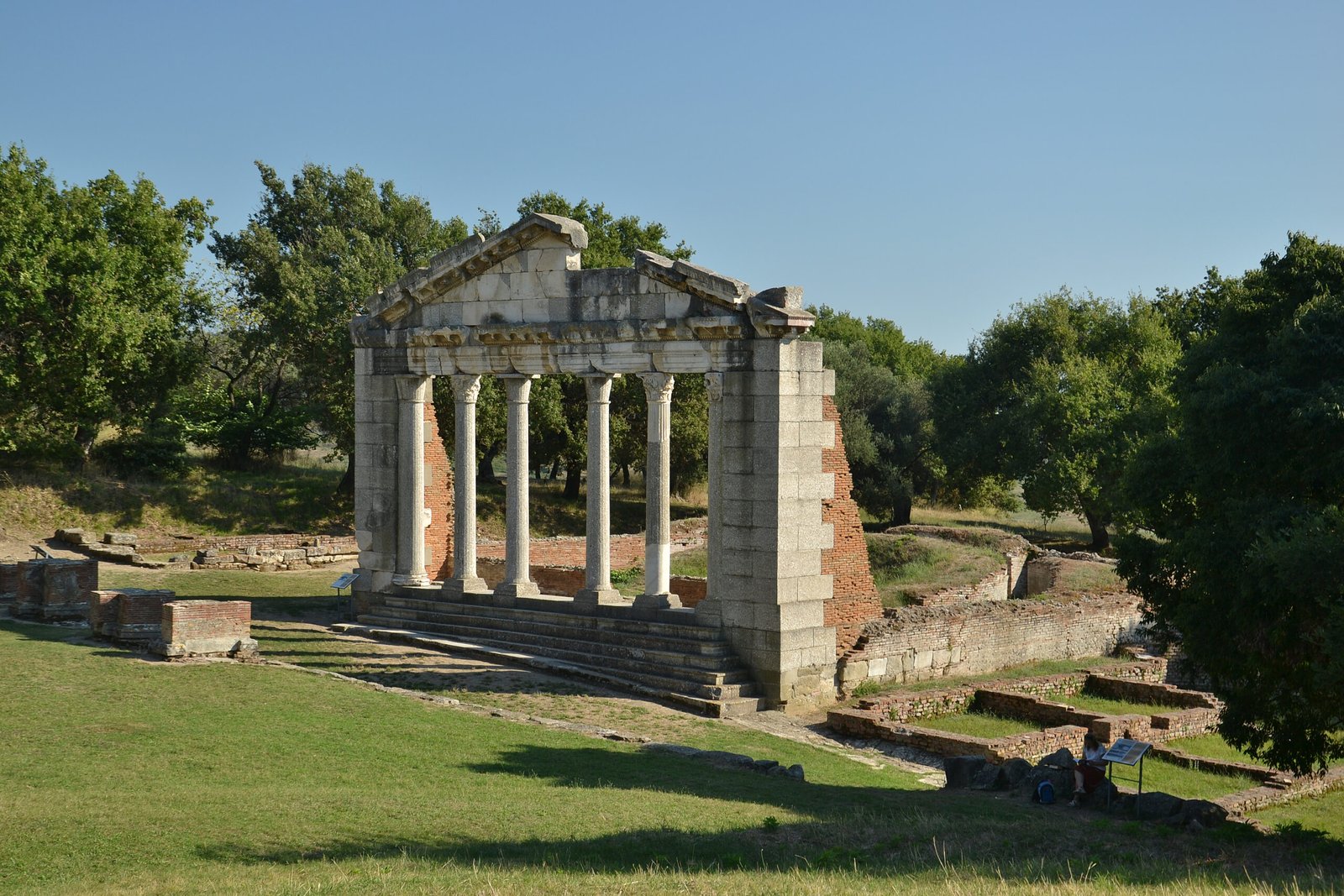
A hilltop archaeological site in southwestern Albania preserving the ruins of ancient Illyria’s most important Greek colonial city — where Julius Caesar launched Balkan campaigns and Octavian, future Emperor Augustus, was studying when Caesar was assassinated in Rome.
At a glance
Founded around 588 BC by Corinthian colonists, Apollonia grew into the largest and most influential city in Illyria — population 60,000 at its peak. The site preserves the best-intact Hellenistic bouleuterion in the Balkans. A still-active Orthodox monastery stands within the ruins, its medieval church built partly from ancient column drums.
Key facts
- Founded: c. 588 BC by colonists from Corcyra, itself a colony of Corinth
- Peak population: Approximately 60,000 in the Hellenistic period
- Controlled 5 satellite cities and minted its own silver coinage traded across the Greek world
- Julius Caesar used Apollonia as his base for Macedonian campaigns
- Augustus connection: Octavian was studying here when Caesar was assassinated in 44 BC — he departed from Apollonia to become the first Roman emperor
- Bouleuterion: 2nd century BC council house with 23 rows of stone seats — best-preserved Hellenistic assembly hall in the Balkans
- Active monastery: 13th-century Orthodox monastery still functioning within the ruins
History
Apollonia was founded around 588 BC by settlers from Corcyra on a commanding hilltop above the Aous River, controlling the primary route from the Adriatic into the Balkan interior. Within two centuries it had grown into the most significant Greek presence in Illyria: a polis with monumental architecture, a famous school of philosophy, its own silver mint, and commercial networks spanning the Greek world. At its Hellenistic peak the city controlled five dependent settlements and held a population of approximately 60,000.
In 44 BC the future Emperor Augustus — then 18-year-old Octavian — was studying at Apollonia’s philosophical school when messengers arrived with news that Julius Caesar had been assassinated in Rome. His tutors urged him to use the nearby army to seize power. He declined, returned to Rome by sea, and pursued the political path that led across seventeen years of civil war to the Roman Empire. The road to Augustus began at Apollonia.
The city declined as the Aous River silted and coastal trade routes shifted, abandoned by the 7th century AD. An Orthodox monastery dedicated to the Archangels Michael and Gabriel was founded within the ruins in the 13th century and remains active today, its church incorporating ancient column drums as structural elements.
What you see
The centrepiece is the Bouleuterion — a semicircular Hellenistic council house with 23 rows of limestone seats, the best-preserved assembly hall of its type in the Balkans, dating to the 2nd century BC. Adjacent is the monumental portico of the Agonothetes, a colonnaded building whose partially reconstructed columns create the most photogenic ensemble on site.
The on-site museum holds sculpture, sarcophagi, coins, and ceramics spanning Greek through late Roman periods. The monastery church, in continuous use since the 13th century, sits immediately adjacent to the ancient remains. The site retains an unhurried atmosphere — the crowds that swamp comparable Albanian sites like Butrint are largely absent.
Practical information
- Location: Pojan village, 12km west of Fier, southwestern Albania
- Opening hours: Daily approximately 9:00–17:00; check locally as hours vary
- Admission: Approximately 3–5 EUR covering site and museum
- Museum: On-site with finds from city and necropolis; labelling in Albanian and English
- Facilities: Limited; small cafe near entrance; bring water
Getting there
Apollonia is 12km west of Fier in southwestern Albania. Fier connects to Tirana (170km north) in approximately 2 hours by car or intercity bus. From Fier, hire a taxi for the 12km trip — no regular public transport covers the final stretch. Allow 2–3 hours on site for ruins, museum, and monastery.
Nearby
- Butrint — 120km south, Albania’s most visited UNESCO archaeological site with Greek, Roman, Byzantine, and Venetian layers in a lake-edge setting
- Berat — 60km northeast, UNESCO-listed Ottoman city with a castle quarter inhabited since antiquity
- Vlore — 50km south, Albania’s main southern Adriatic port
- Fier — 12km east, nearest city with hotels and transport connections
Sources
Find it on the map
See this place and what’s around it →📷 Become a Cultural Heritage Online photographer
Share your photos of places: they stay published under your name as the author. The more they're seen, the more you get noticed — and soon a contest will reward the most appreciated photos.
Log in or sign up free to add a photo