
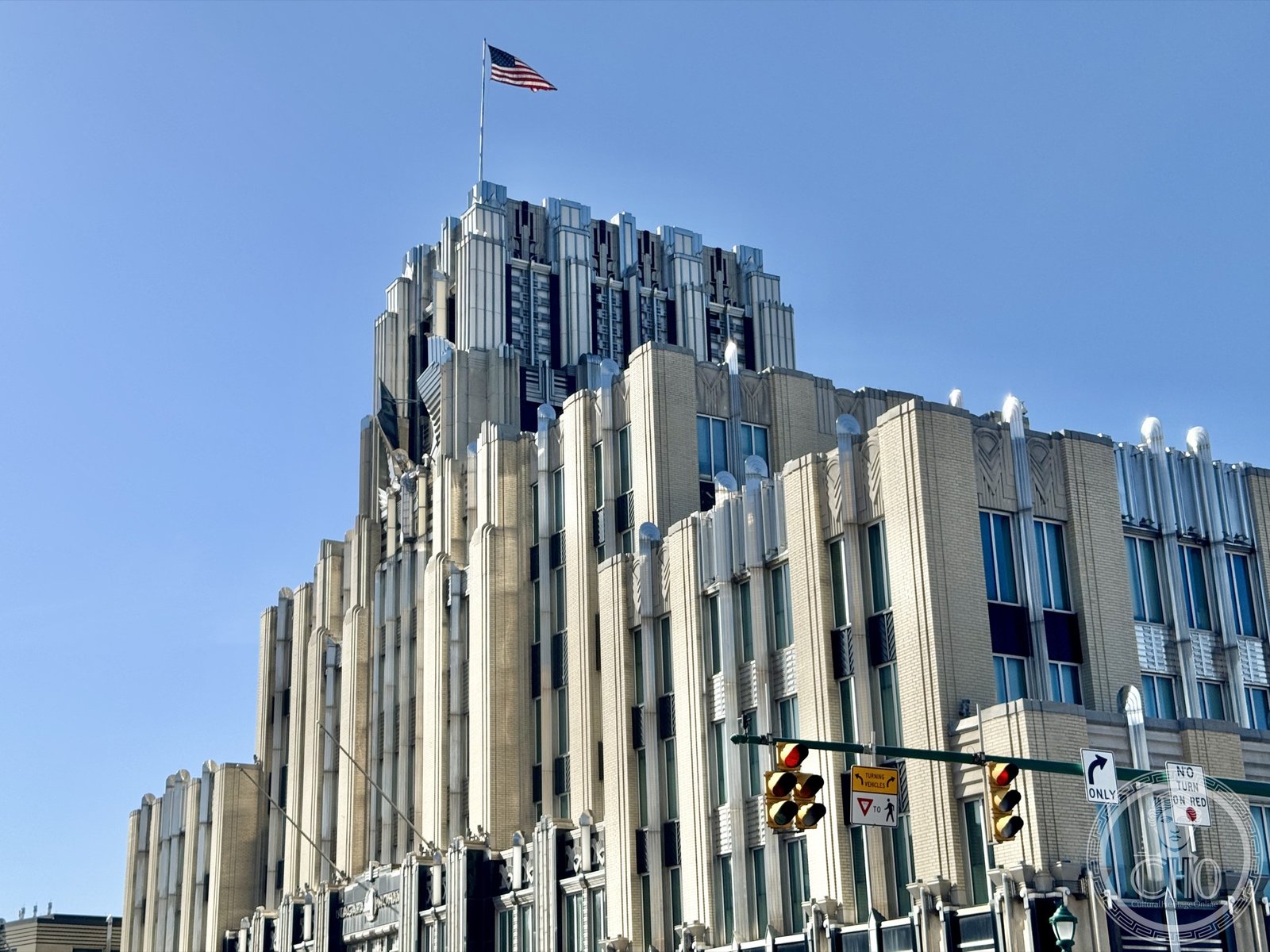
An Art Deco tower sheathed in stainless steel and aluminum, crowned by a monumental winged figure—a declaration, in metal, that electricity had become the defining force of modern life.
At a glance
The Niagara Mohawk Building rises from downtown Syracuse in a gleam of stainless steel and aluminum unusual even by the standards of Art Deco corporate excess. Completed in 1932 for the Niagara Hudson Power Corporation—a major upstate New York electric utility—the tower was designed by the Syracuse firm of Bley & Lyman and finished at the onset of the Great Depression, when its metallic confidence must have seemed deliberately defiant. A monumental winged aluminum figure crowns the main entrance, embodying the era’s conviction that electricity was not merely a commodity but a civilizational force. The building is today a National Historic Landmark and continues in use as a corporate office, occupied by National Grid, the successor company to Niagara Mohawk.
Key facts
- Completed: 1932
- Architects: Bley & Lyman, Syracuse
- Style: Art Deco
- Built for: Niagara Hudson Power Corporation (later Niagara Mohawk Power Corporation)
- Current occupant: National Grid (corporate offices)
- Designation: National Historic Landmark
- Address: 300 Erie Boulevard West, Syracuse, NY 13202
- GPS: 43.0490°N, 76.1537°W
History
The Niagara Hudson Power Corporation was formed in 1929 through the consolidation of several upstate New York electric utilities, creating one of the most powerful privately held power companies in the northeastern United States. The decision to build a landmark headquarters in Syracuse—then the largest city in central New York and a major manufacturing center—reflected both the company’s ambitions and the boom-time optimism of the late 1920s. The commission went to the local firm of Bley & Lyman, who delivered a design that made no concessions to local vernacular building traditions: this was a building determined to announce itself as modern.
Construction proceeded through 1931 and 1932, as the Depression deepened around it. The building’s stainless steel and aluminum cladding was costly and technically demanding—an extravagance that spoke to the electric industry’s particular relationship with modernity. Electricity companies were, by their nature, technology businesses, and their buildings were expected to look the part. The metallic surfaces—catching and refracting light in ways masonry cannot—were a form of advertising as much as architecture.
Niagara Hudson was later renamed Niagara Mohawk Power Corporation, and the building became known colloquially as the Niagara Mohawk Building. The company was eventually acquired by National Grid, a British-headquartered multinational utility, which continues to occupy the building. Its National Historic Landmark designation recognizes not only the building’s architectural distinction but its role as a rare surviving monument of the corporate Art Deco idiom in upstate New York.
What you see
The building’s exterior is its argument: the lower two stories are clad in dark stone, grounding the composition, while the tower above transitions to stainless steel and aluminum—a choice that creates a literal shimmer on clear days and a muted chrome gleam under overcast skies. The vertical lines of the cladding panels are interrupted at regular intervals by horizontal setbacks that follow the Art Deco tower formula, each step reducing the building’s mass as it rises. The effect is of a structure drawing upward out of its own mass rather than simply stopping at a given height.
The entrance is dominated by a monumental winged figure in aluminum, mounted above the main doors—a generic Art Deco allegory of power and speed that in this context reads specifically as the personification of electrical energy. The figure’s scale is disproportionate to the doorway below it, which is deliberate: it belongs to the building’s public face rather than to the human experience of entering. The decorative metalwork of the entrance surround, the mail slot covers, the window frames, and the lobby floor continue the theme of precision metalwork throughout.
Practical information
- Access: The exterior is freely viewable; the building is an active corporate office and not open to the public
- Best viewing: Erie Boulevard West elevation (west-facing facade) in morning light
- Time needed: 15–20 minutes for exterior inspection
- Nearby parking: Multiple surface lots and garages within one block on Erie Boulevard
Getting there
The Niagara Mohawk Building stands at 300 Erie Boulevard West in downtown Syracuse, at the intersection of Erie Boulevard and Franklin Street. By car from Interstate 81, take the Harrison Street exit east toward downtown and proceed to Erie Boulevard; the building is immediately visible on the north side of Erie Boulevard. Centro buses serve multiple stops within two blocks along Erie Boulevard. Syracuse Hancock International Airport is approximately 10 minutes by car or taxi. From the main Amtrak station (Syracuse), the building is a 15-minute walk east along Erie Boulevard.
Nearby
- Erie Canal Museum — within walking distance, housed in a surviving 1850 weighlock building; the Canal era shaped Syracuse’s growth that the electric age accelerated
- Armory Square — Syracuse’s restored Victorian commercial district, 5 minutes walk south; galleries, restaurants, and 19th-century cast-iron facades
- Everson Museum of Art — I.M. Pei’s 1968 museum building, a landmark of Brutalist architecture on Harrison Street, 10 minutes walk
- Onondaga Lake — the ancestral lake of the Haudenosaunee Confederacy, 2 miles northwest; the lakefront has been substantially restored after decades of industrial contamination
Sources
- National Historic Landmark Nomination, Niagara Mohawk Building, National Park Service
- Onondaga Historical Association, Syracuse architectural history records
- Carol Herselle Krinsky, Rockefeller Center (comparative context for Art Deco corporate towers), Oxford University Press, 1978
- David Garrard Lowe, Art Deco New York, Watson-Guptill, 2004
- Wikimedia Commons — image CC BY-SA 2.0
Find it on the map
See this place and what’s around it →Record researched and written by Luigi De Marchi for Cultural Heritage Online, 2026.
📷 Become a Cultural Heritage Online photographer
Share your photos of places: they stay published under your name as the author. The more they're seen, the more you get noticed — and soon a contest will reward the most appreciated photos.
Log in or sign up free to add a photoIs this page about you?
This page is read by travellers and heritage enthusiasts who find it on Google. Tell us how you are connected to this place and we will take it from there.