
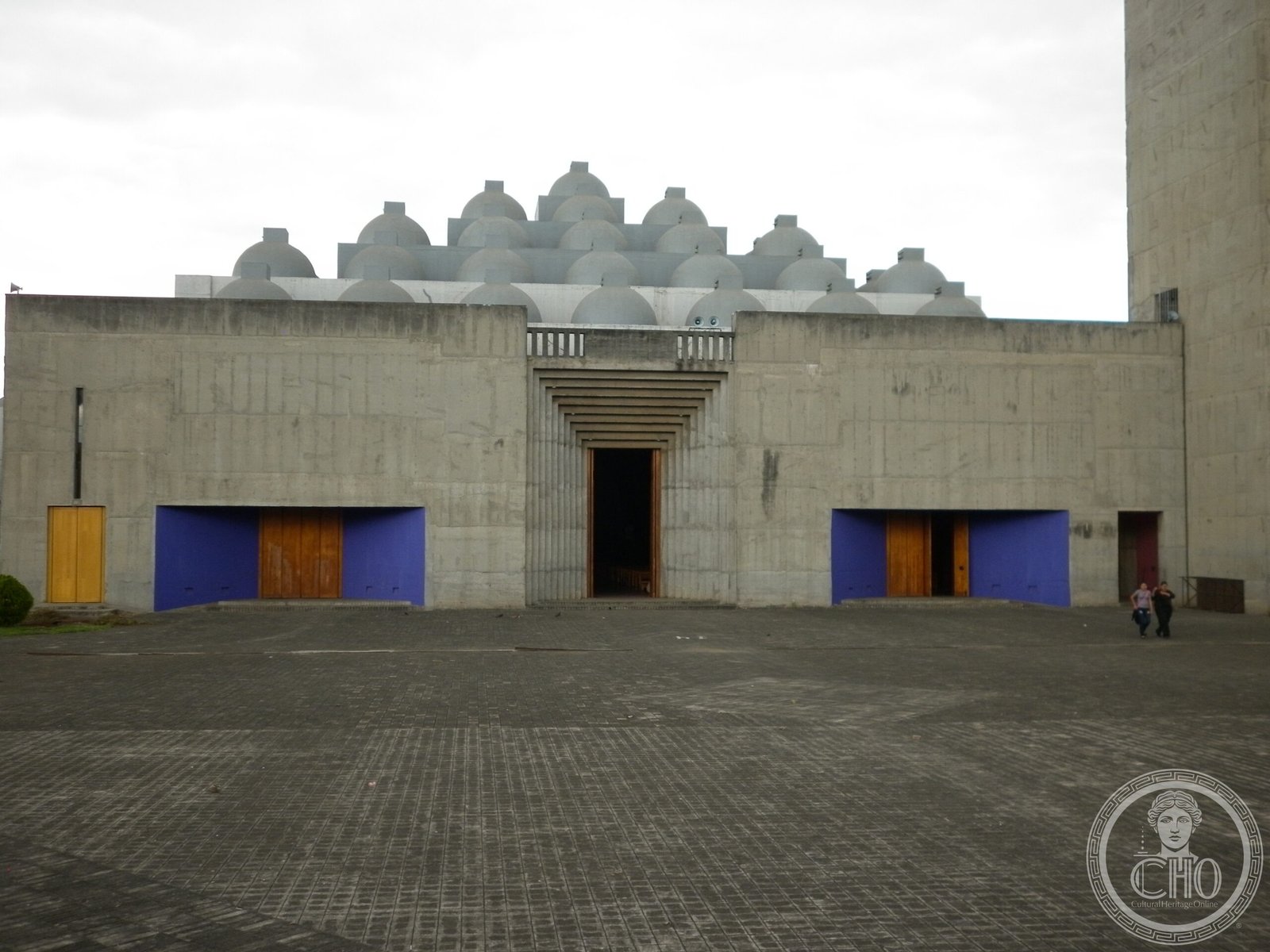
In the centre of Managua, the new metropolitan cathedral of the Immaculate Conception replaced the old cathedral, badly damaged by the earthquake of 23 December 1972 and never again restored for regular worship. Designed by the Mexican architect Ricardo Legorreta, construction began around August 1991 and was completed in August 1993, with inauguration on 4 September of that year, at a cost of around four and a half million dollars. According to several consistent sources, though not a primary financial document, the American businessman Tom Monaghan, founder of the Domino’s Pizza chain, contributed a significant share. The building is crowned by sixty-three small domes, which provide ventilation and natural light through a chimney effect. They are arranged so that the tallest dome sits above the assembly of the faithful, not the altar, a deliberate design choice consistent with post-conciliar theology of communal participation. The people of Managua popularly nickname it “la chichona”, a colloquial reference to the shape of the domes. The archdiocese of Managua, erected on 2 December 1913, is today led by Cardinal Leopoldo José Brenes Solórzano, archbishop since 2005 and cardinal since 2014. Since 2018 the Nicaraguan Catholic Church has been under a systematic campaign by the Ortega-Murillo government, worsened after parishes had sheltered protesters during that year’s demonstrations. According to aggregated reports cited by several Catholic outlets, more than sixteen thousand five hundred religious processions have been banned nationwide, and hundreds of episodes of aggression against the Church have been documented between 2018 and 2024. In this specific cathedral, the traditional procession of the Triumph of Palm Sunday has, in the most recently documented years, been forced to take place in a closed circuit within the churchyard of the building rather than through the streets of Managua, presided over by Cardinal Brenes under the watch of dozens of police officers deployed to prevent the faithful from leaving the perimeter of church property. The Holy Week processions have been banned nationwide for several consecutive years. Bishop Rolando Álvarez, not of Managua but of Matagalpa, was arrested in August 2022, sentenced in February 2023 to over twenty-six years in prison and stripped of his Nicaraguan citizenship, before being released and exiled to Rome in January 2024. The apostolic nuncio was expelled in March 2022, and in March 2023 Nicaragua requested the mutual closure of the respective diplomatic missions with the Holy See, still suspended. Pope John Paul II visited Nicaragua in 1983 and 1996, but the first visit, remembered for the revolutionary shouts of Sandinista supporters that drowned out his words, predates the construction of this cathedral by years and does not appear linked to a mass celebrated inside it.
About the Cathedral
The New Cathedral of Managua, seat of the Archdiocese of Managua, replaced the earthquake-ruined Old Cathedral after the devastating 1972 quake. Designed by Mexican architect Ricardo Legorreta, it was built 1991–1993 and inaugurated on 4 September 1993, crowned by a cluster of 63 small domes that give it its local nickname, “La Chichona.”
Key facts
- 23 December 1972: Managua earthquake destroys the old cathedral, never repaired for regular worship.
- 1991–1993: new cathedral built to designs by Ricardo Legorreta, ~$4.5 million cost.
- 4 September 1993: cathedral inaugurated, 63 small domes for natural ventilation and light.
- 2 December 1913: Archdiocese of Managua erected.
- March 2022–2023: Vatican nuncio expelled and Nicaragua–Holy See diplomatic missions mutually closed.
- Since 2023, this cathedral’s Holy Week processions have been confined inside its own grounds under police watch, part of a nationwide ban.
History
Rising from the ruins of a 1972 earthquake that left Managua’s old cathedral an unusable shell, the new cathedral became, two decades after its 1993 completion, a frontline institution in Nicaragua’s escalating conflict between the Ortega-Murillo government and the Catholic Church — a conflict that intensified after parishes nationwide sheltered anti-government protesters in 2018. By the 2020s, the cathedral’s own Holy Week processions, once a public event through Managua’s streets, were forced to remain within its grounds under police cordon, part of a broader pattern that has included the exile of Bishop Rolando Álvarez and the severing of formal diplomatic ties between Nicaragua and the Holy See.
What you see
A pale concrete modernist facade rises beneath a stepped pyramid of 63 small white domes, with blue-recessed side entrances and a ribbed concrete portal — a deliberately community-facing design, with its tallest dome set over the congregation rather than the altar.
Practical information
- Opening hours: generally open daily outside services; check current hours before visiting.
- Address: Distrito I, near Avenida Bolívar, Managua, Nicaragua.
Getting there
The cathedral stands in central Managua’s Distrito I, near Avenida Bolívar. GPS: 12°07′58″N, 86°15′57″W.
Nearby
- Old Cathedral of Managua — the earthquake-ruined predecessor cathedral, left as a shell since 1972.
Sources
- Wikipedia — “Immaculate Conception Cathedral, Managua”
- Legorreta Arquitectos (legorreta.mx) and ArchDaily — architectural and construction details.
- GCatholic.org and Catholic-Hierarchy.org — Archdiocese of Managua records.
- Catholic News Agency, National Catholic Reporter, Our Sunday Visitor — coverage of the Nicaraguan government’s crackdown on the Catholic Church, 2018–2025.
- Vatican News, PBS — coverage of the 2022–2023 severing of Nicaragua–Holy See diplomatic relations.
- Catholic World Report — coverage of Pope John Paul II’s 1983 and 1996 visits to Nicaragua.
Find it on the map
See this place and what’s around it →📷 Become a Cultural Heritage Online photographer
Share your photos of places: they stay published under your name as the author. The more they're seen, the more you get noticed — and soon a contest will reward the most appreciated photos.
Log in or sign up free to add a photo