
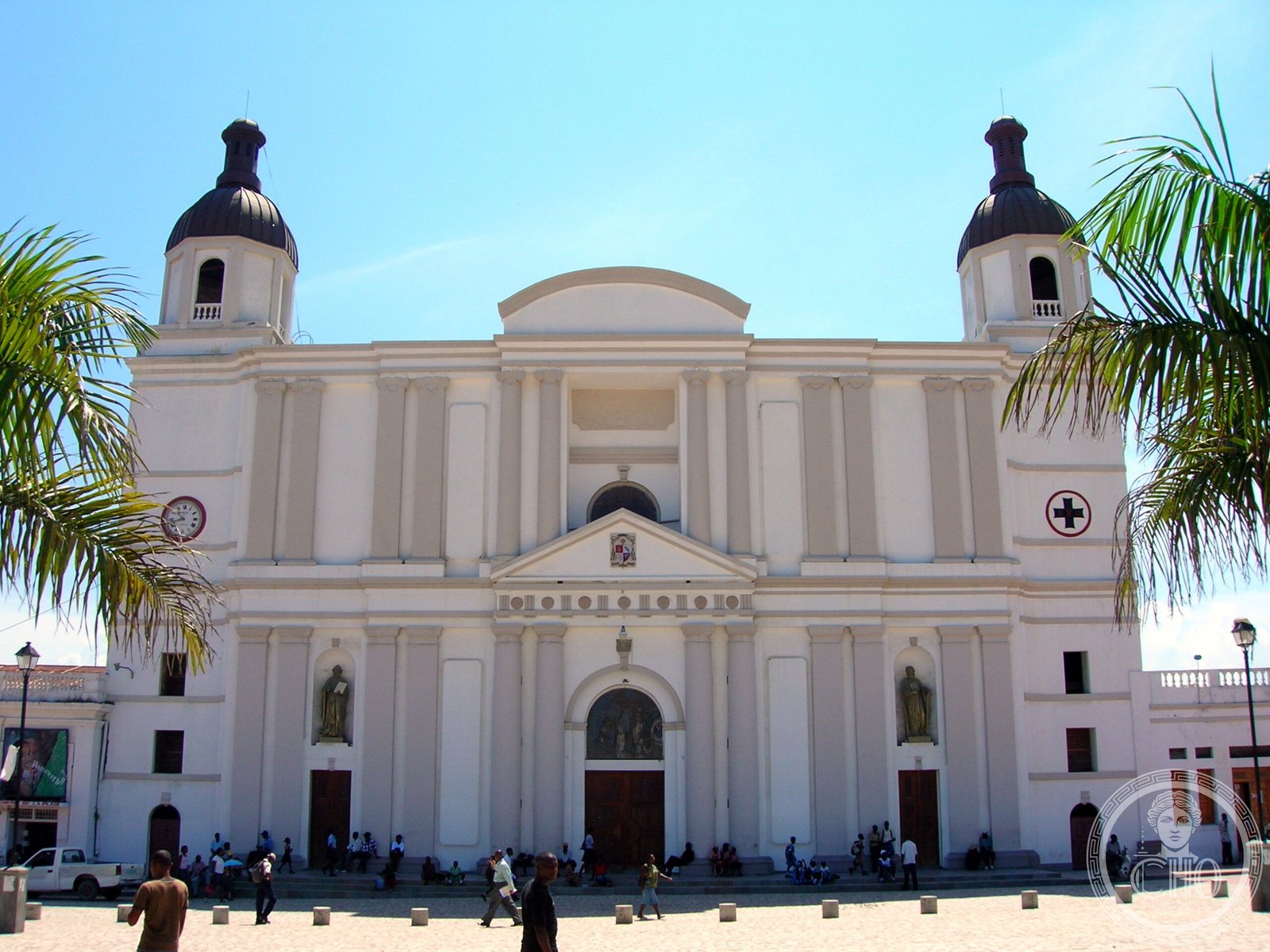
On the Place d’Armes of Cap-Haïtien, the cathedral of Notre-Dame de l’Assomption stands on the site of a succession of buildings. According to the detailed reconstruction by the local historian Jean-Claude Bastien, there have been at least eight building phases since 1680. Four wooden churches burned during Spanish and English raids between 1680 and 1695. A first stone church was consecrated in 1718. A building of 1748 collapsed in 1771, was rebuilt by the engineer Rabier and came into use in 1774. Lightning damaged it in 1790, and fire half-destroyed it during the revolutionary fighting of June 1793, then again in February 1802 with the arrival of the troops of General Leclerc. One encyclopaedic source links this square to the proclamation of general emancipation on 29 August 1793, but a second independent source does not confirm it. Rebuilt under the architect Besse of Port-au-Prince and blessed in 1840, the cathedral was almost entirely destroyed by the violent earthquake of 7 May 1842. Estimates put the dead at about five thousand people, close to half the population of the city at the time, and only two fragments of wall were left standing. Attempts to rebuild under three different Haitian heads of State stalled for decades. A first portion was blessed in 1878, and the present facade, with its triangular pediment, was rebuilt in 1929. The building visible today was blessed definitively on 7 May 1942, exactly one century after the earthquake that had razed it. No link is documented between this cathedral and the coronation of Henri Christophe as king of Haiti on 2 June 1811. Historical sources place that ceremony not here but in a temporary wooden church built for the purpose on the Champ de Mars, where the sovereign was crowned by the archbishop of Milot, Jean-Baptiste-Joseph Brelle. The archdiocese of Cap-Haïtien was erected as a diocese on 3 October 1861 and raised to a metropolitan archdiocese on 7 April 1988. It is led today by Archbishop Launay Saturné, in office since 2018. No papal visit to this cathedral is on record: John Paul II went to Haiti once, in March 1983, and only to Port-au-Prince. The building does not appear to have been damaged by the devastating Port-au-Prince earthquake of 2010, some two hundred and fifty kilometres away. On 6 September 2021 Father André Sylvestre, aged seventy, was shot dead in the centre of Cap-Haïtien by a criminal group. That killing came some years before the armed-gang crisis that broke out nationally from 2023. As of the date of this card no documented direct attack on the cathedral or the archdiocese in the most recent period has been found, although United Nations sources report the violence spreading north along the corridor between Cap-Haïtien and Port-de-Paix.
About the Cathedral
The Cathedral of Notre-Dame de l’Assomption, on Cap-Haïtien’s Place d’Armes, seat of the Archdiocese of Cap-Haïtien, occupies a site rebuilt at least eight times since the 1680s. The present building, blessed on 7 May 1942, replaced its predecessor destroyed in the catastrophic 1842 Cap-Haïtien earthquake.
Key facts
- 1718: first stone church on the site consecrated.
- 1793–1802: church repeatedly damaged by fire during the Haitian Revolution’s fighting in Cap-Haïtien.
- 7 May 1842: catastrophic earthquake destroys the cathedral and kills an estimated 5,000 people, roughly half the city.
- 7 April 1988: Cap-Haïtien elevated to a metropolitan archdiocese.
- 7 May 1942: present cathedral finally blessed, exactly a century after the earthquake that destroyed its predecessor.
- 6 September 2021: Father André Sylvestre of this archdiocese shot dead by an armed group in downtown Cap-Haïtien.
History
Rebuilt at least eight times since Cap-Haïtien’s earliest colonial years, the cathedral suffered its most catastrophic loss on 7 May 1842. An earthquake killed roughly half the city’s population and left only fragments of its walls standing. Reconstruction attempts under three successive heads of state stalled for decades, and the current building was finally completed and blessed on the earthquake’s centenary in 1942.
Unlike the Port-au-Prince cathedral 250 km south, this building was not damaged by the devastating 2010 earthquake. Haiti’s gang crisis has increasingly reached toward northern Haiti since 2023, and no documented direct attack on the cathedral itself has been found — though the 2021 killing of a local priest, Father André Sylvestre, shows the archdiocese has not been entirely insulated from armed criminal violence.
What you see
A white colonial-style facade with a triangular pediment, remodeled in 1929, rises between twin bell towers each capped with a dark dome, flanked by statues at the main portal — a building roughly 2,000 square meters in area with seating for about 2,500.
Practical information
- Opening hours: generally open daily outside services; check current hours before visiting.
- Address: Place d’Armes, Cap-Haïtien, Nord Department, Haiti.
Getting there
The cathedral stands on the Place d’Armes in central Cap-Haïtien, Haiti’s second city. GPS: 19°45′40″N, 72°12′03″W.
Nearby
- Citadelle Laferrière — the mountaintop fortress built under King Henri Christophe, a short distance inland from Cap-Haïtien.
Sources
- Wikipedia (English and French) — “Cathedral of Notre-Dame de l’Assomption, Cap-Haïtien,” “Archdiocese of Cap-Haïtien,” “1842 Cap-Haïtien earthquake,” “Kingdom of Haiti”
- villeducaphaitien.com — detailed construction history by local historian Jean-Claude Bastien.
- GCatholic.org and Catholic-Hierarchy.org — Archdiocese of Cap-Haïtien records.
- Agenzia Fides, Le Nouvelliste, Aleteia — coverage of the 2021 killing of Father André Sylvestre.
- UN OHCHR and UN News — coverage of Haiti’s gang violence crisis, 2023–2025.
Find it on the map
See this place and what’s around it →📷 Become a Cultural Heritage Online photographer
Share your photos of places: they stay published under your name as the author. The more they're seen, the more you get noticed — and soon a contest will reward the most appreciated photos.
Log in or sign up free to add a photo