
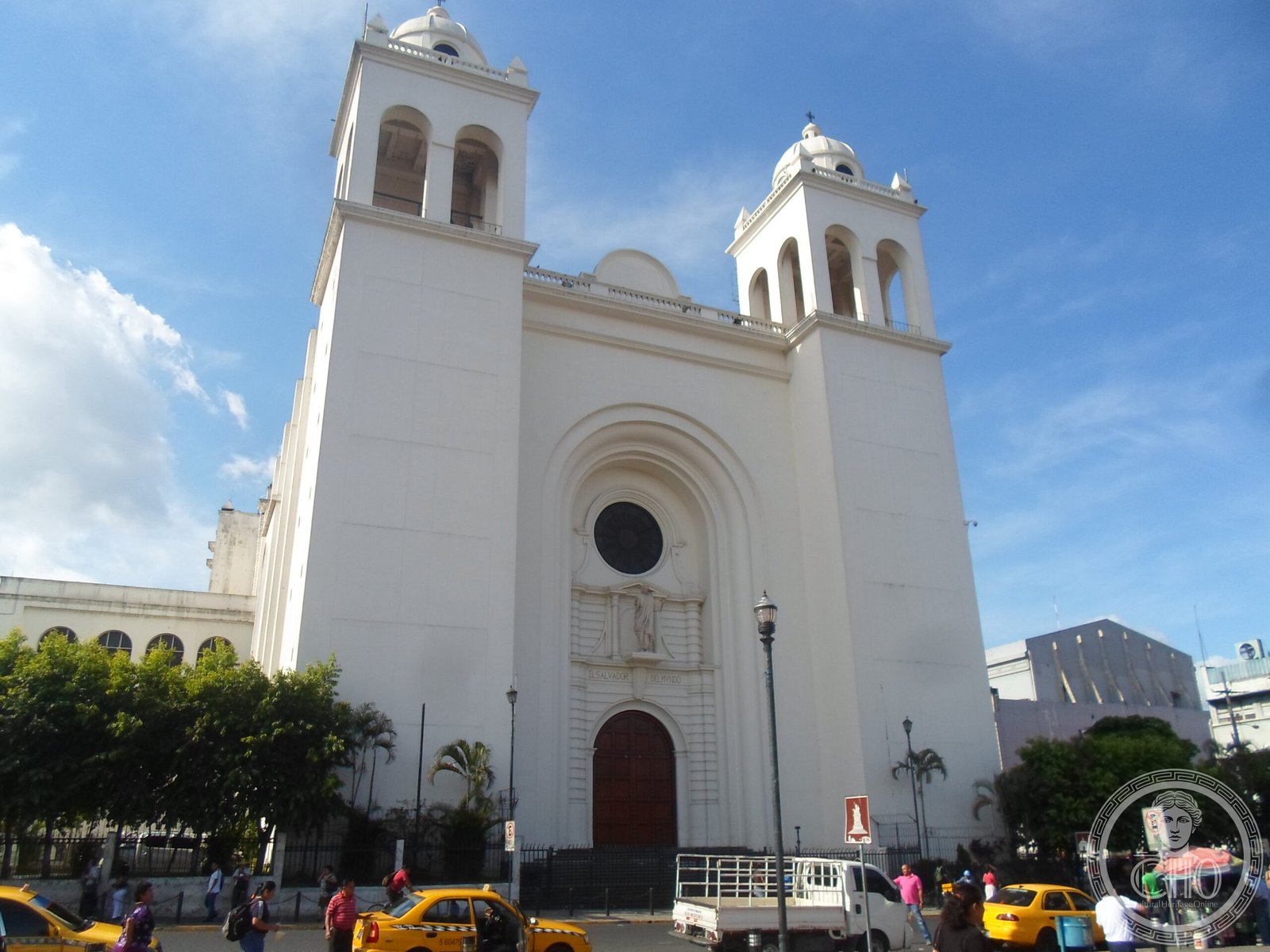
In the historic heart of San Salvador, on Plaza Barrios, the present metropolitan cathedral is the third built on this site. The first, raised in 1842, was destroyed by an earthquake in 1873; the second, of wood, burned down in 1951. The first stone of the present building was blessed by Archbishop Luis Chávez y González on 12 October 1956, but the works stopped for decades during the Salvadoran civil war, from 1979 to 1992, and the cathedral was completed and consecrated only on 19 March 1999 by Archbishop Fernando Sáenz Lacalle. The original plans, which came from Germany, are attributed to the architect Dominikus Böhm, who died in 1955, before the works began, while the executive direction of the site was entrusted to the Spanish architects Joaquín González Miranda and Joaquín Loras. The original facade was a mosaic of two thousand seven hundred ceramic tiles by the artist Fernando Llort, entitled «Harmony of my people» and conceived as a tribute to the peace accords of 1992. It was removed in December 2011 without consulting either the artist or the cultural authorities, on the orders of Archbishop José Luis Escobar Alas, raising a national controversy that has never entirely died down; one encyclopaedic source gives December 2012 instead, but the reports of the time agree on 2011. In the crypt of this cathedral rests Monsignor Óscar Romero, archbishop of San Salvador, murdered on 24 March 1980 by a sniper, not at the cathedral but in the chapel of the Hospital of Divine Providence, while he was celebrating mass. The Truth Commission of the United Nations attributed the order for the killing to Major Roberto D’Aubuisson, without anyone ever being convicted. The funeral of Romero, celebrated in this cathedral on 30 March 1980 before tens of thousands of people, was marked by explosions and gunfire that set off a stampede in the square outside: estimates of the dead vary considerably by source, between thirty and fifty, most of them crushed rather than shot, while hundreds were injured. Romero was declared a martyr by Pope Francis on 3 February 2015, beatified on 23 May 2015 in a ceremony held not here but in the square of El Salvador del Mundo, and canonised a saint on 14 October 2018 in Saint Peter’s Square. Pope John Paul II visited this cathedral and prayed before the tomb of Romero on two occasions, in 1983 and 1996; Pope Francis never visited San Salvador in person. The civil war struck the Salvadoran clergy hard elsewhere too: on 16 November 1989 six Jesuits of the Central American University, together with their housekeeper and her daughter, were killed by the Atlacatl battalion, an elite army unit trained by the United States, an episode separate from this cathedral but belonging to the same season of violence against the Salvadoran Catholic Church.
About the Cathedral
The Metropolitan Cathedral of San Salvador, seat of the Archdiocese of San Salvador on Plaza Barrios in the historic center, is the third cathedral built on this site, its cornerstone laid in 1956 but not consecrated until 19 March 1999 after decades of civil-war interruption. It holds the crypt tomb of Saint Óscar Romero, canonized in 2018.
Key facts
- 12 October 1956: cornerstone of the current cathedral blessed.
- 19 March 1999: cathedral finally consecrated, after a construction gap during the civil war.
- 24 March 1980: Archbishop Óscar Romero assassinated at a hospital chapel, not this cathedral.
- 30 March 1980: a stampede triggered by gunfire and explosions at Romero’s funeral here killed an estimated 30–50 mourners.
- December 2011: Fernando Llort’s ceramic-tile mural facade removed by archdiocesan order, without consulting the artist.
- 14 October 2018: Romero canonized a saint by Pope Francis; his tomb in this cathedral’s crypt is a major pilgrimage site.
History
Begun in 1956 and not finished until 1999 after the Salvadoran Civil War halted construction for years, the cathedral became, even before its completion, the burial place of Archbishop Óscar Romero, assassinated in 1980 for his outspoken defense of the poor and opposition to state violence. His funeral here on 30 March 1980 turned into one of the war’s defining tragedies when explosions and gunfire in the crowded plaza triggered a stampede, killing dozens; the cathedral’s crypt has since become a pilgrimage site, especially after Pope Francis declared Romero a saint in 2018.
What you see
A cream-colored Neoclassical facade rises between twin bell towers flanking a rose window and the inscription “EL SALVADOR DEL MVNDO,” beneath a large dome patterned in chevron-tiled color; the plain current facade replaced Fernando Llort’s colorful ceramic-mosaic mural in 2011.
Practical information
- Opening hours: generally open daily outside services; check current hours before visiting.
- Address: 2a Avenida Sur No. 213, San Salvador, El Salvador.
Getting there
The cathedral stands on the north side of Plaza Barrios in San Salvador’s historic center, near the National Palace and National Theater. GPS: 13°41′54″N, 89°11′27″W.
Nearby
- National Palace of El Salvador — the former seat of government, facing the same historic Plaza Barrios.
Sources
- Wikipedia — “Metropolitan Cathedral of San Salvador,” “Óscar Romero,” “1989 killings of Jesuits in El Salvador”
- Catholic-Hierarchy.org — Archdiocese of San Salvador records.
- Vatican News, Jesuits.org, NPR — coverage of Romero’s canonization and the UCA Jesuit massacre.
- Fox News, Pulitzer Center, France 24 The Observers — coverage of the 2011 removal of the Fernando Llort mural facade.
- Vatican official itinerary archive — Pope John Paul II’s 1983 and 1996 visits to El Salvador.
Find it on the map
See this place and what’s around it →📷 Become a Cultural Heritage Online photographer
Share your photos of places: they stay published under your name as the author. The more they're seen, the more you get noticed — and soon a contest will reward the most appreciated photos.
Log in or sign up free to add a photo